Feeling very lucky to have had the opportunity to attend my graduation from Monash earlier this week. A wonderful opportunity to share in and celebrate learning ☺️ @MonashUni
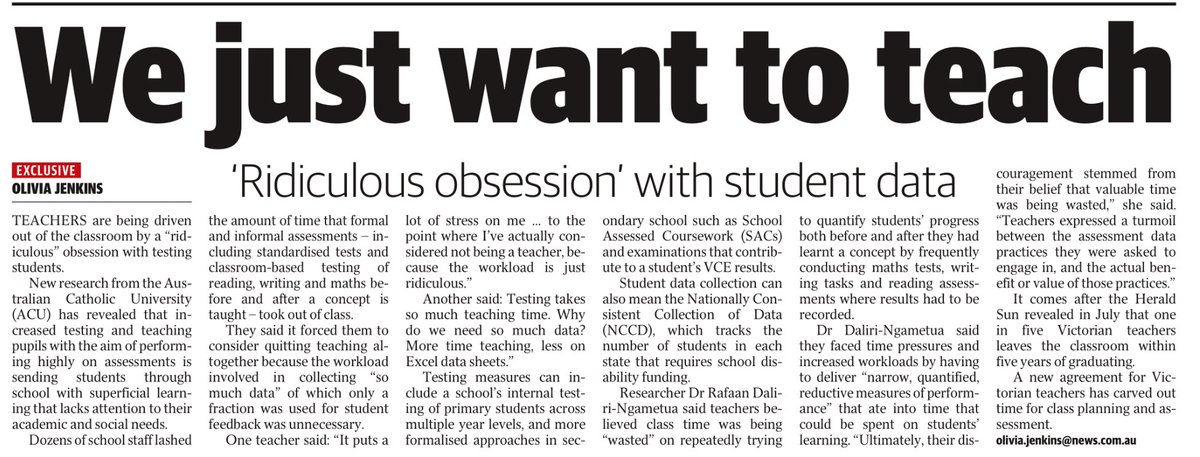
“Teachers expressed a turmoil between the assessment data practices they were asked to engage in, and the actual benefit or value of those practices.”
Ultimately, their discouragement stemmed from their belief that valuable time was being wasted,” she said.
@ACUmedia
Thanks @EducationHQ_AU for publishing this piece! ☺️Hopefully it resonates with others in schools, and those who have the power to change the way that needs-based funding in schools works 🙂
https://t.co/udFbVqKfz5
"The world changes according to the way people see it, and if you alter, even but a millimetre the way people look at reality, then you can change it" - reflections on politics and education on the blog now 🙂https://t.co/cet7XDpOAG
The obvious time to ask heavy questions about my career is 2 days before school goes back for the term 😅 Am I being dramatic? Are these concerns justified? I'll add these to my (growing) list of questions about my career ...
https://t.co/dIcH479sbL
A5) this is such a broad question - it's contingent on so many things (school context, family context, individual student). As a general rule, I find that feedback/input from parents, classroom and specialist teachers and school leadership help to develop effective strategies.
A3) - some systems are introducing 'planning for personalised learning' planning documents that incorporate templates of class profiles and examples of adjustments in different areas. I find this really beneficial in my role (LST), and and for the teachers I work with, too ☺️
I tend to re-adjust my strategies based on data that indicates student growth. I often combine this with formal or informal chats with teachers, parents and admin staff #pstchat
@MrJ_Wigg And that's something I think we can overlook, too! Adjustments that we initially intend for students with disabilities are often really beneficial for other students in our care.
A2) I know this is a bit of a cliche in discussions about personalised learning and special education, but for me it really does depend on the student I'm working with. I might use sign language for a nonverbal student, whereas I would use clearer visual cues for verbal students.
Q2) I would love to know more about what @erincanavan95 would do for her students in the special education field. In my setting it involves sitting down with Ps to discuss their child's needs to help set goals, but we also use Ss data & their hobbies and interest. #pstchat
A1) I think there can sometimes be a bit of confusion around who needs 'personalised' learning. Ultimately, I think it's about knowing the profile of your students and making adjustments that are suited to their needs and interests.
A1) For me individualised learning has to be relevant and directly related to the students. There is a perception that it is more work, but for me it is catering for their learning needs. #pstchat