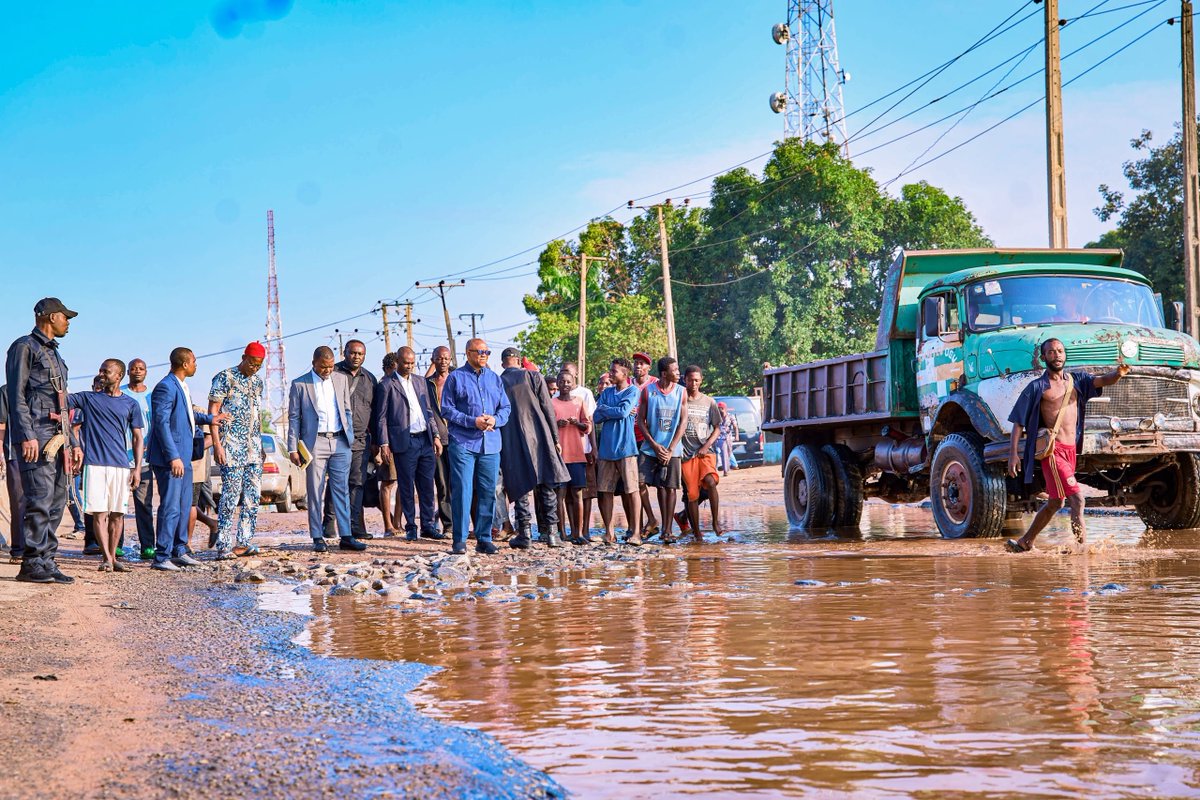
My Stance on Road Development
There is a pertinent reason I have consistently advocated that we should refrain from initiating new road construction projects until we have thoroughly rehabilitated and maintained our existing road network. Instead of undertaking new ventures and dualization projects that offer marginal benefits, our primary focus ought to be on repairing the critical roads already in place.
Consider, for instance, the Asaba–Benin Road. This thoroughfare is a vital artery within Nigeria's transportation infrastructure. Travellers traversing from Akwa Ibom, Anambra, Rivers, Imo, Ebonyi, Cross River, Abia, Enugu, and portions of Benue and Kogi States to Lagos are compelled to utilise this route.
Despite its significance, substantial sections of this road are in a lamentable condition. It has become a major impediment, precipitating persistent traffic congestion and inflicting undue hardship on travellers, businesses, and transport operators.
Regrettably, this situation is not unique; it reflects the reality on many of our busiest national highways.
Our efforts should be directed towards the reconstruction and maintenance of our current road infrastructure before we announce plans for new road projects. The Nigerian populace requires functional and motorable roads, not merely projects that garner public attention.
Efforts aimed at superficial improvements for political gain should not supersede the urgent need to address the condition of our existing, critical roadways.
A new Nigeria is POssible. -PO
Engaging Tomorrow’s Leaders at Madonna University
Yesterday, I continued my engagement with future leaders in the country. I was at Madonna University, Okija Campus, where I had the privilege of interacting with students at the NextGen Mentorship & Leadership Initiative on the theme: “Beyond Now: Raising the Next Generation of Leaders.”
The session was highly engaging, with students asking thoughtful and probing questions. Their concerns reflected the frustration of many young Nigerians who feel constrained by poor governance and widespread corruption, which have denied them opportunities to realise their full potential. However, I was equally encouraged by their optimism and determination to be part of the solution.
I reminded them that leadership is the greatest determinant of a nation’s progress. A true leader must possess the character, competence, capacity, and compassion to make sacrifices for the good of the people. Nigeria’s future depends on leaders committed to safeguarding lives, investing in education, creating opportunities, and building effective institutions.
I encouraged the students to take their education seriously, to prepare themselves for leadership, and to see themselves not merely as spectators but as agents of change. Through active participation in the democratic process, they have the power to enthrone leaders with integrity and the capacity to propel our nation forward.
As part of my ongoing commitment to education, I presented a cheque of ₦15 million to the university to support its educational mission. Investing in education remains one of the most effective ways to develop the human capital necessary for national progress.
Together, by raising a new generation of responsible and visionary leaders, we can build the Nigeria of our dreams that is POssible. -PO
Delighted to Return to School of Nursing Sciences, Emekuku, Owerri, Imo State.
In continuation of my itinerant visits to educational and healthcare institutions in the country, yesterday, I visited the School of Nursing Sciences, Holy Rosary Hospital, Emekuku, where I met with the management, staff, and students, and presented a donation of ₦15 million to the institution.
I reminded the students that the world needs them more than they need the world because healthcare is one of humanity’s most fundamental needs. Any nation that truly desires development must invest in the education and training of healthcare professionals, who remain indispensable to the well-being and productivity of society.
I was delighted to inspect the computer laboratory, which I had previously supported, and to witness the remarkable progress the institution has made. It was also encouraging to reflect on other health institutions, such as Iyi-Enu and Borromeo, which I supported over the years and which have now grown into teaching hospitals. Their transformation reinforces my belief that sustained investments in health and education can produce enduring results. I look forward to seeing Holy Rosary Hospital attain the same status.
Our vision must be to build a Nigeria where functional institutions produce competent professionals, where investments are directed to critical sectors that lift people out of poverty, and where every child, regardless of background, has the opportunity to succeed. That is how we will build a nation where the son of nobody can become somebody without knowing anybody.
A New Nigeria is POssible. -PO
Lokoja Judgment: An Unnecessary Serious Setback for Nigerian Democracy
Today was an exceptionally busy day. I left Lagos in the early hours for Emekuku, where I visited the School of Nursing Sciences, an institution I have consistently supported over the years. It was gratifying to inspect projects funded through my previous interventions, including the school’s computer laboratory. Such investments reaffirm my belief that education remains one of the strongest foundations for national development.
From there, I attended the 80th birthday celebration of the Emeritus Archbishop of Owerri, Most Rev. Dr Anthony Obinna, whose commitment to justice, peace, and the common good has inspired many, before proceeding to Madonna University for another engagement.
It was at Madonna University that I received the court news of the Lokoja court rulings through my brother, Senator Rabiu Musa Kwankwaso.
Every Nigerian committed to the country’s progress should be deeply concerned. This judgment represents another setback for our democracy and the institutions upon which our future depends.
It is regrettable that some who claim to champion democracy now appear determined to weaken the very institutions that sustain it. In doing so, they are undermining public confidence and endangering the future of millions of Nigerians.
The legislature and the judiciary are increasingly being drawn into this pattern of institutional decline. Democracy cannot thrive where institutions lose their independence and credibility.
Those who seek to weaken Nigeria’s democratic foundations will not ultimately prevail. When a similar situation recently affected the ADC, I condemned it without hesitation. I do so again today because my position has always been guided by principle.
My concern is not about who becomes President. My concern is that Nigeria works. Our politics must move beyond the quest for power and focus instead on building a united nation founded on justice, strong institutions, the rule of law, and equal opportunity. That is the Nigeria we owe ourselves and the one we must leave for future generations.
I therefore urge all well-meaning Nigerians to rise above partisan interests and defend our democracy. The survival of our institutions is inseparable from the survival of our nation. It's when we work together that a new Nigeria of our dream is made POssible. -PO
State Police: Commendable Step, but Disorderly Legislation Raises Concerns of Political Misuse
The recent passage of the State Police Bill by the National Assembly marks a significant legislative milestone in addressing a long-standing demand of the Nigerian people. For years, many of us, alongside security experts and regional stakeholders, have consistently argued that a highly centralised policing structure is fundamentally unsuitable for a country as vast, diverse, and complex as Nigeria. However, the legislative and constitutional implementation appears shaky and raises legitimate concerns.
The process should involve greater community participation. Policing should be more visible at the local government and community levels. The mechanism for passing the law appears highly disorganised, with no public hearing on such a sensitive issue. Indeed, the rush to enact the law without proper legislative procedures fuels suspicion among many observers about the political motives behind it.
The greatest concern does not arise from logistical issues; it stems from history. There is a widespread, justifiable fear that state police forces could become instruments in the hands of governors. The suspicion is that a state-controlled police force could be weaponised to suppress political rivals, disrupt opposition rallies, and manipulate elections.
For state policing to evolve from a risky political gamble into a genuine security solution, the law must not only permit states to establish police forces but also clearly provide for independent oversight bodies, such as a state-level Police Service Commission that is entirely free from executive influence, to ensure that policing serves the public interest rather than the interests of the ruling elite.
Going by what Nigerians have seen so far, there is no guarantee that this administration can resist the temptation to take advantage of state policing to influence the 2027 general election by proxy. In view of that possibility and the danger it poses to the polity, it is necessary to defer its implementation until after the general election.
A New Nigeria is POssible. -PO
Owning Up to Leadership Failures and Political Responsibility
This morning, I listened to the British Prime Minister’s speech announcing his planned resignation in July. As a keen observer of global politics, my primary interest lies in examining what successful nations do right and the structural factors that cause others to lag or struggle with governance and development.
The Prime Minister’s planned resignation comes amid mounting public frustration over a stagnant economy, a worsening cost-of-living crisis, and a perceived failure to honour key campaign pledges.
Looking inward in our dear country, we can recall our own situation. Before 2015, our President on several occasions championed the call for the then President Goodluck Jonathan to resign over economic hardship and insecurity affecting Nigerians. During the Chibok school kidnapping incident, he demanded the immediate resignation of President Jonathan, arguing that the government had failed in its most fundamental duty of protecting lives.
During the 2023 election campaign, President Bola Ahmed Tinubu made several promises, including improved electricity supply. He also challenged the electorate not to vote for him for a second term if he failed to deliver on those commitments—particularly in providing stable power, fighting corruption, and improving the welfare of Nigerians.
At present, however, these conditions have worsened. Electricity supply remains unreliable, insecurity has intensified in many areas, including kidnappings, and economic hardship has deepened rather than eased. Similar concerns are reflected across other critical sectors such as security, infrastructure, transportation, and anti-corruption efforts, all of which have regressed. We are in the worst possible condition.
I, therefore, join Nigerians of goodwill in calling for the resignation of the President over monumental failure in governance. Such a gesture would help enthrone a political culture rooted in accountability and responsibility, rather than further entrenching impunity. It would also send a powerful message that public office is a sacred trust, not an entitlement, and help build a society in which future leaders understand that failure carries consequences. Only by ending the culture of impunity can we secure a better future for the society our children will inherit in a New Nigeria that is possible. -PO
APC should not celebrate over the By-election results yesterday in Ekiti, Kano & Enugu.
NDC'election will officially commence on the 16th of Jan 2027 with OK. You guys will see voting/performance you have never seen before.
Presure for pressure
Vote for vote
Numbers for Numbers