Introducing NVIDIA Ising, the world’s first open AI models to accelerate the path to useful quantum computers.
Researchers and enterprises can now use AI-powered workflows for scalable, high-performance quantum systems with quantum processor calibration capabilities and quantum error-correction decoding.
Learn more: https://t.co/jWT7X73T89
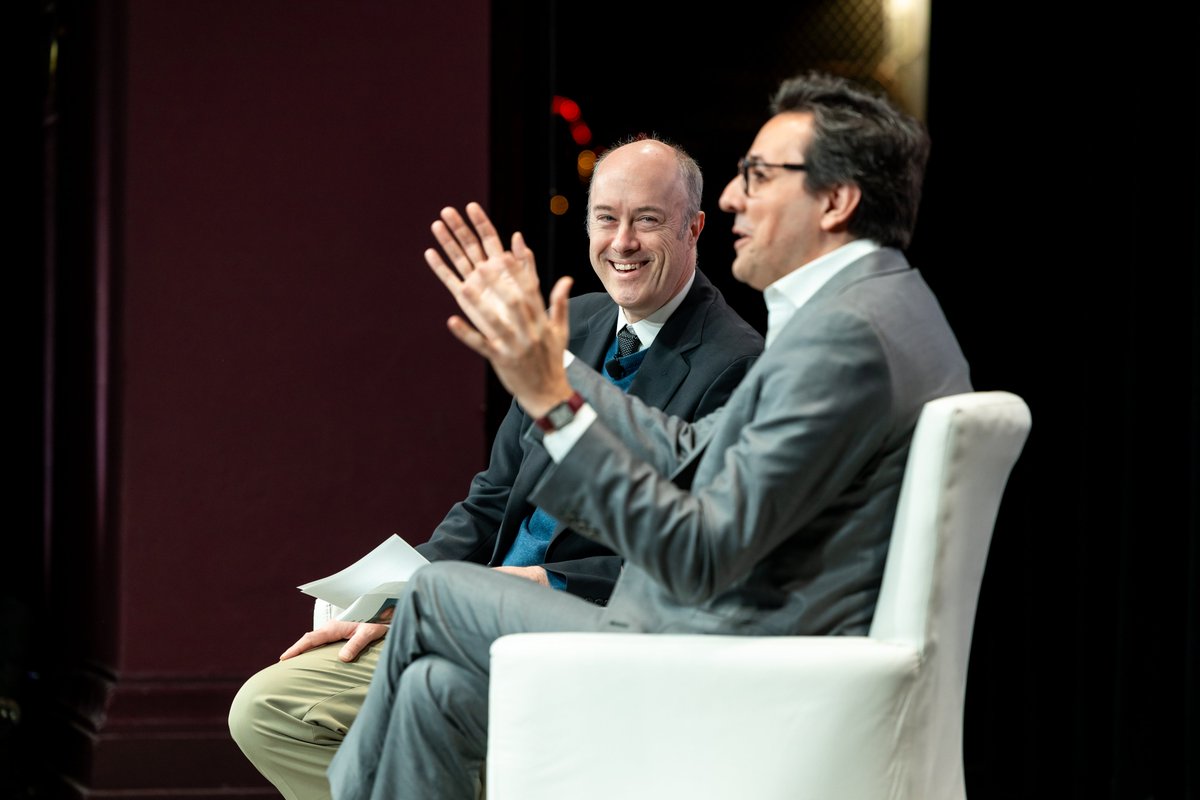
Ian Buck, VP of Hyperscale and HPC Computing at NVIDIA, sat with @dariogila, Undersecretary for Science at @ENERGY, for a conversation on the future of scientific discovery.
As the Undersecretary announced first-round DOE funding to support the Genesis Mission, Ian underscored what it takes to bring that vision to life: advanced computing infrastructure, strong public-private partnership, and close collaboration across national labs, industry, and universities.
NVIDIA is excited to be an industry partner of the DOE Genesis Mission.
To be chosen to participate in the design of the next iteration is a massive honor for us.
Through this project, we target a scientific discovery ecosystem based on full integration of simulation and AI. We hope this will benefit not only Japan, but also researchers worldwide.
Those who have been around #HPC a while know the historical significance (and probably the names) of Japan's flagship supercomputers. They always push the boundaries of technology, but in ways that are driven uniquely by the needs of Japan.
https://t.co/j7XQWGS3HT
@HatemLtaief@HPC_Guru@GeorgHager If you look at DFMA flops (and not GEMM/Tensor Core), the memory bandwidth for NV GPUs has actually grown relative to FLOPs in every generation since Volta.
That's the ratio that matters for most simulations.
Generating cat videos is nice, but what if you could tackle real scientific problems with the same methods? 🧪🌌
Introducing The Well: 16 datasets (15TB) for Machine Learning, from astrophysics to fluid dynamics and biology.
🐙: https://t.co/PMAHK7i2lG
📜: https://t.co/6XLJA5lJnI
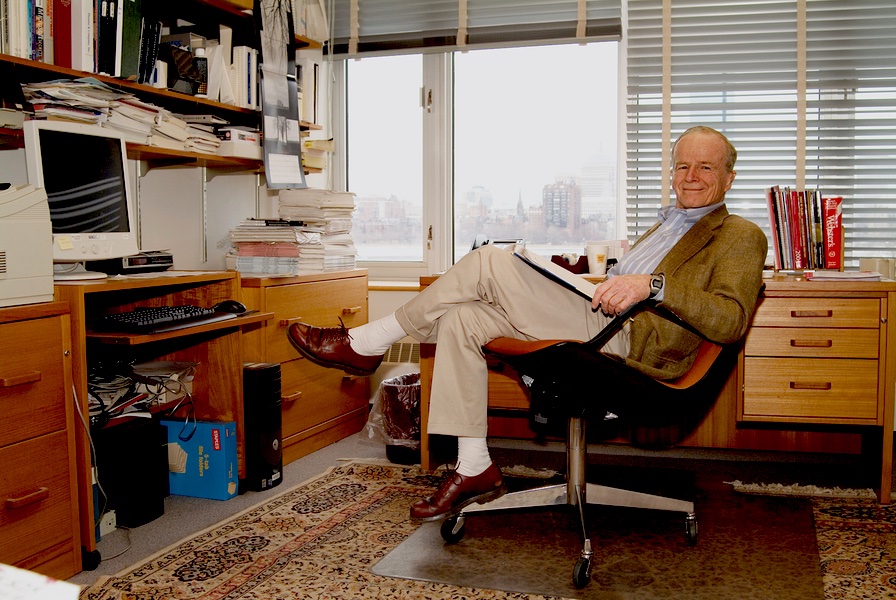
RIP Prof. John D. Little.
He of Little law; the most ubiquitous name in computer performance analysis (even though he knew nothing about computer systems) https://t.co/yJAXnyDFNW
@glennklockwood@RHAlexander I was going to help until you revealed your purpose 😁
There are a couple of centers looking at it, but I don't think any have them yet.
.@xAI's Colossus in Memphis, the world's largest AI supercomputer with 100,000 NVIDIA Hopper GPUs, achieves new heights with NVIDIA Spectrum-X Ethernet. A testament to NVIDIA's dedication to #AI progress.
Read more: https://t.co/NDSMpQKbGl
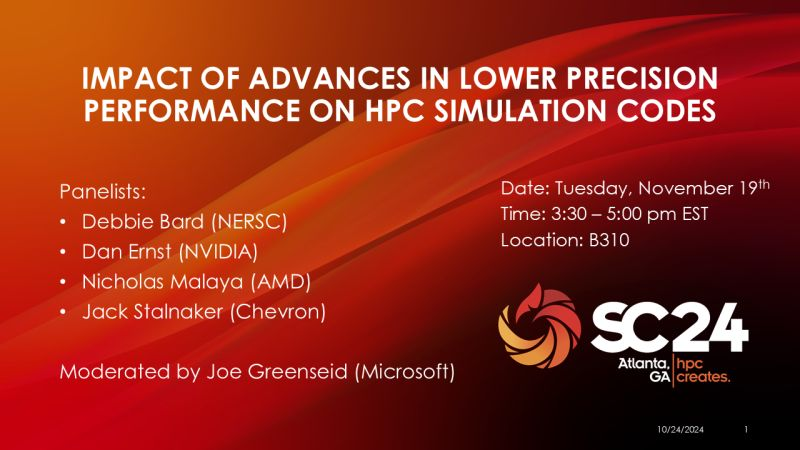
I'll be sitting on a @Supercomputing panel discussing the impact of low precision datatypes on HPC codes.
Mark your calendars for Nov 19th, 3:30 ET and see you in Atlanta! CC: @ernstdj
Microsoft Azure is the 1st cloud running @nvidia's Blackwell system with GB200-powered AI servers. We're optimizing at every layer to power the world's most advanced AI models, leveraging Infiniband networking and innovative closed loop liquid cooling. Learn more at MS Ignite.
Microsoft Azure is the 1st cloud running @nvidia's Blackwell system with GB200-powered AI servers. We're optimizing at every layer to power the world's most advanced AI models, leveraging Infiniband networking and innovative closed loop liquid cooling. Learn more at MS Ignite.
ETH Zürich’s new Alps #supercomputer, powered by 10K+ Nvidia Grace Hopper chips, is set to accelerate breakthroughs in #AI for materials science, universe mapping, and healthcare. The future of scientific discovery is here: https://t.co/I3jh2SJuW5