In the US, card interchange is uncapped.
The fee the bank earns can run up to 3.5% on the right business card.
In Europe, it's capped by law: 0.2% on debit, 0.3% on credit.
Europe also layers in domestic schemes most Americans have never heard of: Cartes Bancaires in France, Girocard in Germany, Bancomat in Italy, all running alongside Visa and Mastercard with their own rules.
The card system isn't one global machine. It's a different game in every country.
Gap (@gaspardlezin) on @TheDryRunPod
Interested in using our services?
Learn how we value our merchants' business and the reasons why we can't onboard everyone.
Message @gaspardlezin if you are legitimate and need an alternative payment processor for your SaaS or to receive payment for your services as a freelancer.
Why our acceptance rate at Suby is under 10% and why that's by design
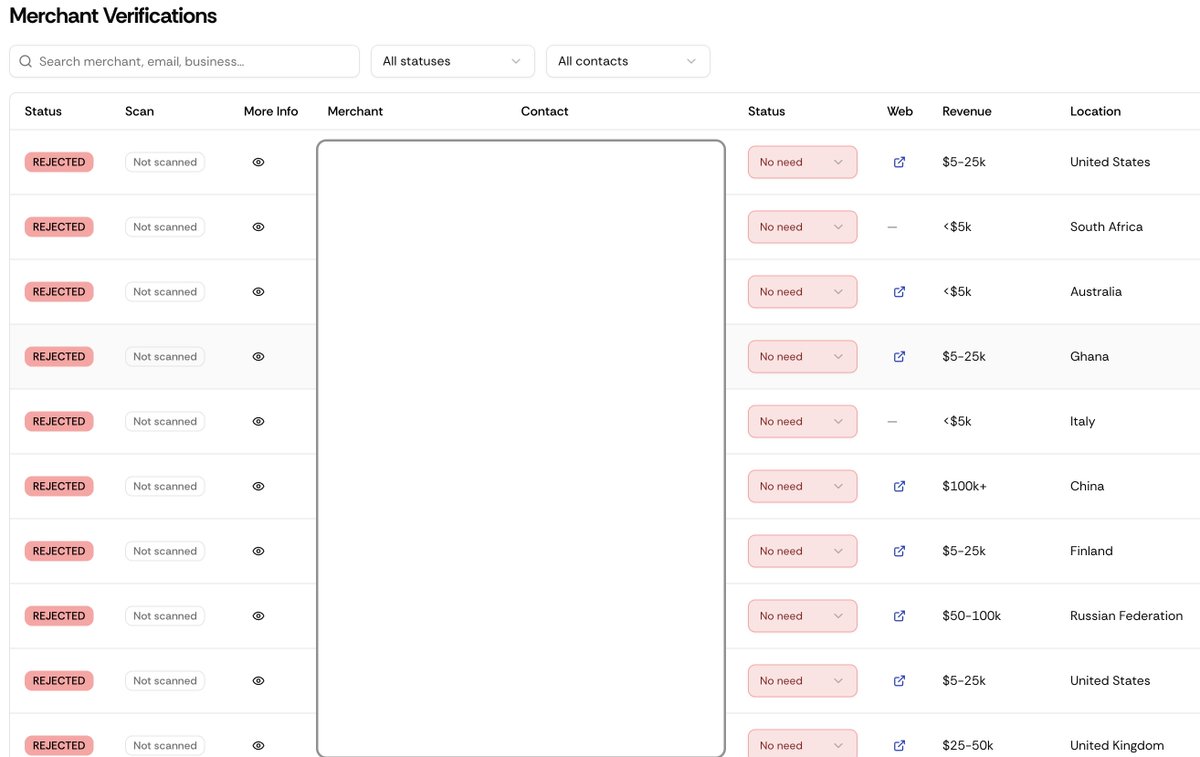
Every week, we turn away the vast majority of merchants who apply to process payments with us. Our acceptance rate sits well below 10%. It's a filter we've built on purpose.
Here's who we say no to, and why.
Category A: Unverifiable
No website. Unknown founder. A business we simply can't understand. If we can't verify who you are or what you sell, we can't take the risk.
Category B: Verifiable but inconsistent
There's a website, and claims of solid volume that would suggest a real, active business. But the web traffic isn't there, and the application comes from an email address that doesn't even match the company's own domain.
We've caught a good dozen of these people trying to actively deceive us: a live website, real traffic, a founder with a credible online presence except they're impersonating someone else's business entirely.
Category C: Verifiable but offboarded by a competitor
A real website, real traffic, dashboards from @stripe , @whop, @creem_io, or @polar_sh to prove it. But they were offboarded by one, or all, of them, and the reasons they give us for that offboarding don't hold up.
This is the hardest category to trust, because the volume can look genuine, we've seen one applicant claiming $600K/year this week.
Category D: Verifiable but high-risk category
Game cheats, travel, ebooks. Real operations, but the category itself carries the risk. Why we turn down Category D almost every time
When a legitimate business gets shut down by Stripe, it's usually not because the business is fake. It's because their fraud or chargeback rate is too high. Visa and Mastercard set a hard ceiling, above 1%, a merchant is considered too risky, and Stripe has to enforce that ratio across every merchant on its platform.
Businesses in Category D land above that threshold roughly 99% of the time.
And here's why we can't make exceptions: as a merchant of record, Visa and Mastercard don't see our individual merchants, they see one single ratio for all of Suby. If one merchant runs at 1.5%, that merchant isn't just risking their own account. They're pulling down the entire pool, and every legitimate business processing under Suby pays the price with them.
That's the real reason our acceptance rate is under 10%. We're not just approving businesses, we're protecting the ability of every merchant on our platform to keep processing at all.
We're onboarding for Suby v3 starting next week.
One payment platform to get paid, your way:
Payments & Payouts:
- Payins: cards, Apple Pay, Google Pay, Klarna, bank, stablecoins and more
- Unified balance with USD, EUR & USDC, EURC
- Payouts: fiat or stablecoins
Capabilities:
- Billing: subscriptions, one-time, pay-as-you-go & bundles and more
- Invoicing, discount codes, free trials, checkout customisation
- API or no-code
Made for:
- SaaS, e-commerce, agencies & freelancers
- 🇺🇸🇪🇺 US & Europe companies only (for now)
DM to request access 👇
Fiserv's FIUSD position across 10K banks and 6M merchant locations is the one that doesn't get enough attention in these conversations. Most stablecoin settlement discussions focus on PSPs and card networks. A bank-facing stablecoin at that distribution scale is a different surface area entirely, closer to how money actually moves inside the traditional banking layer than anything Stripe or https://t.co/FoGs2ycztY is doing. If FIUSD gets traction, it changes the settlement conversation at the correspondent banking level, not just the acquirer level.
Everyone pictured stablecoin adoption as a shopper paying with crypto at checkout.
The actual adoption happened in settlement. In the back office. Invisible to the consumer.
Worldpay: live since 2022. Visa settling acquirers in USDC: since 2023. Mastercard acquiring BVNK: $1.8B.
Gap | Suby @gaspardlezin on where every major acquirer actually stands today 👇
Everyone thinks stablecoins are here to kill Visa. Plot twist: Visa is the one quietly settling acquirers in USDC since 2023. The disruptor became the distributor.
Everyone pictures stablecoin adoption as a shopper paying with crypto at checkout. That's not where it's happening. The real shift is in the back office, settlement and payouts, completely invisible to the consumer. The card still swipes the same way. What changes is how money moves between the merchant, the acquirer, and the network afterward.
And once you look there, almost every major acquirer has already made its move.
Stripe is the clearest illustration. It relaunched stablecoin payments in Oct 2024. The engine? A $1.1B acquisition of Bridge. Then it went further: its own stablecoin-issuance platform (Open Issuance) and a dedicated blockchain (Tempo).
Where each major acquirer actually stands (2026):
Live at scale:
- Worldpay: USDC settlement since 2022, Visa pilot in 2023, then stablecoin payouts to 180+ markets with BVNK
- Stripe: acceptance + settlement + payouts
- Checkout com: first PSP on this back in 2022 (Fireblocks), scaled to US enterprise merchants in 2026, 24/7 settlement
- Shift4: settlement platform launched Dec 2025: USDC, USDT, EURC, DAI across 7 chains
- Rapyd: accept, settle and pay out in stablecoins (Sept 2025)
- Nuvei: stablecoin payout rails, and among the first acquirers named on Mastercard's new settlement network
Announced / rolling out:
- EBANX & dLocal: stablecoin acceptance + settlement for emerging markets
- Airwallex: building a stablecoin team, not live yet
Worldline: stablecoin settlement for European PSPs via Circle's CPN (Apr 2026), plus its own branded digital-currency product
Issuing their own coin:
- Fiserv: FIUSD, across ~10K banks + 6M merchant locations
- PayPal: PYUSD + "Pay with Crypto," Braintree now merged with crypto into one division
The lone holdout:
- Adyen: still the only major acquirer with no live stablecoin product. It joined the Open USD consortium in June 2026, but for now it's betting on its banking licenses and treasury product (Intelligent Money Movement) instead of stablecoin rails.
What's forcing the pace? The networks. Visa has settled acquirers in USDC since 2023. Mastercard agreed to buy BVNK for up to ~$1.8B, then opened on-chain settlement across 6 stablecoins in June 2026. And 140+ of these same companies just co-signed a shared stablecoin, Open USD.
The takeaway: stablecoins in payments are a plumbing upgrade. The winners will be the ones who quietly rewired settlement so merchants get their money 24/7 instead of waiting on banking hours. On that scoreboard, the incumbents are already ahead and Adyen is the one name still conspicuously without a live product.
PS: I post about payments & stablecoins with Suby. Follow for more!
In Europe, stablecoins don't solve payments.
Wero and instant SEPA already move money bank to bank, instantly, at very low rates.
The foundation exists and it's cheap.
Where stablecoins actually matter: cross border payments.
Collecting payments from customers in India, Africa, or Latam means fighting poor acceptance rates and slow FX.
Stablecoins can solve this.
Process the payment locally, convert it to a stablecoin like EURC, then off-ramp EURC to euros over instant SEPA. Fast settlement, better rates.
Gap (@gaspardlezin) on @TheDryRunPod
The Global Payments and Worldpay combined figure at $3.7T post-merger is the one I'd watch most closely over the next 18 months. Acquirers sit at the bottom of the value chain by take rate but they're the ones with direct merchant relationships and the data that comes with it. If acquiring consolidates further while stablecoin settlement starts compressing card network fees, the acquirer layer could end up being the most defensible position in that entire ranking.
Visa is not the world's largest payments company by volume.
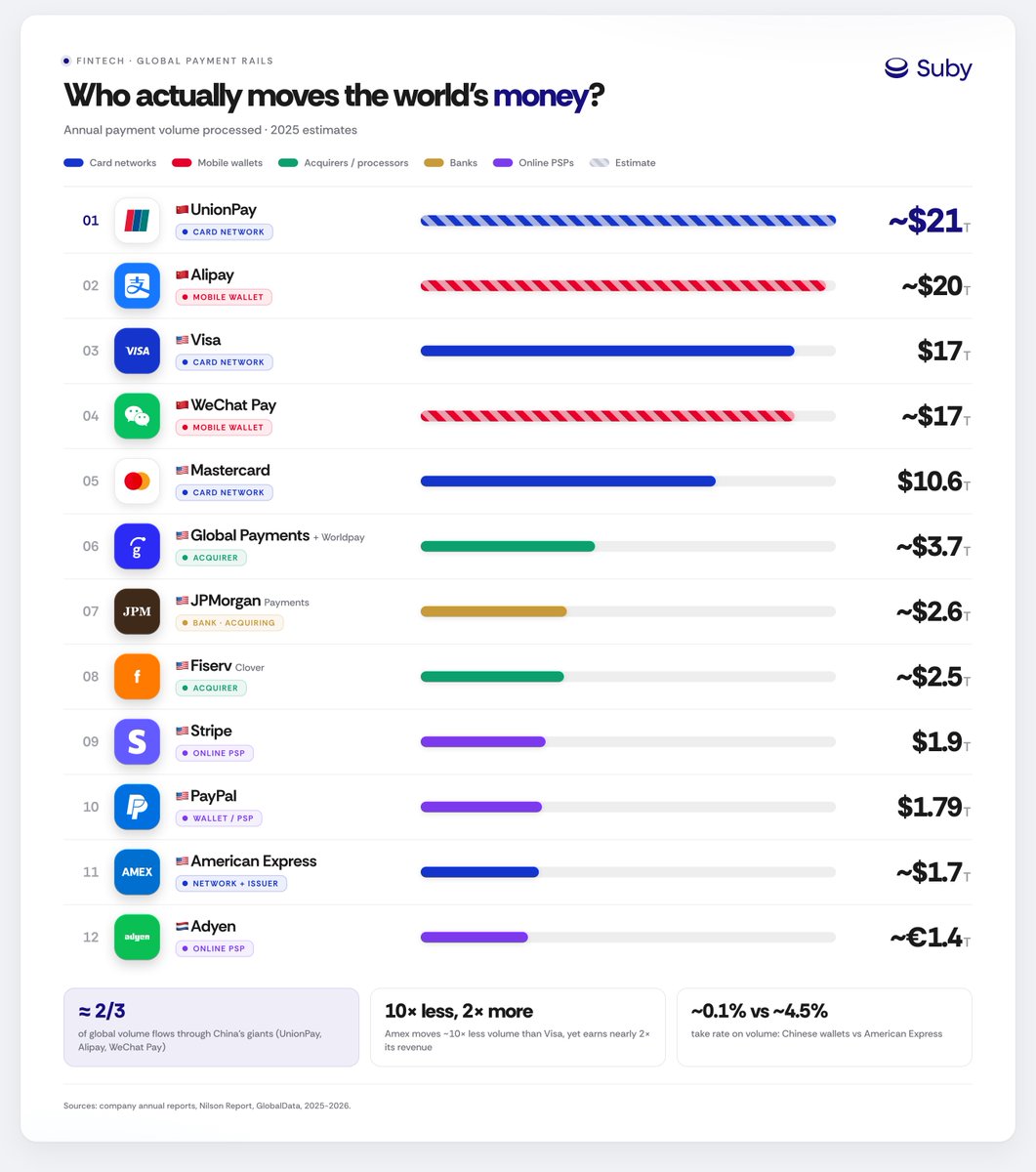
UnionPay is. Then Alipay. Then WeChat Pay. Those three Chinese rails move more than half of the top 12 global volume, almost entirely inside one country.
But the company that moves the most money is not the one making the most of it.
@gaspardlezin on why volume and value have fully decoupled in payments 👇
If Visa is the biggest payments company you can think of, here's a surprise: by volume processed, it's probably not #1.
Valuation tells you what investors believe. Volume tells you who actually moves the world's money. And the two rankings look nothing alike.
Three players you rarely see on Western payments charts, UnionPay International, Alipay, and WeChat Pay, process an estimated $55–60T a year combined. That's more than half the volume handled by the world's largest payment networks, almost entirely inside one country.
And here's the shift almost nobody talks about: volume and value have completely decoupled.
American Express is the clearest illustration. It processes ~10x less than Visa (~$1.7T vs $17T in FY2025), yet generates almost 2x Visa's revenue ($72B vs $40B). Why? Take rates. Amex captures ~4% of every dollar it touches (network fees + card lending). Visa captures ~0.24%. Alipay and WeChat Pay? Estimated closer to ~0.1%. Trillions in flow, pennies in fees.
The Top 12 by annual volume processed (FY2025):
- UnionPay: ~$21T (est.) · card network
- Alipay: ~$17–20T (est.) · mobile wallet
- Visa: $17T
- WeChat Pay: ~$15–18T (est.) · mobile wallet
- Mastercard: $10.6T
- Global Payments Inc. + Worldpay: ~$3.7T combined post-merger
- JPMorgan Payments: ~$2.6T in card acquiring
- Fiserv: ~$2.5T
- Stripe: $1.9T TPV, up 34% YoY
- PayPal: $1.79T TPV
- American Express: ~$1.7T
- Adyen: ~€1.4T
A rough picture of where the ~$100T in Top 12 volume sits:
~57% Chinese rails (UnionPay, Alipay, WeChat Pay)
~29% Western card networks (Visa, Mastercard, Amex)
~14% acquirers & PSPs (Worldpay, JPMorgan, Fiserv, Stripe, PayPal, Adyen)
The takeaway: the companies processing the most money are not the ones capturing the most value. The entire game in payments is take rate. UnionPay moves more money than Visa, but Visa is worth ~$600B on public markets, while near-zero Chinese take rates turn colossal volume into modest revenue per transaction.
Note: "volume" doesn't mean the same thing everywhere. Networks report total volume (Visa) or GDV (Mastercard), wallets and PSPs report TPV (PayPal, Stripe), acquirers report merchant volume (Worldpay, Fiserv) and they overlap: a Stripe payment on a Visa card is counted by both. Chinese figures are estimates (no official disclosure since 2020–21).
PS: I post about payments & stablecoins with Suby. Follow for more!
The two scenarios at the end are the sharpest framing in the piece. House coin versus smart partner. A proprietary RobinhoodUSD earns 100% of a float nobody else accepts. A USDG partnership earns a slice of something neutral and scalable. The lesson from every failed consortium coin is that branded dollars get stuck in their own garden. Staying a distributor rather than becoming an issuer might actually be the more profitable position at scale, and the less obvious one.
"Payment processor" and "merchant of record" are not the same thing.
One moves your money. The other becomes the legal seller in every country you sell to, takes the tax liability, and owns the chargebacks.
Two years ago founders had 2 real MoR options. Today there are 15.
@gaspardlezin mapped all of them 👇
Everyone knows Paddle. Almost nobody can name the 14 other merchants of record that might fit them better.
And that gap is expensive. Because the merchant of record you pick decides who's legally liable for tax in every country you sell to, not a detail you want to default into.
Quick reset, since most founders confuse the two:
A payment processor (Stripe, Nuvei, Adyen) just moves money from the customer to your account. You stay the legal seller, which means registering for VAT/GST/sales tax everywhere, filing returns, tracking nexus, and eating chargebacks and compliance risk yourself.
A merchant of record (MoR) becomes the legal seller. Its name is on the customer's statement. It collects and remits the tax. It owns the chargebacks. You sell your product to the MoR, and it resells to the world. One integration instead of a country-by-country compliance build.
In 2026, with tax authorities tightening enforcement globally, being your own MoR is basically a full-time job. That's why the market exploded and why "just use Paddle" stopped being the only answer.
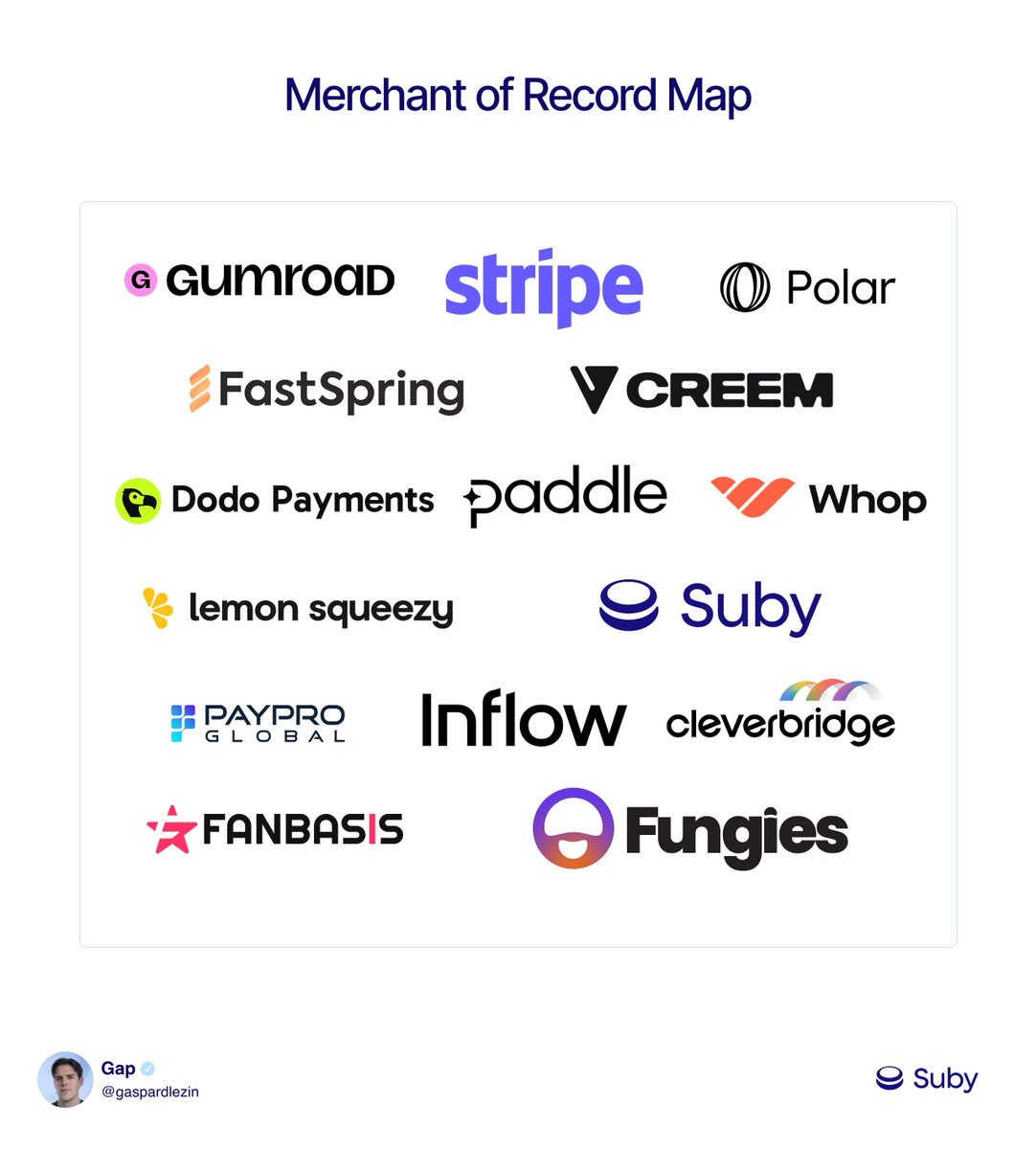
Here's the full map almost nobody has:
— Indie / creator-first: @Gumroad, @Polar_sh, @Subyhq, @Creem_io, @DodoPayments, @LemonSqueezy, @Whop, @Inflowpay, @commas, @fungies_io
(API or no-code, transparent pricing, built for solo founders and AI builders)
— SaaS-focused, established: @Paddlehq, @FastSpring, PayPro, Cleverbridge
(mid-market → enterprise, recurring billing, retention tooling)
— Incumbents entering MoR: Stripe (Managed Payments)
(the biggest processor now bolting on an MoR layer at ~3.5% on top of standard fees)
And here's the shift almost nobody talks about: two years ago, a global SaaS founder had maybe two real MoR options. Today there are fifteen and the best fit for you is probably not the one everybody names by default.
A rough 2026 picture of who lands where:
~50% of new indie / AI SaaS founders start on a creator-first MoR
~30% of scaling SaaS sit on Paddle / FastSpring
~20% enterprise & physical-goods brands run cross-border specialists
The takeaway: choosing a merchant of record isn't a payments decision. It decides who carries your tax liability, whose name your customer sees, and how much of global commerce's legal weight you personally hold.
Get it right and you sell to 150 countries from day one. Get it wrong and switching later is a migration project, not a weekend task.
PS: I post about payments with Suby, stablecoins & the reality of building a payment startup, every week. Follow for more!
The two scenarios at the end are the sharpest framing in the piece. House coin versus smart partner. A proprietary RobinhoodUSD earns 100% of a float nobody else accepts. A USDG partnership earns a slice of something neutral and scalable. The lesson from every failed consortium coin is that branded dollars get stuck in their own garden. Staying a distributor rather than becoming an issuer might actually be the more profitable position at scale, and the less obvious one.
Robinhood built a blockchain. That's not the story.
It already had the users (27.7M), the wallet, and a founding seat in the Global Dollar Network earning reserve yield since November 2024.
The chain just made the stablecoin play structurally inevitable.
@gaspardlezin on what Robinhood actually fired first 👇
.@stripe doesn't want to own the dollar. It wants to own the pipe.
It bought @Stablecoin and @privy_io, incubated @tempo, and co-founded a neutral stablecoin (OUSD) with Visa and 140 others. The coin is free on purpose. The value sits in the rails.
Money in, money out, a cut taken at every step.
Full article bellow 👇
Bridge at $1.1B, a federal OCC trust charter through Privy, Tempo running 100,000 transactions per second with no native token, and now a consortium coin where Stripe controls the pipe without owning the float. That's not a product roadmap. That's a category acquisition strategy executed one layer at a time. The part that still needs proving is whether 11 million Stripe merchants actually adopt stablecoin rails by default or just have the option sitting there unused.
Stripe co-founded a stablecoin it doesn't control, gave away the float, and set mint fees to zero.
Everyone called it a retreat.
Visa doesn't own your money either. It owns the pipe.
@gaspardlezin on why Stripe just ran the Visa playbook 👇