A bright green flag of good software: a predictable price.
A clear, fixed fee you can budget, not a bill that swings with someone's mood. When you know the number, you can plan your runway around it.
Erum runs on a flat, transparent fee.
Every action on your book should leave a record you can export and check, a bot attack or a sharp market move alike.
Good software gives you an audit trail, not a summary you have to believe. Proof beats promises. Erum logs every move and shows it to you.
Never take a liquidity service on faith. Measure it, ask for reporting and numbers.
Too many sign up blind, no clarity on price or results, then call the market a scam.
We work differently: run Erum FREE on one pair for 2 weeks. Improves? Continue. If not, you lost nothing.
Good software is not just code. A team should watch it around the clock.
You trust your liquidity and reputation to people, not just software. Support when things go wrong, any hour, is the standard now.
Defended at 3am and noon. That is Erum, we don't leave clients alone.
"We control our token on all 5 exchanges, we're fine."
The mistake: it feels under control, but your liquidity leaks every day. When price and depth split between venues, buyers get worse fills, bots take the difference.
Good software runs every venue as one book. That is Erum.
Want traders and investors? Don't start with marketing, start with the basics.
A healthy book is your main metric: tight spread, real depth, steady structure. That is what makes people trade with confidence.
A thin, jumpy book scares everyone off. Erum keeps yours tradable.
How should software quality show itself? Speed. Speed is part of liquidity. When placing and cancelling orders is slow, you become food for arbitrage bots.
Good software reacts in under 15ms, so the book is defended before the threat lands. That is the standard behind Erum.
Your spread is a signal. Tight tells the market your token is active and worth trading. Too wide, and nobody trades it, why take a loss?
Good software keeps that signal healthy every second. Erum holds it 24/7. While you sleep, we watch.
What pushes a trader or investor away from your project? The liquidity of your book.
Nobody wants to enter and exit with a couple percent of slippage eating the trade. Real liquidity means clean entries and exits.
Good software builds that, not numbers on a screen. That's Erum.
@Satori_btc A tight spread and a deep book rarely both hold at once. Keeping the spread tight means a market maker sits close to the price with size, which is risky, so real volume makes them pull back. A book can look perfect when quiet and fall apart once people actually trade.
@WispOfDeFi $320M in 24h sitting on $40K of near-touch depth means the book is reprinting its visible size thousands of times a day. That refill rate is the real tell, not the volume headline. Volume is the easiest number to inflate on a thin book
@only1mrwhite Worth clocking that those two large resting orders can vanish the millisecond real size shows up — on thin books, displayed depth is often the first thing pulled. The 30x gap you measured at rest can compress exactly when you need it not to.
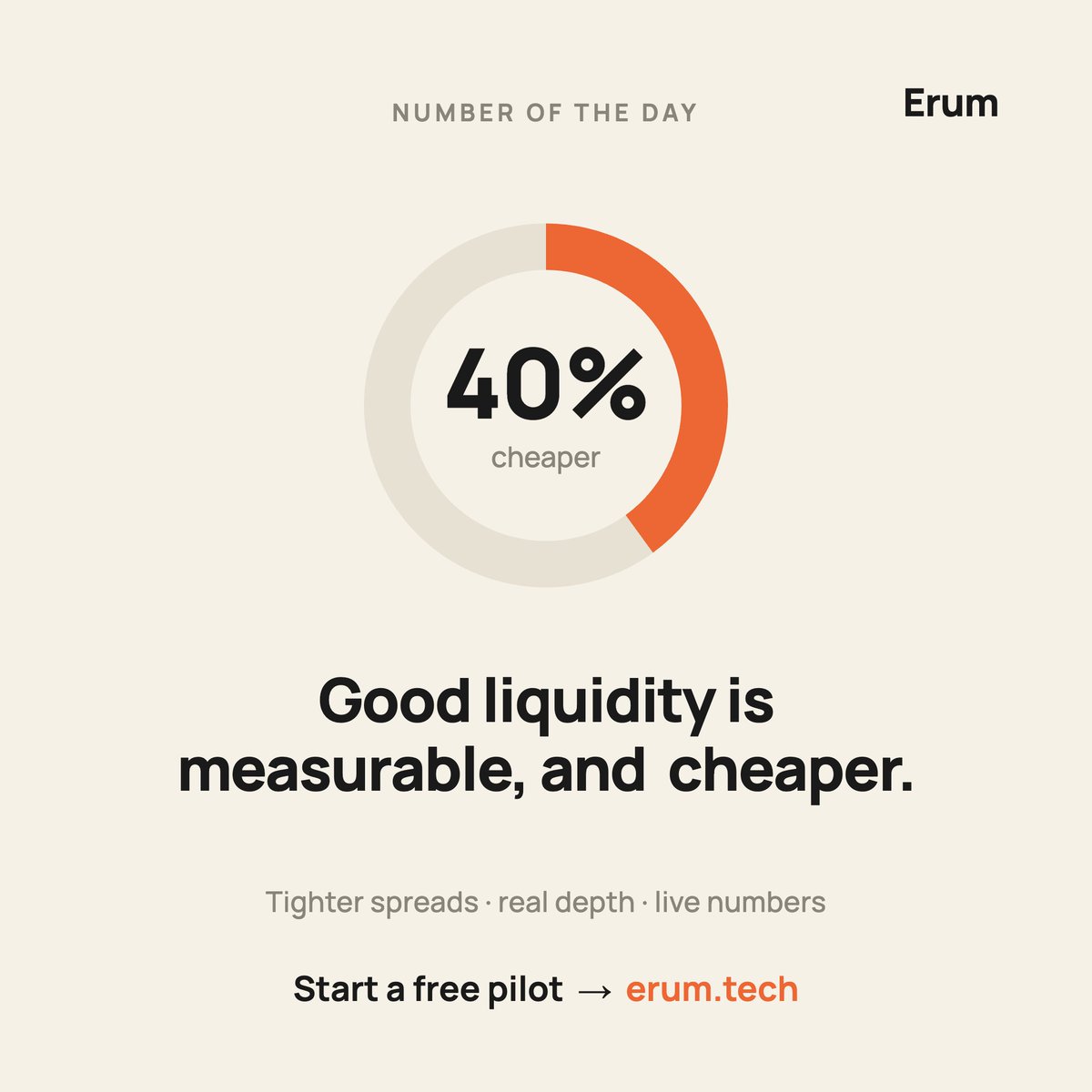
Good liquidity software is measurable. You watch the result live: tighter spreads, real depth, manipulation losses gone, and around 40% less than a traditional desk costs.
Clear numbers, in your dashboard. That is the Erum standard.
Good liquidity software keeps real depth on your book. Genuine size at ±2% that holds when a serious trade lands.
No trader wants a token with a weak book, and that's capital flowing straight out of your project. Real depth is the standard. Erum holds it 24/7.
Good liquidity software runs only your strategy, with zero positions of its own.
That means it can never end up on the other side of your trades. It works for your book and nothing else.
That is how Erum is built.
In 2026, handing over your funds or withdrawal rights is a red flag. No software should touch your money directly.
Neglect security and the project fails.
A trading-only key places and cancels orders but can't withdraw, revoke it anytime. That's an Erum pilot, security first.
Your order book should look the same on every exchange you're listed on.
Same tight spread, same real depth, everywhere.
When software lets venues drift apart, manipulators live in the gaps. Mirroring should be standard, not a paid add-on. In Erum it is.
Exchanges don't warn you before they delist. They judge one thing: the result, read from your book, not your pitch.
Good software keeps that result clean: tight spread, real depth at ±2%, same healthy book at 3am Sunday as noon Tuesday. That is exactly what Erum does, 24/7.
Your liquidity provider is your project's night watchman, answering for your safety. So how do you know it does the job well? A monthly PDF is too weak. Run our 2-week trial: you get a full report of the work done plus an audit of your token's state. That's how Erum works.
How does "manipulation defense" actually work?
The system spots stuffing, spoofing, and cross-exchange raids as they happen and blocks them in under 15ms, before a human even sees the alert. Every hour, every day.
Speed - that's what you pay us for.