Researchers working at @LMU_Muenchen contacted 1,206 authors who published research using @ESS_Survey data, asking them to share code for replication purpose. Pls guess, what % complied with the request?
Now, the @meta_rep project will continue replicating studies...
The 2nd release by @ESS_Survey also contains 🇩🇪 data collected in the self-completion mode in Round 10. Data can be downloaded from the ESS Data Portal 👉 https://t.co/83g4E5yj4G
We are quite happy and thank all colleagues working with us on the ESS!
@gesis_org@sikt_research
Ahead of our initial Round 10 (2020-22) #data release, we've published a report showcasing analysis from the first nine rounds of the #survey (2002-19).
It includes summaries of #research on a wide range of topics using different analytical techniques.
https://t.co/gS5uiaAanD
We've published #data collected during Round 10 (2020-22) for the first time!
Data comes from 10/32 participating countries: Bulgaria 🇧🇬, Croatia 🇭🇷, Czechia 🇨🇿, Estonia 🇪🇪, Finland 🇫🇮, France 🇫🇷, Hungary 🇭🇺, Lithuania 🇱🇹, Slovakia 🇸🇰 and Slovenia 🇸🇮.
https://t.co/8duHGZWTBb
#EuropeanSocialSurvey
Don't forget to tune in: @jlschanze, Anja Böller & @OshratHochman will talk about implementing the European Social Survey (#ESS) in self-completion modes. Due to the COVID-19 pandemic, the ESS decided to switch survey modes. https://t.co/sWuK1Fkl23
Our German national team based at @gesis_org 🇩🇪 will deliver a free #webinar on Monday 16 May.
Part of their Meet the Experts series, the team will discuss the switch to self-completion #data collection during Round 10 of our #survey from 1-2pm (CEST).
https://t.co/rsSIYgLgnN
Did you already published research with ESS data?
Here is a new task for you: Share your results with a wider community, simply by adding it to our new bibliography tool.
The tool also allows you to filter by ESS item and easily find the literature you are interested in 👇
Submit your #research that includes analysis of our #data to our enhanced Bibliography by simply entering the DOI number.
The #Bibliography has details of over 8,000 papers, searchable by author(s), question(s) or the round(s) of data collection.
https://t.co/079gZ5s1A4
Die Türen des @ESS_Survey sind weit geöffnet 👇
Noch bis zum 6. Mai 2022 können Teams von Wissenschaftler*innen eine Bewerbung mit Themen einreichen und ihre Fragen an unsere ESS-Befragten in ganz Europa stellen🧐
Wir sind sehr gespannt und wünschen viel Erfolg!
@gesis_org
We're delighted to announce our open call for Round 12 rotating modules.
Teams of researchers are invited to propose up to 30 questions on a single topic, to be included in Round 12 (2025) of our survey.
The deadline for applications is 6 May 2022.
https://t.co/xKTRf5FMaJ
Why do some people still deny of question climate change and its human causes? @ChLuebke uses @ESS_Survey data to analyze such attitudes and their ideological and socio-economic roots at the individual, national, and regional level. Check out @ESR_news 👉 https://t.co/5qHf4zuRyb
You can now access and download the full Round 10 source questionnaire and showcards from our website.
We have also published a self-completion questionnaire, used by countries who could not undertake face-to-face fieldwork as a result of the pandemic.
https://t.co/3mQAoxIvW5
A formal call for academics to apply to field #questions in Round 12 of our #survey will be published next month (February 2022).
Fieldwork for Round 12 will take place from February to December 2025 with the #data available for analysis in 2026.
https://t.co/zUUTVJk35J
Der heutige #UNDay2021 ist die Gelegenheit für einen weiteren Blick in die Daten des @ESS_Survey. Das mittlere Vertrauen in die 🇺🇳 ist nahezu unverändert in 🇩🇪 seit 2016. Jeder vierte Befragte hatte 2018 hohes Vertrauen, ebenso viele Befragte vertrauten eher der @UN eher nicht
Anlässlich des Inkrafttretens ihrer Charta findet heute der Tag der Vereinten Nationen statt #UNDay. Die ESS Daten zeigen ein mittleres Vertrauen in die Organisation in Deutschland, welches im europäischen Vergleich eher geringer ausgeprägt ist. @UN@ESS_Survey@gesis_org
Und dieses Jahr wird Runde 10 des ESS in 🇩🇪 kurz nach der Wahl und ohne den Einsatz der professionellen Interviewer*innen erhoben👉#Corona
Mal abwarten, was das für die Genauigkeit der nächsten Schätzung der #Wahlbeteiligung bedeutet...🧐
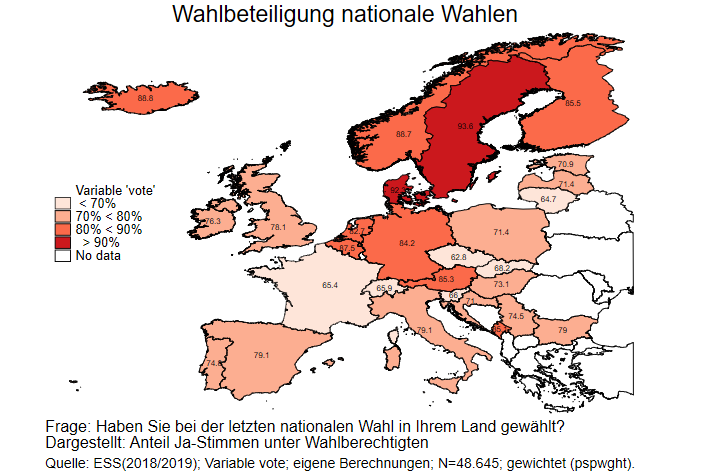
Sonntag öffnen die #Wahllokale für die #Bundestagswahl. Die #Wahlbeteiligung ist ein wichtiger Indikator, der auch im @ESS_Survey vergleichend in allen Ländern abgefragt wird✍️🗳️
Die Beteiligung bei der letzten Wahl lag in 🇩🇪 bei 76,2%, wurde also im ESS 2018 leicht überschätzt
2) Aufgrund von Erinnerungseffekten bei den Befragten („Habe ich letztes Jahr gewählt oder nicht?“) 🤔
3) und nicht zuletzt wegen der sozialen Erwünschtheit gegenüber den Interviewer*innen (die Norm zur Wahl zu gehen)😳
Der Vergleich der ESS-Länder ist trotzdem aufschlussreich!
Die #Zufriedenheit mit der #Demokratie ist ein wichtiger Indikator des @ESS_Survey. In Südosteuropa ist Unzufriedenheit stark verbreitet👎, in Nordeuropa und einigen Nachbarländern 🇩🇪 zeigen sich die Befragten sehr zufrieden👍 Spitzenreiter ist die🇨🇭mit ihrer #DirektenDemokratie
Registration for the 2021 Sir Roger Jowell Memorial Lecture is now open.
@PJTheEconomist (@TheIFS) will discuss the economic and social challenges after COVID.
The #lecture will be held at @CityUniLondon 🇬🇧 and broadcast online on Tuesday 28 September.
https://t.co/w3CkgoupAr
#Wählen ist nur eine der möglichen Formen politischer Beteiligung. Mehr Befragte in 🇩🇪 boykottieren bestimmte Produkte oder unterschreiben Petitionen✍️ als noch 2006. Der Anteil der Demonstranten 🪧 unter den Befragten ist hingegen recht konstant über die Runden des @ESS_Survey