In a new paper published in PSPB, we show that immoral behaviors lead to stronger inferences about a target’s negative ability than inable behaviors do about negative morality - an asymmetric Horn Effect.
w/ @MarcoBicocca, Marcos Dono, and Alex Koch
https://t.co/997Lp22ce6
Our new work published in PSPB shows the primacy of morality in generalizations between social-evaluative dimensions.
@essematta Alex Koch, Marcos Dono @SPSPnews@unimib@ChicagoBooth
https://t.co/sGL2qI4bK8
New paper published in Memory & Cognition: We found that the Illusory Truth effect is greatly reduced - almost eliminated - when information is questioned rather than affirmed. w/@matteomotte and Claudia Bianchi
https://t.co/h7BLw6rXzV
Our new paper published on PSPB shows that repeating statements increases source credibility
https://t.co/VnwTniwmAh
@essematta Christian Unkelbach
@SPSPnews
We discuss potential mechanisms behind this effect, drawing on factors like cognitive fluency and familiarity. In highlighting the strategic value of repetition as a persuasive tool, our findings have implications for domains such as political discourse and misinformation.
New preprint out 🚀, w/ @MarcoBicocca and Christian Unkelbach.
We showed that repetition doesn’t just make statements seem more truthful - it also boosts the credibility of the source delivering them. 🧵
https://t.co/8atYq5iGPG
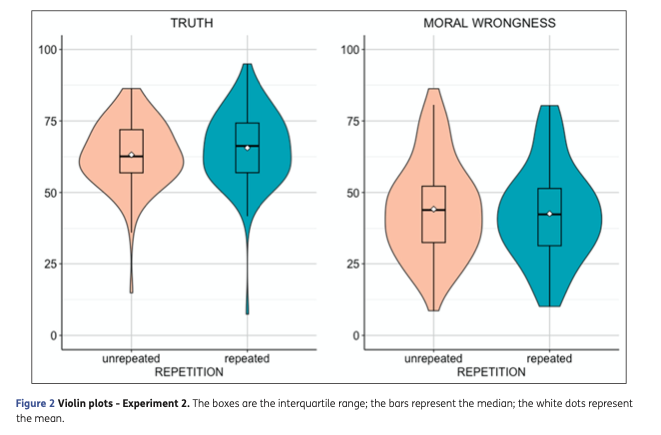
Experiments 2-4 addressed procedural concerns by showing a 'generalized' effect: repetition-induced source credibility extended to truth judgments about entirely novel statements attributed to sources previously associated with repeated (vs. new) statements.
New research helps us understand how we form and change our opinions about people in everyday life, where we often encounter multiple types of information about others.
✍️: Matteo Masi, @essematta, @fabiofas17, and @MarcoBicocca
Read more in #PSPB: https://t.co/0GIPpSaJ2p
Our research contributes to our understanding of the cognitive mechanisms underpinning the reinforcement of positive stereotypes, showing that increased exposure can make their negative effects worse.
What are the consequences of positive stereotypes exposure?
Our new paper, published in @irsp_rips, addresses this question.
w/ Claudia Bianchi, @MarcoBicocca, and @matteomotte
https://t.co/TYTYFX6Y8m
Our findings indicate that repetition is a powerful rhetoric tool that transcends political alignment. Implications? Politicians may use repetition to shape beliefs across the political spectrum.
On target evaluations: Praises repeated more often led to more favorable evaluations of targets, while repeating derogations had a lesser (negative) impact.