The European Smoking Tobacco Association is the voice of Small & Medium sized companies in Europe who manuafacture and distribute Traditional Tobacco Products
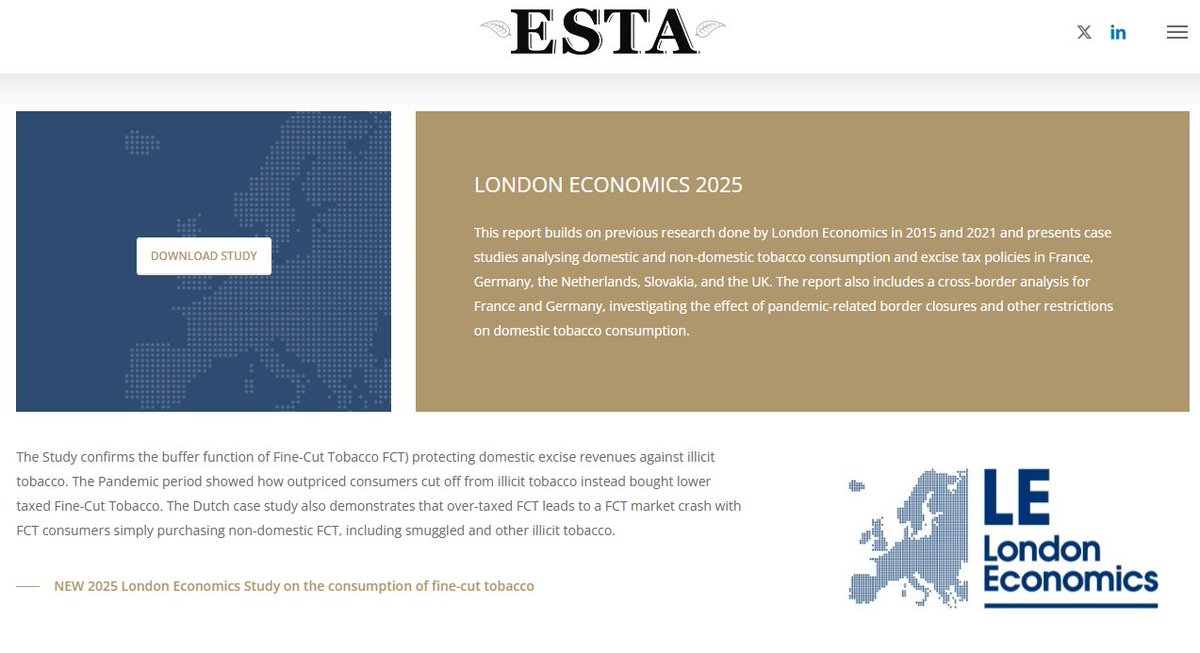
Where the Commission adopts a tobacco tax proposal without releasing the economic studies it is based on, ESTA publishes the NEW 2025 London Economics Study on fine-cut tobacco on which its public positions are based.
https://t.co/MLlZ2eQhEr
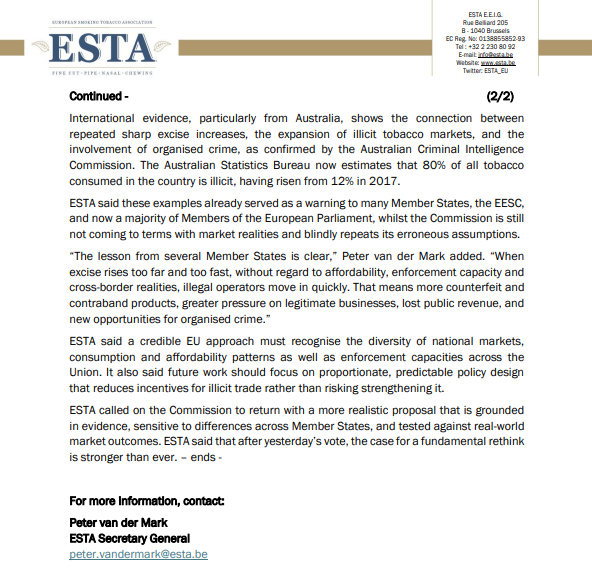
Today’s vote in the European Parliament confirms a broader institutional stalemate. The Commission’s Tobacco Excise proposal has failed to gain traction across all fronts – criticised by the EESC, blocked among Member States in Council, and now lacking support in Parliament. This reflects fundamental flaws in both its design and its assumptions.
The Commission’s approach to revising the Tobacco Excise Directive, themed as 'ambitious,' is actually disconnected from economic and market realities understood by the other institutions. Proposing a one-size-fits-all model of tax rates higher than applied today in member states and, as such, overlooking significant differences between member states it has proposed a framework that cannot command consensus across a diverse European Union. Its denial of illicit trade and of economics at play did not leave much room other than to advise and vote against the proposal.
ESTA’s June 2026 submission on the Tobacco Products Directive calls for evidence-based policymaking, a full impact assessment, careful respect for the internal market legal base, and a rigorous SME test. European traditional tobacco products deserve regulation that is proportionate, workable and grounded in science.
https://t.co/F5iXl1Im2z
Australia is teaching us a difficult lesson, which the EU Commission and several EU member states are failing to learn. Sudden and excessive excise hikes might play to your populist health dogma, but they ruin your state income and make gangsters rich, while assumed health targets are missed.
#EUCom #DG_GROW #DG_TAXUD
Australia is teaching us a difficult lesson, which the EU Commission and several EU member states are failing to learn. Sudden and excessive excise hikes might play to your populist health dogma, but they ruin your state income and make gangsters rich, while assumed health targets are missed.
#EUCom #DG_GROW #DG_TAXUD
Commissioner Hoekstra is yet another Commissioner who appears to misunderstand his brief.
His recent comments in the Luxembourg Times on so-called “tobacco tourism” are not only shockingly uninformed and undiplomatic, they are also strikingly hypocritical coming from a former Dutch finance minister now presenting himself as the champion of tax fairness in Europe.
At ESTA, we believe policy should be grounded in facts, evidence, and respect for Member State sovereignty – not slogans, moral grandstanding, or failed economic theories recycled in Brussels.
Let’s be clear: Luxembourg did not create cross-border tobacco purchasing.
What Commissioner Hoekstra calls “tobacco tourism” is in reality a predictable consequence of certain neighbouring countries – most notably the Netherlands, France, and Belgium – choosing to raise excise duties to unsustainable levels. When governments deliberately widen price gaps far beyond what consumers can bear, people naturally seek legal alternatives across borders.
That is not market distortion caused by Luxembourg. It is the result of poor tax design elsewhere.
Luxembourg, by contrast, has operated within the framework of the EU Tobacco Excise Directive and has maintained a stable, lawful, transparent market. It has not “undermined” anyone. It has simply chosen a more balanced fiscal approach.
If high taxation were the silver bullet Brussels claims, then countries with the highest prices should enjoy the lowest smoking prevalence and the best outcomes.
Yet reality tells a different story.
Luxembourg – despite being regularly criticised for lower prices – has reported comparatively low smoking prevalence relative to several higher-tax neighbours. That strongly suggests that prevention, education, cessation support, and sensible regulation matter far more than blunt tax escalation alone.
This is precisely why simplistic “tax more, problem solved” policymaking fails.
Commissioner Hoekstra repeats a familiar line often promoted through WHO and World Bank frameworks: raise taxes aggressively and consumption will fall while revenues rise.
But the European evidence increasingly shows the limits of that model.
France has pursued repeated steep excise hikes over recent years. Yet instead of eliminating smoking, it has seen large-scale displacement into non-domestic channels and illicit trade. Consumers do not disappear because prices rise. They adapt.
When taxation moves beyond affordability and realism, demand is redirected – not removed.
That means:
Fewer legal sales
Less government revenue
More organised crime
Less product control
Greater enforcement costs
Worse public policy outcomes
This is not theory. It is observable reality across multiple markets.
Europe should also look beyond its borders.
Australia’s extreme tobacco tax strategy is frequently praised in abstract policy circles, yet the practical outcome has been a flourishing illicit market, criminal networks, counterfeit products, and massive tax leakage.
When legal products become unaffordable, illegal operators step in.
That is the real danger of Commissioner Hoekstra’s approach: he risks creating a criminal windfall while claiming a public health victory.
Luxembourg is a sovereign EU Member State operating within agreed European rules. It should not be publicly lectured for refusing to copy the policy mistakes of others.
Differences in taxation across the EU are not a flaw – they are a reflection of different economies, income levels, consumer realities, and democratic choices.
Trying to erase those differences through forced harmonisation is neither smart economics nor smart politics.
ESTA supports evidence-based regulation that genuinely reduces harm and protects public finances. That means:
Maintaining proportionate taxation that avoids rising illicit trade
Fighting illicit trade with real enforcement
Respecting subsidiarity and national competence
Using data, not ideology
Final Thought:
Ignoring the facts, disregarding data, and relying on economic models that repeatedly fail in practice – all in the name of political theatre – is not becoming of a European Commissioner.
Europe deserves better than moralistic soundbites. It deserves serious policymaking.
#ESTA #EU #TaxPolicy #ExciseDuty #SinTaxErrors #IllicitTrade #Luxembourg #TobaccoPolicy #SingleMarket #EvidenceBasedPolicy #DG_TAXUD
The European Commission appears to be disregarding Better Regulation principles in its approach to tobacco legislation.
First, the Tobacco Excise Directive, adopted in July 2025, was based on a 2022 opinion from the Regulatory Scrutiny Board and introduced a new policy option that had not been assessed in the Impact Assessment. But, apparently, this is overlooked when it comes to tobacco.
Now, in its Evaluation Report on the “tobacco acquis,” the Commission initially failed to publish the Regulatory Scrutiny Board’s opinion alongside the report. That opinion was only released yesterday - and its contents are striking.
It is a negative opinion from December 2025, containing scathing criticism (the RSB Report is now included in an amended Evaluation Report). A review of the Evaluation Report suggests that many of these concerns have been brushed aside: the evidence remains weak, and the “lessons learned” appear to have been shaped around pre-determined policy conclusions ahead of a proposal expected later this year.
We are monitoring this closely. The Commission’s assumption-driven approach to legislation must be addressed - if only to ensure that future measures are proportionate and genuinely effective in achieving their objectives.
#DGSANTE #TPD3
After three and a half years of anticipation, ESTA welcomes the release of the European Commission’s evaluation of the Tobacco Products Directive and the wider tobacco control framework. It is both necessary and overdue.
It is necessary because EU institutions need to recognise that the assumption-based legislation of the 2014 TPD increased the regulatory burden, while several of its underlying assumptions have proven to be incorrect.
The evaluation states that, for cigarettes and traditional tobacco products, ingredient regulation as well as packaging and labelling requirements have positively contributed to tobacco control.
Nonetheless, it then draws peculiar conclusions as a basis for possible future regulation. Over a nine-year period, it did not identify a single fine-cut tobacco product suspected of having a characterising flavour. The Commission nevertheless concludes that this is due to a cumbersome and complicated procedure, rather than acknowledging satisfactory industry compliance or recognising that it may have regulated a non-existent problem in the first place.
Similar assumptions regarding the use and effects of ingredients have led to cumbersome reporting obligations, the dismissal of studies, and the scientifically questionable banning of certain ingredients.
Another assumption – that an elaborate but expensive track-and-trace system for individual tobacco packs would combat illicit trade – has proven incorrect. While the system is mischaracterised as a ‘success’, legal manufacturers have invested hundreds of millions to ensure compliance, yet illicit trade remains as high as ever, reaching up to 50% in Member States such as France, Belgium, the Netherlands, and Ireland. Several small and mid-sized manufacturers have gone out of business, unable to meet the exorbitant investment requirements.
The evaluation ignores the impact on small and mid-sized companies, even though they are the most affected by regulatory burdens based on assumptions rather than scientifically grounded regulation.
The evaluation therefore misses critical elements, constructs conclusions to support predetermined next steps, and overlooks better regulation principles such as proportionality and the SME test.
ESTA expects the Commission to remain committed to transparency, scientific rigour, and proportionality when proposing a revision of the TPD later this year.
The European Commission's DG TAXUD claimed today before the European Parliament's ECON Committee that there is "no direct correlation between (tobacco) tax rates and levels of illicit trade." That’s not just misleading – it is demonstrably false.
The evidence across Europe comes from three Member States that hiked their tobacco taxes over the past five years:
• France - Illicit cigarettes now account for more than half of total consumption
• Ireland - Nearly 50% of the rolling-tobacco market is non-domestic
• The Netherlands - Illicit consumption has surged by 140% in just five years
These are not coincidences. They are the predictable consequences of aggressive tax increases.
The dogmatic denial of its own data leads only to one result: a larger black market, reduced tax revenues, and diminished oversight of consumer safety and regulatory standards. And that without any real reduction in smoking rates.
Europe is on track to repeat Australia's failed tax policies, where crime related to illicit trade is out of control.
https://t.co/FK3xZchPXO
Policy should be based on facts, not on the denial of them.
The black market has surged in Australia, with recent figures from Australia's new Illicit Tobacco and E-cigarette Commissioner revealing that in 2024-25, an estimated 509 tonnes of loose-leaf tobacco and 2.66 billion cigarettes were seized by authorities, with a street value of $3 billion.
The commissioner estimates criminal syndicates control between 50% and 60% of the market, valued between $4 billion and $6 billion.
The scale of Australia’s illicit tobacco market has increasingly been linked by analysts to the country’s very high tobacco excise levels, which have risen steeply over the past decade. In the past five years, excise rates on cigarettes have increased by 36%, and on rolling tobacco by 52%.
As legal prices climbed to some of the highest in the world, the price gap between regulated products and illicit alternatives widened dramatically. Since 2020, cigarette prices have increased by 39% and rolling tobacco prices by 48%. Meanwhile, illicit prices have not changed. Smokers are aware of this, which is why on practically every corner in Australia's major cities, one can buy these illicit packs, in normal branded packaging, for as little as $13 a pack, i.e. less than one-third the price of legal packs.
This has created strong incentives for organised crime to expand supply. Law enforcement agencies have repeatedly warned that the profitability of illegal tobacco now rivals that of other established criminal markets, drawing sophisticated trafficking networks into the sector.
This experience is attracting growing attention in Europe, with Commissioner Hoekstra calling for massive increases in tobacco excise duties, saying "Higher tobacco taxes and prices have been demonstrated to be the single most effective measure to reduce overall tobacco use". The Impact Assessment claims that "The price of illegal products is typically set in relation to the price of legal ones, and at about 50%-60% of it" (p.100). It's clear, given the reality of Australia's current crisis, that the European Commission has made the wrong estimate.
European countries that have implemented steep tobacco excise hikes in the past five years have seen levels of illicit trade similar to those before the hikes. In France, Ireland, and the Netherlands, illicit consumption has increased by 60%, 122%, and 177%, respectively.
While public health objectives remain the motivation for these policies, authorities across the continent are already confronting a noticeable rise in contraband and counterfeit cigarettes in many markets. The Australian case illustrates how rapid and substantial tax hikes stimulate illicit trade to the point that it is fully out of control.
https://t.co/TQpul5DsPs
More than 9 million illegal cigarettes were seized in Ireland yesterday – representing around €7 million in lost tax revenue. Yet this is only a fraction of the estimated 1.1 billion illicit cigarettes circulating in the country every year. The expansion of the illicit market has coincided with repeated tobacco tax increases far above inflation, creating a growing and obvious incentive for organised crime.
Yet in the Impact Assessment for the Tobacco Excise Directive proposal, the European Commission says it “could not find a statistically significant association between illicit trade and cigarette prices”. Meanwhile, in its July 2025 Excise Tax Strategy, the Irish government estimated that a €1 increase in cigarette prices – alongside a pro-rata +50% increase for rolling tobacco – would generate an additional €73 million in tax revenue.
When policy assumptions ignore market realities, the result is predictable: more illicit trade, stronger criminal networks, and less revenue than expected. Ireland and the European Commission need joined-up thinking on tobacco taxation before this problem grows even worse.
#excise #ireland2026 #smuggling
Today, we mark International Pipe Smoking Day. Pipe smoking is part of Europe’s culture and regional heritage, supported by family-owned businesses and SMEs.
#InternationalPipeSmokingDay#Europeanheritage#SMEs
Interesting article in the New York Times this week showcasing Australia’s failed tobacco tax policy, characterised as being "pseudo-prohibition". Hiking tobacco taxes without considering consumers’ affordability limits and relying on theoretical public health mantras leads to undesirable societal consequences. In Australia Illicit trade is spiralling out of control with gang warfare, fire-bombings of shops and overwhelmed 'whack-a-mole' enforcement. Today 50% of all cigarettes consumed in Australia are illicit. In Europe, high-taxing Ireland, the Netherlands and France are fast catching up to these levels. The European Commission’s approach: emulate the tax policies of these Member States and Australia, then force it upon the other Member States.
ESTA continues to advocate within European Commission and Member States that official data, economic reality, and serious analysis should drive policies rather than debunked theories and assumptions that may be politically desirable but have serious consequences down the line.
https://t.co/FK3xZchPXO
Ahead of last week's EU Competitiveness Summit, Chancellor Merz stated that all sectors need deregulation. The EU must act to strengthen, not weaken, its industries.
ESTA reiterates that abrupt tax hikes increase illicit trade, threaten revenues, tobacco SME's & thousands of jobs
Wishing our members and friends a successful and prosperous 2026. We look forward to continued engagement as we work together on the issues shaping our industry
Wonderful interview with Arthur Laffer.
ESTA has long said that excessive taxation is counterproductive and can have very serious real-world consequences.
“If you tax people who work and you pay people who don’t work, don’t be surprised if you find a lot of people not working. I mean, it’s just duh!”
Legendary economist @realartlaffer breaks down why taxing the rich isn’t the right way to get Britain growing again.
@KateEMcCann
ESTA has submitted its feedback on the EU Commission’s Tobacco Excise Directive (TED).
We believe the Commission ignored its own market data – relying instead on ideology over evidence.
The result? Harm to small businesses and a boost for illicit trade.