"Some in Ottawa continue to advocate playing the “long game,” apparently assuming that conditions will improve after the U.S. midterm elections or once Trump leaves office.
That is speculation, not strategy.
Nothing guarantees that Congress will become more sympathetic to Canada after November. Nothing guarantees that the next administration will abandon protectionism after 2028."
Read full article below.
In a matter of days, the Canadian dollar could fall below US$0.70 again—roughly where it stood when Mark Carney became Prime Minister 15 months ago.
A weaker loonie makes imported food more expensive, putting even more pressure on food affordability.
Here are a few key economic indicators affecting food affordability since Mark Carney took office:
1⃣Food inflation: 3.2% → 3.8% (highest in the G7)
2⃣Employment rate: 60.9% → 60.7%
3⃣Federal deficit: $35.3B → $72B (larger deficits can weigh on the currency)
4⃣Household saving rate: 5.3% → 3.5% (less financial breathing room for the middle class)
These trends matter because they directly affect Canadians' purchasing power at the grocery store.
This is what economic pain looks like. Canadians chose this path in April 2025.
@bunsenbernerbmd I'm not a vet but the mention of his lungs caught my attention. Our dog is finally out of the woods after a year of treatment for Blastomycosis. We are also in a rural environment with leaves and spores every. Apparently, cats can get it too. Wishing you a good outcome.
"Canadians have chosen pain over prosperity. Most don’t realize it yet, but that’s the path they’ve taken. Turning our backs on the most powerful economy in history is beyond comprehension—and it will make things even more challenging for our farmers and Canada’s agri-food sector."
Listen to the Food Professor Podcast below...
We are learning that the Liberal government, now holding the slimmest of majorities in the House of Commons, intends to assert control over all parliamentary committees—over votes, witness selection, points of order, agendas, and more.
Committee work is among the most important responsibilities of Parliamentarians, full stop. It is where legislation is thoroughly examined to ensure that decisions made by government serve the best interests of all Canadians.
While the Liberals are entitled to seek greater control, what I witnessed firsthand in Ottawa last week was troubling: a tone of arrogance, along with the mistreatment of some witnesses who expressed views not aligned with the party in power.
This is what is unfolding, and Canadians should be aware. Parliament will look very different over the next three years—even with only a razor-thin majority.
The Carney Liberals did not win a majority government through a general election or today's by-elections. Instead, it was won through backroom deals with politicians who betrayed the people who voted for them.
While the Prime Minister spent the year on this cynical power grab, he has doubled the deficit, and given Canada the worst grocery prices and housing costs in the G7.
Liberals expect Canadians to give up, get complacent and go away, so Carney can have total power without any accountability. That will not happen. Our country and its people are worth fighting for.
We will continue to fight for people to afford homes, food and fuel.
We will continue to fight for safety in our streets.
We will continue to fight for our resource workers and soldiers.
I will continue to lead that fight every day and in every way in Parliament, across the country and in the next election, when Canadians will reclaim the country we know and love.
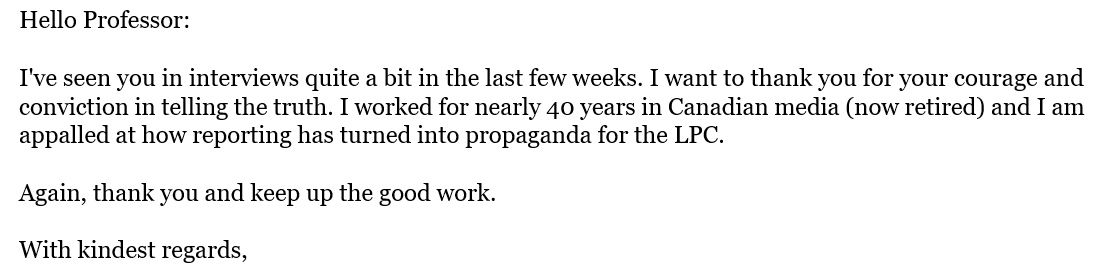
I occasionally receive emails like this ⬇️from former media professionals—now retired and finally able to speak freely.
I’ve withheld the name for obvious reasons. This one comes from a very well-known figure.
Thought I’d share this one with my followers tonight.
Remember how the Bank of Canada was gaslighting Canadians about the impact of the carbon tax on inflation? ⬇️
Stop the daydream, Canada.
Be skeptical.
Ask questions.
Hold institutions accountable.
Much of the media is celebrating the first anniversary of Mark Carney as Prime Minister, suggesting his first year in office has delivered significant progress. The data, however, tells a more complicated story.
Canada currently posts the highest food inflation rate among G7 countries.
The overall unemployment rate has remained largely unchanged, while youth unemployment continues to climb.
The national deficit has nearly doubled.
Interprovincial trade barriers—despite a commitment to eliminate them by July 1, 2025—remain firmly in place.
Our tariff situation with the United States has deteriorated compared with when he took office. Meanwhile, several of the transformational projects announced months ago have yet to receive formal approval.
Either there is something I’m missing, or parts of the media narrative surrounding the first year of Prime Minister Carney’s mandate are significantly disconnected from the underlying economic indicators.
When I speak with a reporter, I know that up to $29,750 of his or her salary may be covered by taxpayers.
Canadians need to know this. If it’s the CBC, the funding is entirely public.
The Opposition has been clear: they intend to end the program.
So the question remains — can a press that relies on substantial, ongoing government subsidies truly remain fully independent?
Thank you to @mindingottawa for the information.
There is zero chance that Canada will ever become part of the United States.
But neither will we replace our relationship with the American people, our closest neighbour and biggest customer, with a New World Order led by Beijing.
To my X followers,
I’ve worked with the media for nearly 25 years. For most of that time, the relationship was professional and balanced. But in recent years, something has shifted.
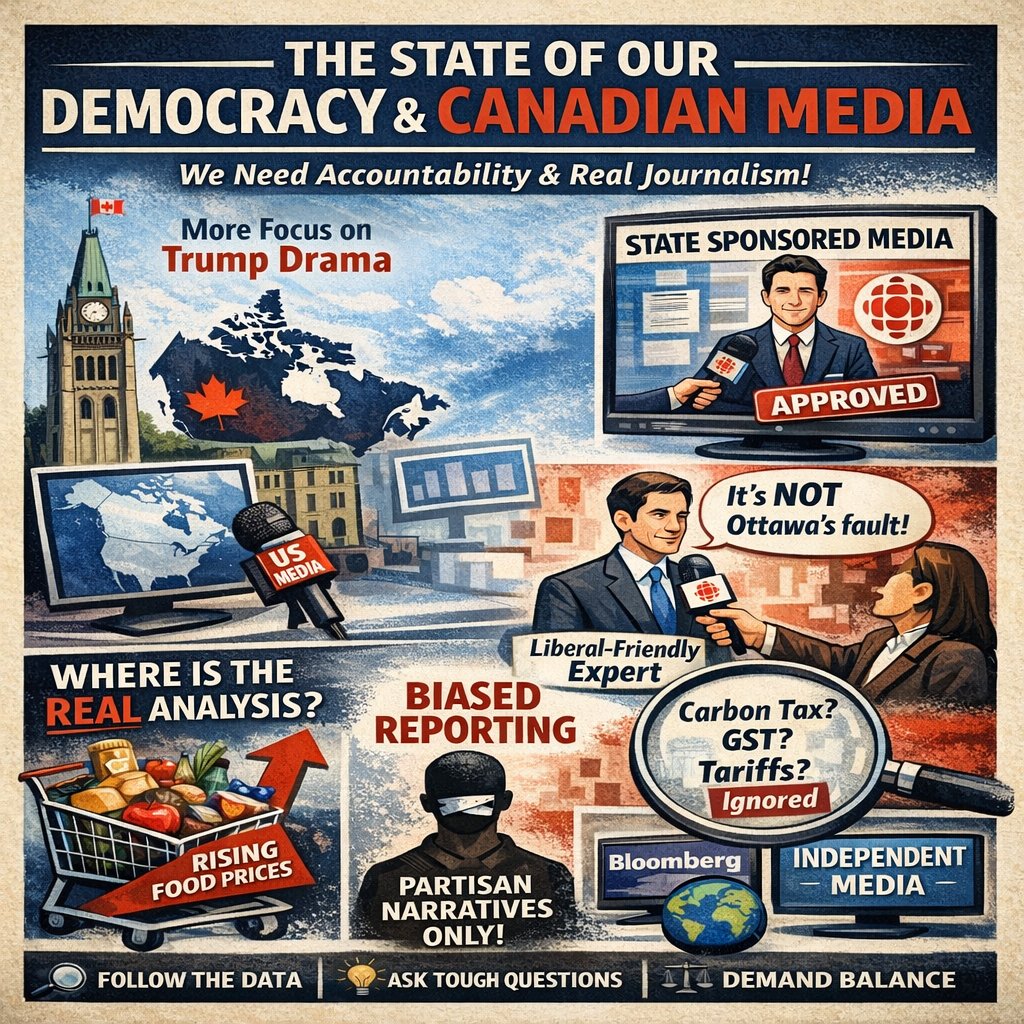
I am increasingly concerned about the state of our democracy — particularly how media, in general, are informing Canadians about food policy, food inflation, and economic policy.
I now find myself learning more about Canada’s economy and policy changes from American outlets than from Canadian ones. Much of our national coverage feels reactive, shallow, or overly fixated on partisan narratives rather than substantive policy analysis.
What troubles me most is the lack of scrutiny applied evenly across governments and institutions.
For example, when the Bank of Canada suggested that Ottawa’s counter-tariffs contributed to food inflation, only one major outlet — Bloomberg — gave it meaningful coverage. The grocery benefit program received very little examination regarding how it would be financed. It took days before anyone pressed for clarity.
During the latest spike in food inflation, several outlets turned to the same small circle of commentators who dismissed any potential role of federal policy — carbon pricing, GST holidays, counter-tariffs — despite mounting evidence that policy decisions can and do affect food prices.
Instead of investigating structural drivers of inflation, much of the coverage focuses on fact-checking opposition rhetoric, even though the opposition has not governed since 2015. Scrutiny should be applied equally — not selectively.
Quebec media, while imperfect, appear to have maintained a broader range of debate. In much of the rest of Canada, I see increasing concentration of voices — often from the same region, Ontario, often reflecting similar policy perspectives — and less diversity of thought grounded in empirical research.
This isn’t about partisan politics. It’s about accountability, transparency, and healthy democratic discourse.
Media are under financial pressure — that’s real. But public trust depends on independence and depth. Subsidy structures, incentives, and newsroom economics all matter.
Canada deserves stronger policy journalism — especially on food affordability, supply chains, and economic resilience.
We need more data-driven analysis, more intellectual diversity, and more courage to ask uncomfortable questions — regardless of which party is in power.
Until that happens, Canadians would be wise to diversify their news sources and think critically about what they’re being told — and what they’re not.
@FoodProfessor Bought nectarines at Metro yesterday. I didn't examine the clam shell. Got them home, all but 2 were totally rotten... Unfortunately, too far to drive to return them.