@lookonchain Our model, Nov 5: Uniswap B, 70.4, #8
Whale flow is the price record. Our fundamentals still read Uniswap as a leading DeFi venue with moderate value capture.
None of that shows up in a yield number. I wrote the staking side up as a free deck, The Low-Effort Guide to Staking in 2026 (and What the Yield Really Is): https://t.co/GjQcd173Tj (4/4)
A staking yield is paid in the token you staked. So before you compare yields, compare the assets paying them. Two that a lot of people stake, on our record of November 3, 2026, carry the same letter grade and are not the same asset underneath. (1/4)
Almost all of those 11.4 points sit in one of our six inputs. On-chain usage and economics reads 4.3 of 5 for Polkadot and 1.7 of 5 for Cosmos Hub. They are level on tokenomics and on security. Polkadot leads on ecosystem, Cosmos Hub on valuation. (3/4)
In the good times, it's easier for projects and tokens to look like a good investment from the outside.
It's when there is a stress test (like North Korean hacks) that you can see who truly has the strong fundamentals, such as tokenomics, liquidity, security and market structure.
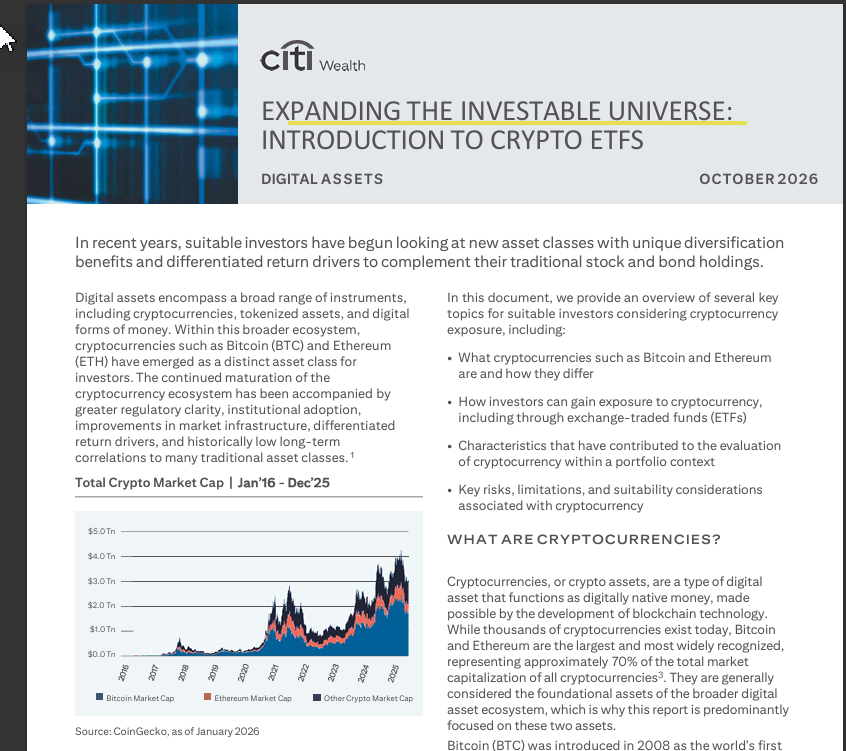
Citi Wealth just published “Expanding the Investable Universe: Introduction to Crypto ETFs”, which pitches spot BTC and ETH ETFs as the regulated, brokerage-account way for suitable clients to add digital assets alongside stocks and bonds.
Separately, Citi said on Aug 18 that its new Custody+ platform will start holding bitcoin for institutional clients this year.
By my count, that would make Citi the 6th of 29 G-SIBs (systemically important banks) to have institutional bitcoin custody live or announced, after BNY, Standard Chartered, Société Générale, State Street and Deutsche Bank. BNY, Standard Chartered and SocGen’s SG-Forge are already licensed and serving institutions, and Deutsche Bank says it is weeks away. JPMorgan has said custody is off the table for now.
The Binance hack last week could be one reason Citi has stayed quiet on timing. I heard that the service was already set for launch last week.
Binance reopens withdrawals, starting with Bitcoin ( bitcoin:native ); proof of reserves due Nov 2–3
WHAT
Binance restarted Bitcoin withdrawals at 06:20 UTC on Nov 1 as the first of 15 networks in phase one, then ethereum:0xdac17f958d2ee523a2206206994597c13d831ec7 , ethereum:0xa0b86991c6218b36c1d19d4a2e9eb0ce3606eb48 , ethereum:native and binancecoin:native on Ethereum and BNB Chain; it says ~90–95% of the ~$6.3B stolen has been replaced from company funds (including SAFU), and the FBI attributed the theft to North Korea's TraderTraitor group.
WHY IT MATTERS
The withdrawal freeze was the main channel that could re-squeeze DeFi stablecoin rates.
5/5 A yield tells you what a position pays. It does not tell you what the asset is. Both are worth knowing, and they are not the same work.
I wrote the yield side up as a short research deck:
https://t.co/GjQcd173Tj
1/5 A staking reward and a fundamental grade answer two different questions. The reward is a yield on a position you already hold. The grade is about whether the asset is worth holding in the first place. Our model only answers the second one.
4/5 Neither number has anything to do with a reward rate. Our model scores six weighted inputs, 0 to 5 each.
Cardano's weakest is on-chain usage and economics, 1.4 of 5 on a weight of 22.
Polkadot's is relative valuation, 1 of 5 on a weight of 12.