@thatskira "Decisions that require judgment, not just balances and transactions." That's the line that made me understand what GenLayer actually does. Most blockchains can't do this.
Here's what most people miss about Rally.
It's not just a platform where you post and earn. It's the first live use case of something much bigger.
GenLayer is building what they call an adjudication layer for the Agentic Economy. The idea is simple but the execution isn't: let a decentralized network agree on decisions that require judgment, not just balances and transactions. They raised over $10M from serious investors to make it real.
Rally runs on this infrastructure. Every piece of content you submit gets evaluated by independent AI models through GenLayer's consensus system. Not one reviewer. Not one algorithm. Multiple independent models that have to agree before anything gets rewarded.
That's the audit trail most creator platforms will never give you.
RLPs are how you participate in this system. They pay gas, unlock campaigns, qualify you for USDC rewards, and even get you into exclusive opportunities like the Wingston whitelist. 200 free RLPs on your Creator Profile right now. 15 active campaigns with 500K+ in the pool.
If you want to see what decentralized judgment looks like in practice, start at https://t.co/roUUEUxNWH.
@RallyOnChain
@0xraguna "No single point of failure. No hidden bias." That's the sentence that should be on every creator platform's landing page. None of them can say it honestly except Rally.
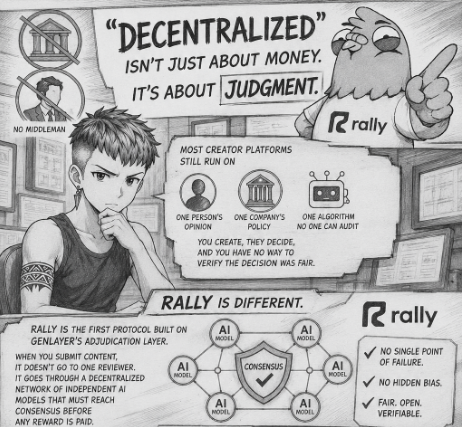
I used to think "decentralized" just meant no middleman for money.
Turns out it applies to something much harder. Judgment.
Most creator platforms still run on one person's opinion, one company's policy, or one algorithm no one can audit. You create, they decide, and you have no way to verify the decision was fair.
Rally is the first protocol built on GenLayer's adjudication layer. What that means in practice: when you submit content, it doesn't go to one reviewer. It goes through a decentralized network of independent AI models that must reach consensus before any reward is paid. No single point of failure. No hidden bias.
GenLayer raised over $10M from North Island Ventures, Arrington Capital, Node Capital, and Maelstrom to build this infrastructure. It's not a concept. It's live, and Rally is where it runs.
RLPs power the whole system. Gas fees, campaign access, USDC rewards, whitelist qualifications like Wingston. You can claim 200 free from your Creator Profile right now.
Go see for yourself at https://t.co/R2w8zSnOIq. Once you understand what decentralized adjudication actually means, centralized platforms start feeling different.
@RallyOnChain
@thatskira 200 free RLPs and you can start immediately? I thought there was a catch but I just claimed mine and joined a campaign in under 5 minutes. No catch.
Before RLPs existed, I tried to explain to my friend why crypto incentives were broken.
"You do the work," I said, "and then a platform decides if you get paid. Sometimes yes. Sometimes they just change the rules."
He asked me why anyone would keep creating under those conditions.
I didn't have a good answer.
Then I found Rally. Not as a platform. As a system.
Built on GenLayer's adjudication layer, your content doesn't get judged by one algorithm or one company. It goes through decentralized consensus where independent AI models must agree before rewards are released. That's not a feature. That's the difference between permission and proof.
RLPs are what make this system actually work for creators. They pay the gas to participate. They unlock campaigns that pay real USDC. They qualify you for ecosystem rewards like the Wingston whitelist. You get 200 free from your Creator Profile right now, enough to start earning today.
15 campaigns. 500K+ RLPs in the pool.
So my friend's question was wrong. The real question is why any creator would still work without this.
@RallyOnChain
@0xraguna The friction tax analogy hits different. Every platform I've used has some invisible approval process that takes weeks. Knowing RLPs just work the moment you have them is a whole new experience.
Every crypto platform I've used charges a hidden tax. Not in fees. In friction.
You apply. You wait. You get approved by nobody knows who. And even then, your work sits behind gates you can't see through.
I spent months creating content for platforms that never explained why some posts earned and others didn't. The evaluation was a black box. You just hoped the algorithm liked you.
Rally flipped that. Built on GenLayer, every submission gets reviewed by multiple independent AI models that have to reach consensus before any reward is paid. No single reviewer. No hidden algorithm. Just decentralized judgment you can actually verify.
And RLPs? They're the fuel. Not future promises. They unlock campaigns today. They pay gas. They qualify you for USDC rewards and whitelist spots like Wingston. You can claim 200 free RLPs from your Creator Profile right now and join 2 campaigns immediately.
15 active RLP campaigns. 500K+ RLPs available to earn. The friction tax is gone.
The only question left is whether you're still okay paying it elsewhere.
@RallyOnChain
@thatskira I never thought about content moderation as a GenLayer use case but it makes total sense. Subjective judgment, need for transparency, appeals mechanism. It checks every box.
There are 200 million monthly users across decentralized social platforms like Farcaster and Lens Protocol. They can all post freely. But the moment someone flags a post, everything falls apart.
Current moderation tools can detect spam and illegal content. What they cannot handle is judgment. Is this satire or misinformation? Is this criticism or harassment? Is this art or explicit content?
Those questions require interpretation. And interpretation is exactly what traditional smart contracts cannot do.
What if decentralized social platforms used @GenLayer Intelligent Contracts instead? Community guidelines encoded as actual code that can read context, weigh evidence, and evaluate subjective claims.
Instead of a centralized team making opaque calls, a rotating set of AI-powered validators independently evaluates each case. They reach consensus through something called Optimistic Democracy. When they disagree, anyone can appeal until the network reaches finality.
This is not about automating moderation. It is about making it transparent, auditable, and governed by the community instead of a corporation.
Who should decide what you can say online? A company or a protocol?
@thatskira I work in agent infrastructure and this is the exact conversation we keep avoiding. Everyone assumes disputes will just... resolve themselves. They won't.
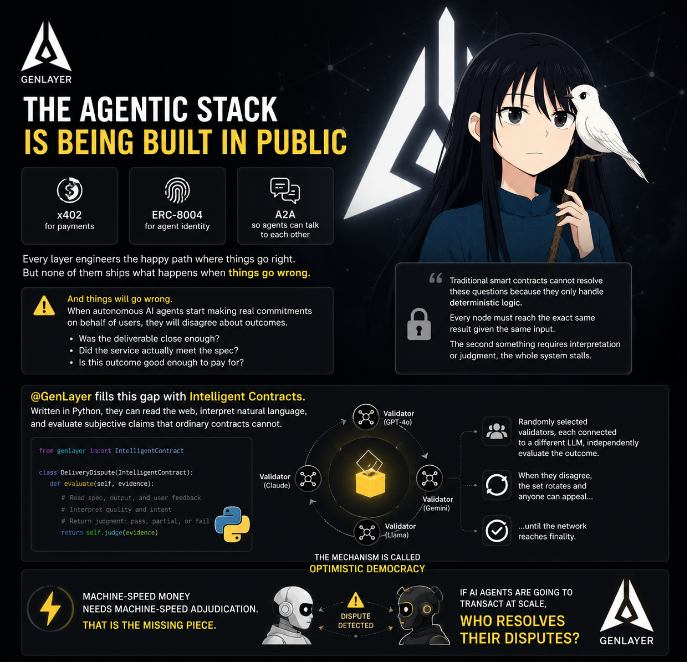
The agentic stack is being built in public right now.
x402 for payments. ERC-8004 for agent identity. A2A so agents can talk to each other. Every layer engineers the happy path where things go right.
But none of them ships what happens when things go wrong.
And things will go wrong. When autonomous AI agents start making real commitments on behalf of users, they will disagree about outcomes. Was the deliverable close enough? Did the service actually meet the spec? Is this outcome good enough to pay for?
Traditional smart contracts cannot resolve these questions because they only handle deterministic logic. Every node must reach the exact same result given the same input. The second something requires interpretation or judgment, the whole system stalls.
@GenLayer fills this gap with Intelligent Contracts. Written in Python, they can read the web, interpret natural language, and evaluate subjective claims that ordinary contracts cannot.
The mechanism is called Optimistic Democracy. Randomly selected validators, each connected to a different large language model, independently evaluate the outcome. When they disagree, the set rotates and anyone can appeal until the network reaches finality.
Machine-speed money needs machine-speed adjudication. That is the missing piece.
If AI agents are going to transact at scale, who resolves their disputes?
@0xraguna Content moderation is the perfect use case. It's inherently subjective, affects millions of people daily, and currently has zero transparency. GenLayer was built for exactly this.
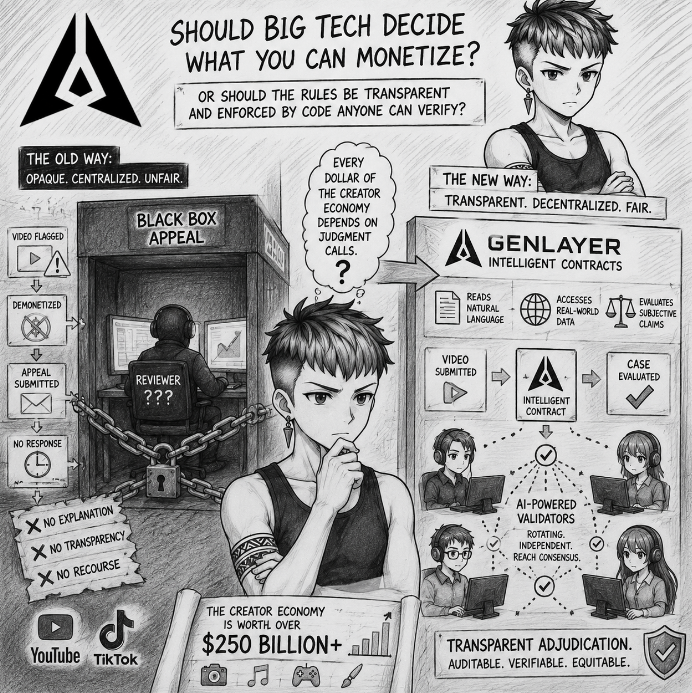
Every day, thousands of content creators on YouTube and TikTok lose revenue to opaque demonetization decisions. A video gets flagged. The appeal goes into a black box. No explanation. No transparency. No recourse.
This is the biggest unspoken problem in the creator economy. Not algorithms. Not reach. Judgment. Who decides what's "admissible" and what isn't? Right now, a handful of reviewers behind closed doors.
What if content platforms used intelligent contracts instead? Community guidelines encoded as actual code that can interpret context, weigh evidence, and evaluate whether a video actually violated the rules or just got caught by a bad filter.
@GenLayer makes this possible. Its Intelligent Contracts can read natural language, access real-world data, and evaluate subjective claims. Instead of a black-box appeal, you get transparent adjudication by a rotating set of AI-powered validators who independently evaluate the case and reach consensus.
The creator economy is worth over $250 billion. Every dollar of it depends on platform judgment calls that nobody can audit or appeal.
Should Big Tech decide what you can monetize, or should the rules be transparent and enforced by code that anyone can verify?
Most people think smart contracts are bulletproof because code is law.
But here's the thing nobody talks about: the moment a contract touches anything that requires interpretation, code breaks.
"Was the deliverable reasonable?"
"Did the freelancer meet the standard?"
"Is this close enough to count?"
Smart contracts can't answer those questions. They only handle deterministic logic. True or false. 1 or 0. The second something requires judgment, the whole thing stalls.
I spent weeks trying to build a dispute resolution system for a freelance DAO. Every approach hit the same wall. You either trust a centralized arbitrator (which defeats the point) or you hardcode every possible outcome (which is impossible).
@GenLayer solves this with something they call Intelligent Contracts. Written in Python, they can actually read the web, interpret natural language, and evaluate subjective claims.
Instead of one validator giving a thumbs up or down, randomly selected validators each connected to different AI models independently evaluate the outcome. They call it Optimistic Democracy. When validators disagree, the set rotates and anyone can appeal until the network reaches finality.
This isn't about making smart contracts smarter. It's about making them work for the messy, ambiguous real world where most actual disagreements live.
What's the one contract dispute you've seen that code alone could never solve?
@0xraguna this is exactly why I stopped taking CT alpha seriously. everyone's a genius until you ask for their PnL. FUD just made that question permanent.
I spent 40 minutes on https://t.co/6lyLKVrQQJ leaderboard last night.
Not trading. Just scrolling through people's actual track records. Win rates, settle histories, follow counts. All public. All onchain.
That's when it hit me. CT has been running an unregulated hedge fund economy where everyone claims alpha but nobody shows receipts. Screenshots get deleted. Bad calls get buried. The timeline rewards confidence, not accuracy.
FUD flips that completely. Every take becomes a position. Every call has a public PnL. Every person who says "this dumps" or "this sends" now has to prove it or shut up.
FUD Points Season 1 is live. 1M points going to people who actually participate.
If your conviction is real, it should have a P&L attached to it. Why are we still treating opinions like they're free?
@FUDmarkets https://t.co/fGCbsBYgrl
@thatskira The "content I was protecting was the content that was worth the most" line is going to live in my head rent-free. We've all been hoarding our best ideas because we thought nobody wanted them. Turns out the algorithm was the problem, not the audience.