5/ So source monitoring in VLMs is neither purely symbolic nor purely distributional: models use both cues. You can also manipulate these signals with an adversarial intervention vector.
Huge shout out to my collaborators: @tianyunnn and @Brown_NLP
For more results & code:
🌐 Website: https://t.co/PffECt4APu
📄 Paper: https://t.co/Uq40gZLsaC
1/ How does a vision-language model know which part of its input is image and which part is text?
In our #COLM2026 paper, we study source-modality monitoring: how VLMs track where information comes from, and how they bind words like “image” or “text” to the right source.
🧵👇
4/ This leads to an interesting interaction between symbolic and semantic signals.
Ask for the “text”, and models can often identify it from the content itself.
Ask for the same tokens as a “document,” and they rely much more heavily on explicit markers telling them where the document is. (results from Qwen2.5-VL-32B)
I've been unsettled lately. Reading messages or papers feels like dissociating. Everything seems a bit alien, even if it's completely human. I've had a realization: When our simulations finally exited the Uncanny Valley, they brought the Uncanny with them. https://t.co/fdrKq6MkbM
📣We are excited to announce our 🔭 Interpretability for Discovery workshop at NeurIPS, Atlanta!
⏰Deadline: Aug 29, AoE
🔗Website: https://t.co/MvNS0aZqBx
🌟We are also looking for reviewers! https://t.co/bHycMbrFsl
Stay tuned for more details!
Prompt sensitivity remains a basic problem in using and evaluating LLMs.
In our ICML paper, we study one mechanism behind this problem, and find features that help explain some model failures.
I will be presenting this paper at ICML mech interp workshop in-person next Friday, July 10th! (11:00-12:00 am, poster board 214). Come or dm me to chat about representational geometry and predicting model behaviors!
We don’t always know what problems are hard for LLMs. So devs evaluate on tasks HUMANS find hard or on broad benchmarks. What if we could instead anticipate which scenarios a model will fail on—all without evaluating specific input examples?
🧵NEW PAPER by @jenniferlumeng &al
🗣️ Prediction, Explanation, or Over-interpretation?
Recent work suggests LLMs can verbalize information about latent states and future generations. But training of different verbalization methods varies.
Are they verbalizing, or are we over-interpreting from the explanation?
1/n
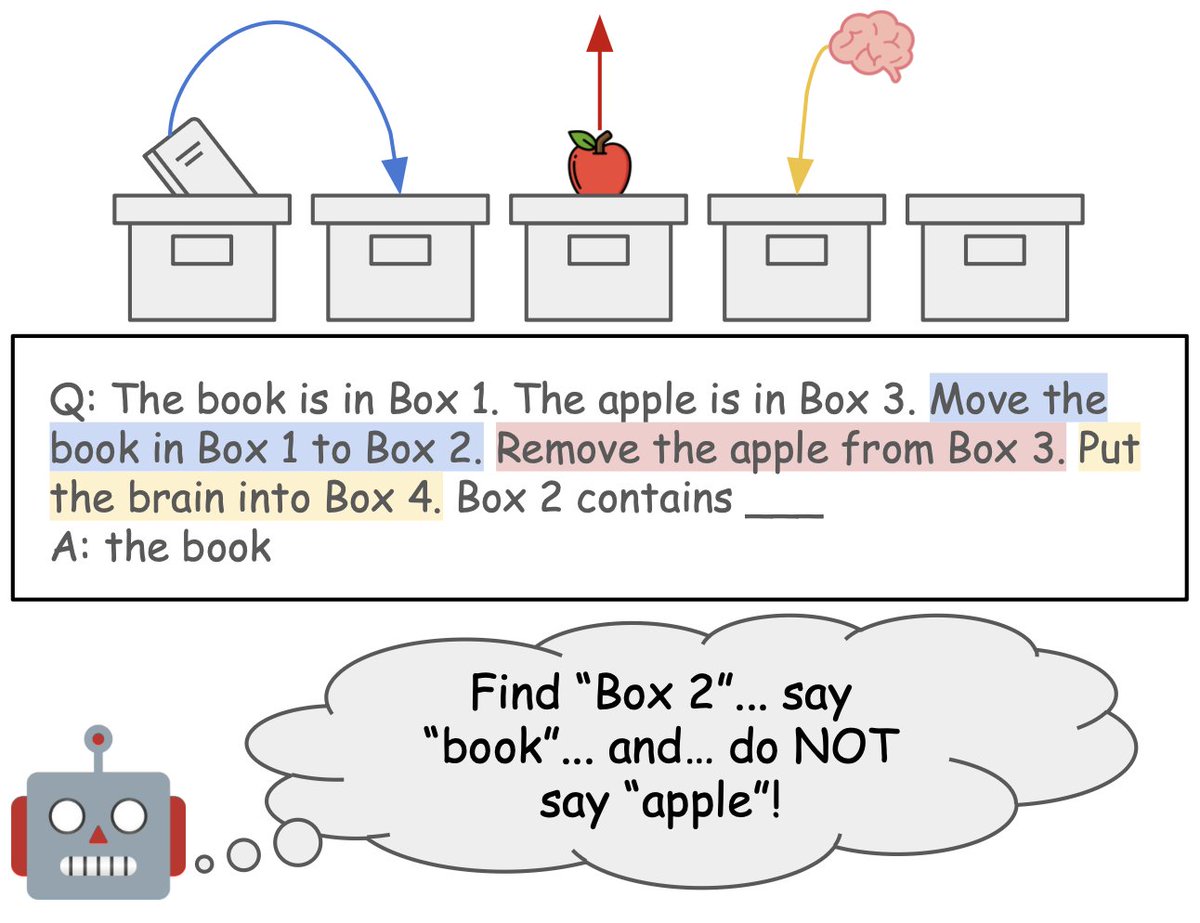
How do language models track entities across state changes? When tracking objects in different boxes, do they cumulatively build up a global state of what’s in every box? How do they add objects or remove objects (i.e. Entity Unbinding)? Find out in our ICML paper! 🧵
📣 We’re proposing the first workshop on Interpretability for Science 🔬 at ICML 2026
We’re inviting expressions of interest from researchers willing to serve as PC members. If accepted, PC members would review a small number of submissions. Express your interest here https://t.co/QrbjGRGLZl
The workshop focuses on how interpretability techniques can be tailored to scientific foundation models to support discovery and real-world scientific impact. Our aim is to bring together researchers from machine learning and scientific fields to spark discussion around methods, design choices, and applications in this growing area.
We have five amazing invited speakers confirmed so far!
Organizing Committee: Yonatan Belinkov @boknilev, Ekdeep Singh Lubana @EkdeepL, Yaniv Nikankin @YNikankin, Chenhao Tan @ChenhaoTan, and Amirtha Varshin
I’ll be at the San Diego Alignment Workshop and @NeurIPSConf next week! @tianyunnn and I will be presenting our work on VLM conflicting information processing (https://t.co/LArVCOEdSb) at the workshop, including some new follow-up findings. Excited to reconnect with friends and meet new people:) DM me if you’d like to chat about LM/VLM interpretability!
My lab at BU is recruiting PhD students and possibly a postdoc this year!
We study humans & machines, centered around topics like meaning, generalization, evaluation methods and design, and the nature of computation and representation that underlie language and cognition.
🫴🫴
@DonatoCrisosto1@HuggingPapers@tommaso_mncttn@teelinsan@EmanueleRodola Hi Donato - really interesting work! If I understood correctly, SipIt needs access to hidden states at each token position for a given layer, right? Would it work if we only have the final token’s hidden representation?