What if inside every Transformer, there was a smaller, faster, and better one?
With Model Carving, we let gradient descent find it during training: up to 34% smaller, 1.6× faster decoding, and better than models trained with up to 1.7× the compute! 🧵
📝 Blog: https://t.co/9VAQRgk2SJ
📄 Paper: https://t.co/UYeJAUfC0F
💻 Code: https://t.co/xVIS32Vf02
w/ Pratyusha Sharma @pratyusha_PS!
I've been unsettled lately. Reading messages or papers feels like dissociating. Everything seems a bit alien, even if it's completely human. I've had a realization: When our simulations finally exited the Uncanny Valley, they brought the Uncanny with them. https://t.co/fdrKq6MkbM
1/ Excited to launch my lab as a new assistant professor at UNC–Chapel Hill (@uncsdis)! 🧠🤖🐟
We'll study Natural and Engineered Intelligence through simulation, data science and theory, working closely with experimentalists.
https://t.co/UdOHjuO5Jj
Sat has been one of my greatest inspirations. It is extremely empowering to work with someone so thoughtful, and his work has always been (and kept me) grounded in strong principles. Can’t wait to see how this lab pushes our understanding of intelligence!! (both natural and artificial :) 🧠🤖🐟
Looped Transformers are suddenly everywhere, but the idea isn't new! Check out how we got to today's looped LLMs, in the History of Recurrence guide I wrote for @askalphaxiv
For most international students, being denied a UK visa means losing the opportunity to study at a particular UK university. For many Afghan women, it means losing the opportunity to study altogether!
As someone who receives many applications from students from Iran and other countries who have offers from Ivy League universities but cannot get US visas and subsequently want to come to Oxford, I feel a rare sense of optimism and empowerment about humanity when these students get a chance to pursue their dreams
But for many women in Afghanistan who are banned from even go to secondary school, to get to study at a UK uni must incredibly life changing and to have your visa refused after coming this far must be heartbreaking :(
How can you sleep at night, @ShabanaMahmood? You, of all people, should understand the struggles of women and what it means to be given a chance at a better life
Also remember, this is the same Shabana Mahmood who dreams of a future where the "eyes of the state could be on us at all times", with her, I worry that we lose hope not just for afghan women but also democracy
What a sad day
So many people in the US don’t seem to understand that ICE has decided by themselves that whole classes of people are “illegal” based on (illegally!) reinterpreting/rewriting immigration policies. An example is PhD students overstaying their visa with a valid I20.
I supervised Eva during her UROP at MIT for two years. She is a brilliant researcher and a delightful person. This is unconscionable. I cannot imagine what necessitated her detention. @AndyKimNJ@CoryBooker@GovSherrillNJ
An independent, 100% human, claimed proof of RH (only 940 pages long). (Seems like this was finished months ago, but has been privately being reviewed.)
https://t.co/xz4sFkNesk
@yoavgo@TuhinChakr Cliches aren't the only issue. It makes you work hard to understand, but often literary awards go to writing that makes you work hard. It's a deliberate choice to write that way! If it's not a deliberate choice, the challenge stops being interesting.
AI technical writing is bad for different reasons. By recognizing the same cliches, you learn to avoid it because your life is short and you don't want to waste your time on Earth. That's different from whether writing deserves an award.
"If this was good writing before AI, it's good writing after AI." No, because good writing avoids cliche. And cliches change! When Shakespeare wrote, "All that glitters is not gold," he was a genius. When you copied it in an essay in middle school, you were leaning on cliche.
When I heard "all science will be done by AI", I assumed it meant "AI will exceed human scientist capabilities", not "human scientists will give up on their work once AI slop overwhelms the systems that science relies on to function, so only AI science still stands"
The oddest intellectual position I have encountered over the last decade is the refusal of so many to believe that the current version of Pangram is incredibly good at avoiding false positives (i.e., flagging a human-written text of some length as AI-generated). It is not terribly hard to trick Pangram into false negatives (i.e., classifying an AI-generated text of some length as human-written) with “humanizing” tools and some careful editing. But the other way around? Nearly impossible.
For two weeks, I have been running experiments in many different situations for a new paper I will circulate tomorrow (and because, as an editor, I care a lot about the answer). Not in a single case did a human-written text of reasonable length score above 10% for AI generation. And, yes, many the texts I used (including mine!) are from ESL writers.
Frankly, the counterarguments I have read over the last week here on X (and the papers linked to “back them up”) are childish in the extreme.
If you think that false positives at Pangram are, as of November 16, 2026, a concern, you are lying to yourself.
@Miles_Brundage #1 is the only concern if you trust the government response to be directed by experts who want to enforce the law or address concerns publicly. Otherwise, #2 is a concern. (#3 is just Influencer Disease.)
@TongLiu15731072@roydanroy I suspect you might be able to, but you would have to know how the mechanism will be implemented in advance. But there are likely shared properties between emergent capabilities.
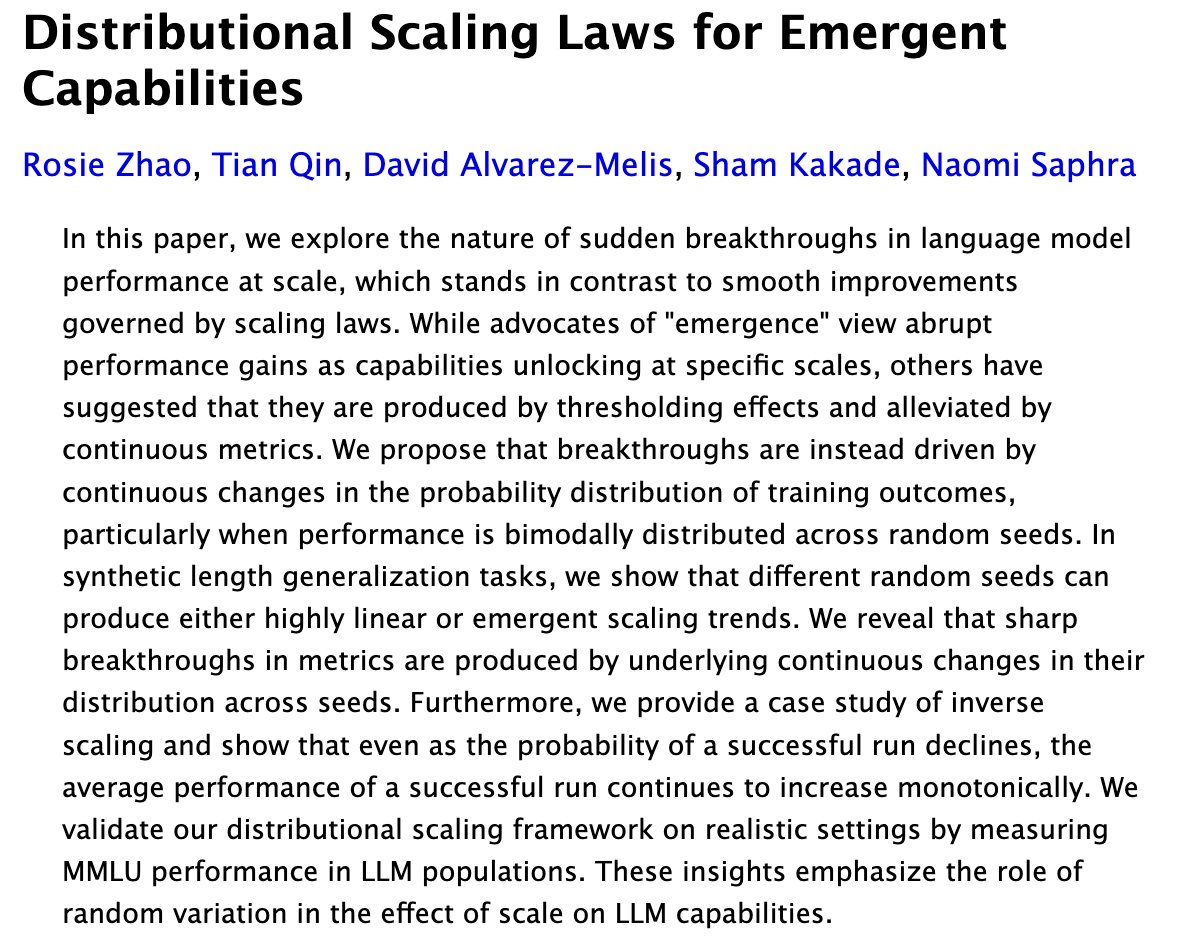
Ever looked at LLM skill emergence and thought 70B parameters was a magic number? Our new paper shows sudden breakthroughs are samples from bimodal performance distributions across seeds. Observed accuracy jumps abruptly while the underlying accuracy DISTRIBUTION changes slowly!