Just some personal thoughts now that the AI co-mathematician tech report is public...
First, I'm so excited to see the co-mathematician team's hard work out for the world to preview. 💪+🦾=🔥 The team has built a system for mathematicians, with mathematicians. The fact it's now top of the FrontierMath leaderboard is a cherry on top, not the goal. Vibes and utility >> benchmarks.
The system is currently being tested with a small number of professional mathematicians. It is not widely available, but I personally hope that, one day, we can get even more capable systems into the hands of all mathematicians.
It's been a privilege working with this team at Google DeepMind since January.
Props to @dhhzheng, @ADaviesAI, and @pushmeet for their leadership. Give them all a follow to not miss exciting upcoming work.
The future of Math is mathematicians and AI agents working together.
Very pleased to introduce @GoogleDeepMind's AI co-mathematician: a multi-agent system designed to actively collaborate with human experts on open-ended research mathematics.
Mathematicians testing the agent across areas as diverse as group theory, Hamiltonian systems, and algebraic combinatorics have reported impressive results.
In autonomous mode evaluation on the rigorous FrontierMath Tier 4 problems, AI co-mathematician scored an unprecedented 48% — a new high score among all AI systems evaluated.
Hands down a cargo e-bike has been my best SF purchase since covid.
The freedom to ride by something and think, "oh lets stop there and get ice cream" or "oh hey that matcha place doesn't have a line right now" and be able to park for free right in front of it opens the door to 10,000 adventures with my kids that I will never forget.
Get an angle-grinder resistant lock and bike insurance and you are golden.
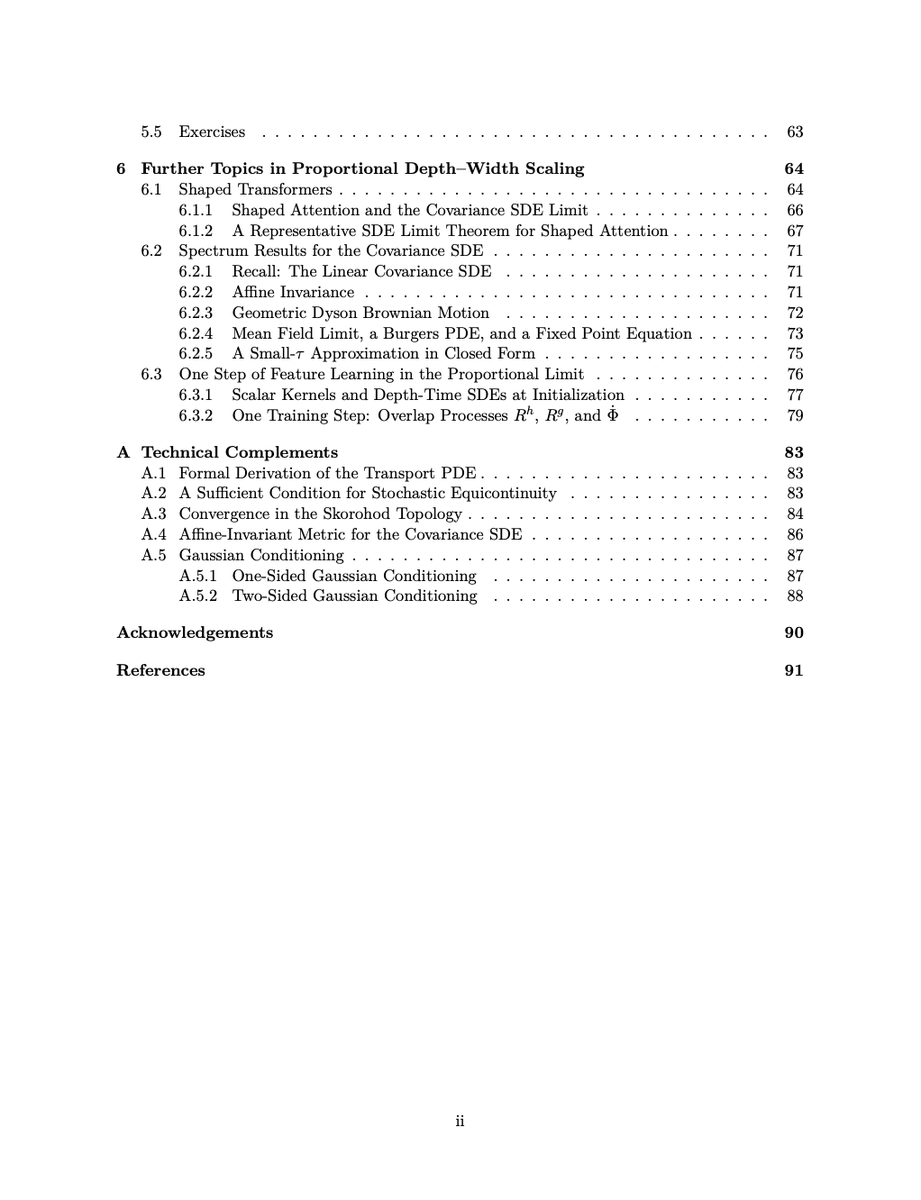
I wrote up some lecture notes (with help from GPT) based on a topics course on deep learning theory that I taught at Waterloo last fall. They focus on scaling limits of neural networks. Comments and corrections are very welcome.
https://t.co/aO0IK9BLMJ
I’m incredibly excited to finally introduce Geodesic Intelligence @Geodesiclab.
We started Geodesic with an ambitious goal: build AGI for drug discovery and find the shortest path from biology to medicines.
We’re bringing together frontier AI, biological foundation models, and experimental science, and building the full stack from intelligence to medicines.
Today, we’re launching NovaDDE and NovaAtom-Lite-Preview.
This is just the beginning.
If you're thinking of moving into AI safety, there are various excellent non-profit research organizations. They generally pay very well and some try to match AI lab salaries. They have generous compute budgets (and increasing fast).
Here's a quick list of those I'm most familiar with:
@redwood_ai@ApolloResearch@farairesearch
METR
ARC
UK AISI (UK Government, lower pay but very valuable)
Resolution
@CAIS
My organization (https://t.co/Pwkw13jeFD) will also run a hiring round soon.
Navier Stokes represents a new moment for AI.
Hopefully, OpenAI will turn its attention to problems of societal importance, like DeepMind has, and to the mathematical foundations of AI alignment, which are sorely lacking.
With AlphaFold we mapped the protein universe - now with AlphaGenome Atlas we’re charting the human genome. It can predict the impact of all 9 billion possible single-letter DNA variants, helping scientists better understand disease. Freely available for academic research: https://t.co/Gsy6lW3z6O
The developments of the last few weeks are a powerful reminder of the sheer pace of AI progress. It highlights the urgent need for us to build better coordination mechanisms to govern and harness this technology for the benefit of human civilization.
1/5 🧬 Today, our team @GoogleDeepMind is taking another step on our mission of deciphering the genome. We are releasing AlphaGenome Atlas, a massive (petabyte-scale) resource containing AlphaGenome predictions for every possible single-letter DNA change in the human genome — 9 billion in total.
https://t.co/Lf9DWRfWCu