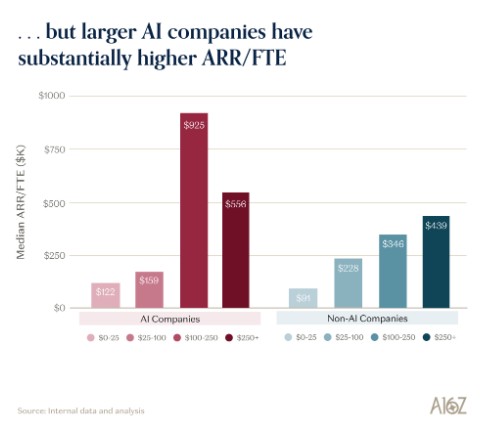
Your AI company might be less competitive than a non-AI company.
In AI, power laws are everywhere and leverage compounds fast.
A small number of AI companies achieve staggering ARR per employee, while everyone else becomes increasingly disposable, sometimes even worse than non-AI companies.
If you’re not on the steep part of the curve, you’re getting pushed out.
This might be the most comprehensive skills collection out there.
(Skills are reusable capabilities that AI agents can plug in to handle specific tasks.)
Over 4,500 unique agent skills have been added via 𝚗𝚙𝚡 𝚜𝚔𝚒𝚕𝚕𝚜 from major products across the ecosystem:
• @neondatabase
• @remotion
• @stripe
• @expo
• @tinybird
• @supabase
• @better_auth
Find new skills and level up your agents at https://t.co/wcRHxRUm9u
If people are still debating latency, interruptions, and glitches in voice AI apps, it means voice is still being treated as a keyboard replacement, rather than enabling something that was previously impossible in these apps.
The voice mode for AI apps is still bad:
Claude: Still makes me tap the screen to talk and doesn’t support hands free mode. Also tends to be extremely terse in its responses. Actually suggested I go back to text chat to continue the conversation.
Gemini: Voice mode seems to have no access to memory or my Google Drive - knows nothing about me.
Such a missed opportunity.
The reason voice AI applications have not truly taken off is that most of them treat voice as a substitute for keyboard input, rather than enabling something that was previously impossible. As a result, the value they create is limited.
At the same time, voice has many built-in sources of friction. Speaking is exposed, continuous, and requires permission from the surrounding environment. This means voice has to be significantly better than typing for people to be willing to change their behavior.
The key to voice AI lies in finding scenarios where voice is indispensable, such as driving or exercising, or in creating experiences that are fundamentally different once voice is added, like voice-based companionship.
4 hard lessons from Browser Use building agents
1️⃣ Start with freedom, then add constraints
Most agent failures come from limited action spaces, not weak models. Assume the model can do almost anything. Give it freedom first, then restrict behavior with evals, safety, and policies. This scales as models improve.
2️⃣ Expose low-level control, not fragile abstractions
High-level primitives like click or scroll encode assumptions and break easily. Expose raw control surfaces such as browser protocols or system APIs. Human-level action spaces let the model adapt and recover when things fail.
3️⃣ Require explicit completion
Stopping when the model stops calling tools leads to premature exits. Autonomous agents should only terminate when the model explicitly calls a done tool to signal completion. This forces deliberate task closure instead of implicit guessing.
4️⃣ Keep large state ephemeral
Browser state and similar data grow too large to keep in context. Long histories cause confusion and hallucinations. Keep only the most recent states and discard older ones. Recency matters more than completeness.
90% agents fail because they remember too much.
After reading this paper, I summarized it into 5 practical context-engineering lessons:
1️⃣ Context should grow in spikes, not lines
Let the agent explore freely, then aggressively collapse that exploration into a compact state. Repeat. Long flat context accumulation is the root cause of slow, confused agents.
2️⃣ Compression must be an explicit control primitive
Summarization is not a side effect. It is a deliberate action with clear boundaries: what gets kept, what gets destroyed, and where the result is stored. If compression is optional, it will not happen.
3️⃣ Discard reasoning once it has paid its rent
Intermediate thoughts are scaffolding, not assets. After they produce a validated decision or insight, they should be removed. Keeping them actively harms future reasoning.
4️⃣ Over-compression is cheaper than under-compression
It is usually better to risk re-exploring a small detail than to drag a bloated context through every future step. Token pressure silently degrades agent behavior long before it fails outright.
5️⃣ Only compress after the agent can restate the problem cleanly
A simple test: if the agent cannot explain the state in a few sentences, it has not actually finished thinking. Compression before clarity causes loops and hallucinated certainty.
I summarized this paper into 5 practical context-engineering lessons I actually use
1️⃣ Don’t treat context as a one-off prompt
Context should be structured and persistent, not a string you glue together each time. That’s how you get debuggability, replayability, and auditability.
2️⃣ Separate long-term and short-term context
History, long-term memory, and the current scratchpad serve very different lifecycles. Mixing them is how systems become fragile.
3️⃣ Design around the real constraints
Token limits, stateless models, and probabilistic outputs aren’t edge cases. Your context selection and compression strategy has to start from these constraints.
4️⃣ Build a pipeline, not prompt spaghetti
Context construction, injection, and evaluation should be explicit stages. Ad hoc prompt stitching doesn’t scale past demos.
5️⃣ Keep humans in the loop when it matters
Humans shouldn’t just consume outputs. They should validate, correct, and contribute to context itself if you want reliability in production.
New on the Anthropic Engineering Blog: Demystifying evals for AI agents.
The capabilities that make agents useful also make them more difficult to evaluate. Here are evaluation strategies that have worked across real-world deployments.
https://t.co/UD0yGglTU0