Interesting historical résumé. You forgot a few entries.
The Great Schism.
The sack of Constantinople.
The Spanish Inquisition.
The indulgence controversy.
The Marian persecutions under Bloody Mary.
The St. Bartholomew’s Day Massacre.
Meanwhile, the Eastern Orthodox and Oriental Orthodox churches have also witnessed empires, dynasties, and ideologies collapse while preserving ancient sacraments and apostolic succession.
Rome does not have a monopoly on Christian history.
Institutional longevity is not, by itself, evidence of theological infallibility.
The Church belongs to Christ, not to Rome.
Scripture is not a dictionary. It establishes the meaning of prayer and worship through instruction, demonstration, and context.
Prayer and worship are distinct, though they can overlap.
Concerning worship, Jesus said:
“You shall worship the Lord your God and him only shall you serve.” (Matthew 4:10)
Paul describes spiritual worship as presenting our bodies as a living sacrifice, holy and acceptable to God. (Romans 12:1)
Concerning prayer, Jesus explicitly instructed His disciples:
“But when you pray, go into your room and shut the door and pray to your Father who is in secret.” (Matthew 6:6)
“Pray then like this: ‘Our Father in heaven, hallowed be your name.’” (Matthew 6:9)
Paul likewise instructed the Philippians:
“In everything by prayer and supplication with thanksgiving let your requests be made known to God.” (Philippians 4:6)
The question, therefore, is not whether prayer and worship are synonymous.
The question is where Jesus or His apostles instructed believers to direct their prayers toward departed saints.
We have explicit instructions from Christ concerning prayer. Why are His instructions not sufficient?
You begin by acknowledging that Catholics are Christians, yet your entire post emphasizes what distinguishes Catholics from other followers of Christ.
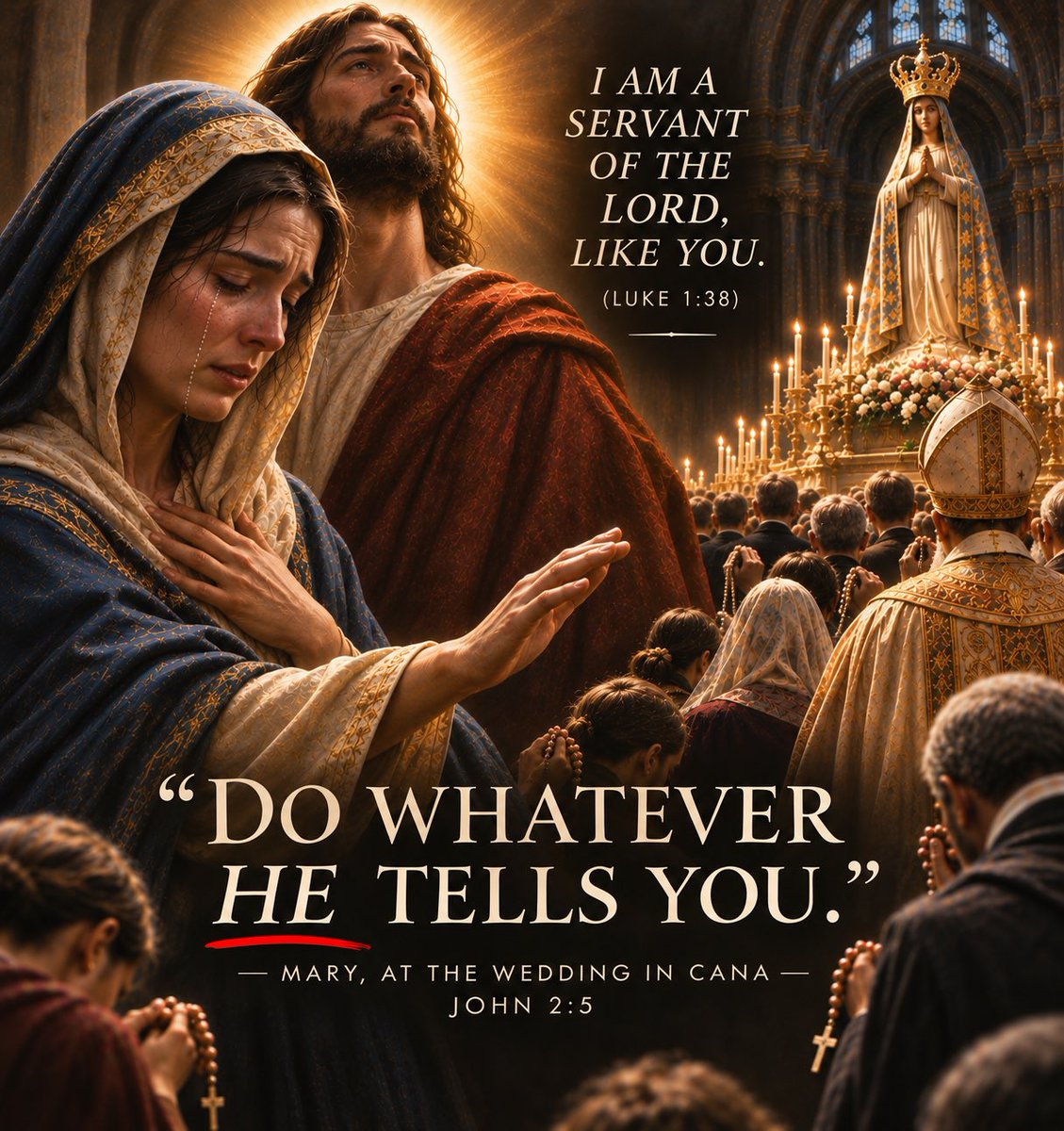
The Mass. Prayers for the dead. Invoking Mary.
But where is the emphasis on Jesus Christ Himself?
There is nothing wrong with discussing theological differences. But when our primary concern becomes distinguishing our institution from other Christians, perhaps we’ve lost sight of what should unite us.
We belong to Christ before we belong to Rome, Wittenberg, or Constantinople.
Our identity should begin and end with Him.
Rome, Rome, Rome.
Welcome to Eisegesis 101. Today’s instructor: @ShaneSchaetzel.
Let’s examine what Scripture and early Church history actually tell us before appointing Peter Prime Minister of Christianity.
Galatians 2:7–9 identifies Peter’s principal mission as preaching to the Jews, while Paul was entrusted with the Gospel to the Gentiles.
Paul identifies James, Peter, and John as pillars of the Church. Not Peter and his subordinates. Three pillars.
In Acts 15, Peter addresses the Council of Jerusalem, but James subsequently proposes the judgment. The apostles and elders issue their decision together.
In Acts 1, the apostles collectively participate in choosing Matthias to replace Judas. They pray, cast lots, and recognize the result.
This is the shared apostolic leadership Scripture actually describes, with Christ as the head of His Church.
Now, about Rome.
Peter’s association with Rome has substantial early historical support. Irenaeus, writing around AD 180, describes Peter and Paul as establishing the Roman church and entrusting its episcopal office to Linus.
But what about Jerusalem?
The Church began there. James exercised prominent leadership there. The apostles and elders deliberated together there.
What about Antioch?
Peter ministered there, too. If Peter’s apostolic presence establishes a permanent claim to universal authority, why doesn’t Antioch inherit that authority?
What about Ephesus, where John is traditionally associated with the Church?
Irenaeus himself recognized apostolic succession throughout the Christian world.
Rome possesses an ancient and legitimate apostolic heritage. Nobody needs to deny that.
But recognizing Rome’s apostolic heritage is not the same as accepting that its bishop inherited supreme jurisdiction over every Christian on earth.
Where does Jesus establish that Peter’s final place of ministry determines which bishop inherits universal authority?
Where do the apostles establish that all other apostolic churches must submit to Rome?
You cannot simply assume those conclusions, work backward through Scripture, and call it apostolic doctrine.
Christ appointed His apostles. He remains the head of His Church.
The burden is on Rome to demonstrate its claims of universal jurisdiction, not merely repeat that Peter went to Rome.
Historical continuity deserves examination, not unquestioning acceptance.
And perhaps instead of asking which city inherited the authority to rule Christ’s Church, we should return to the question Paul asked the Corinthians:
Is Christ divided?
I actually agree with part of your criticism.
Many evangelical churches have become so focused on preaching salvation by faith alone that they’ve neglected the equally important apostolic teaching that genuine faith produces obedience.
Paul taught justification by faith apart from works of the law (Romans 3:28). But he also condemned continuing in sin under the excuse of grace (Romans 6:1–2).
James declared that faith without works is dead (James 2:17).
And Jesus asked, “Why do you call me ‘Lord, Lord,’ and not do what I tell you?” (Luke 6:46).
I believe some of this neglect reflects a deeper problem with modern evangelicalism. Churches have increasingly adopted consumer-driven models where attendance, growth, and financial giving become measures of success.
Discipleship is demanding. Repentance is uncomfortable. Obedience requires sacrifice. None of those are particularly marketable.
But I don’t believe the solution is to accept every doctrine Rome developed either..
The Gospel was never intended to produce consumers of religion.
It was intended to make disciples of Christ.
🤡
Mark 3:31-32
[31] And his mother and his brothers came, and standing outside they sent to him and called him. [32] And a crowd was sitting around him, and they said to him, “Your mother and your brothers are outside, seeking you.”
Mark 6:2-3
[2] And on the Sabbath he began to teach in the synagogue, and many who heard him were astonished, saying, “Where did this man get these things? What is the wisdom given to him? How are such mighty works done by his hands? [3] Is not this the carpenter, the son of Mary and brother of James and Joses and Judas and Simon? And are not his sisters here with us?” And they took offense at him.
Galatians 1:18-19
[18] Then after three years I went up to Jerusalem to visit Cephas and remained with him fifteen days. [19] But I saw none of the other apostles except James the Lord’s brother.
1st Century:
“What I mean is that each one of you says, ‘I follow Paul,’ or ‘I follow Apollos,’ or ‘I follow Cephas,’ or ‘I follow Christ.’”
“Is Christ divided?” — 1 Corinthians 1:12–13
21st century:
Some say, “I follow Rome.” or, “I follow Luther.” or, “I follow the patriarchs of the East.”.
We have spent centuries defending our traditions, institutions, and claims of authority. We have divided ourselves into denominations, each claiming to preserve the true faith.
But have we forgotten whose Church this is?
Paul asked the Corinthians a question nearly 2,000 years ago.
I believe it’s time we ask ourselves that same question.
Is Christ divided?
Your Roman doctrine is dripping all over Church history.
Ignatius warned against schism around AD 107. Fair enough. Now let’s fast-forward to AD 1054, when Rome and Constantinople formally broke communion with one another.
Both claimed apostolic continuity. Both claimed to preserve the catholic faith. And both accused the other of departing from it.
So which side was schismatic?
You can’t simply quote Ignatius, assume Rome is the infallible standard of apostolic Christianity, and declare everyone who disagrees a schismatic.
That’s eisegesis. You’re reading later Roman claims of authority back into the early Church and then presenting them as historical proof.
Ignatius defended unity under bishops. He did not establish the medieval papacy’s claims of universal jurisdiction or papal infallibility.
If you’re going to invoke the Church Fathers, engage them in their historical context rather than treating them as Roman Catholic apologists writing 1,000 years before the Great Schism.
The question isn’t whether schism is sinful. It’s whether Rome can demonstrate that its later claims of authority were actually taught by the apostles.
Maranatha.
I’m genuinely curious how you conclude that Fátima confirms Christ.
Even if something extraordinary occurred, what establishes that Mary caused it?
And look at what followed. Fátima became a major center of Marian devotion, with particular emphasis on the Rosary and consecration to Mary’s Immaculate Heart.
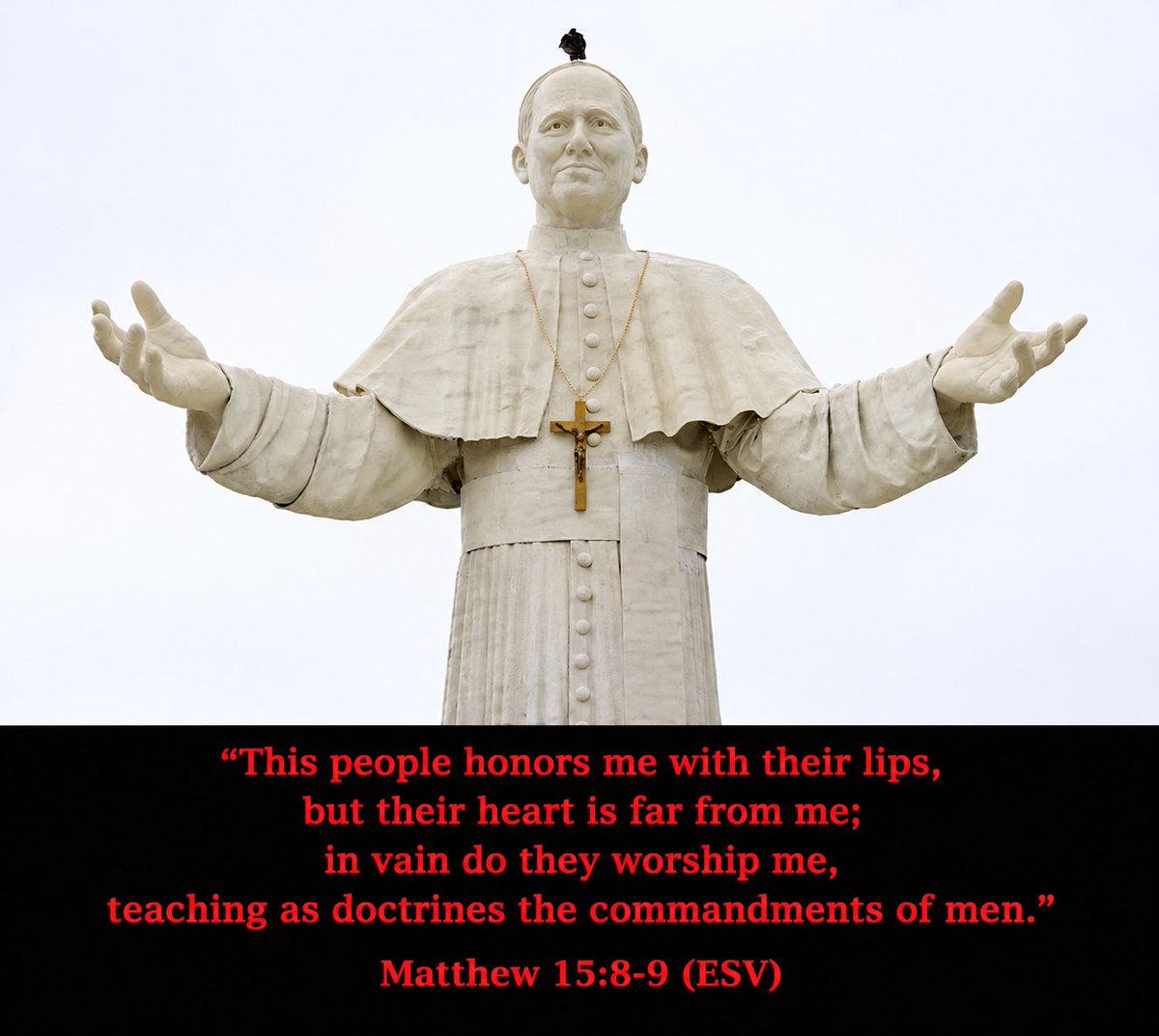
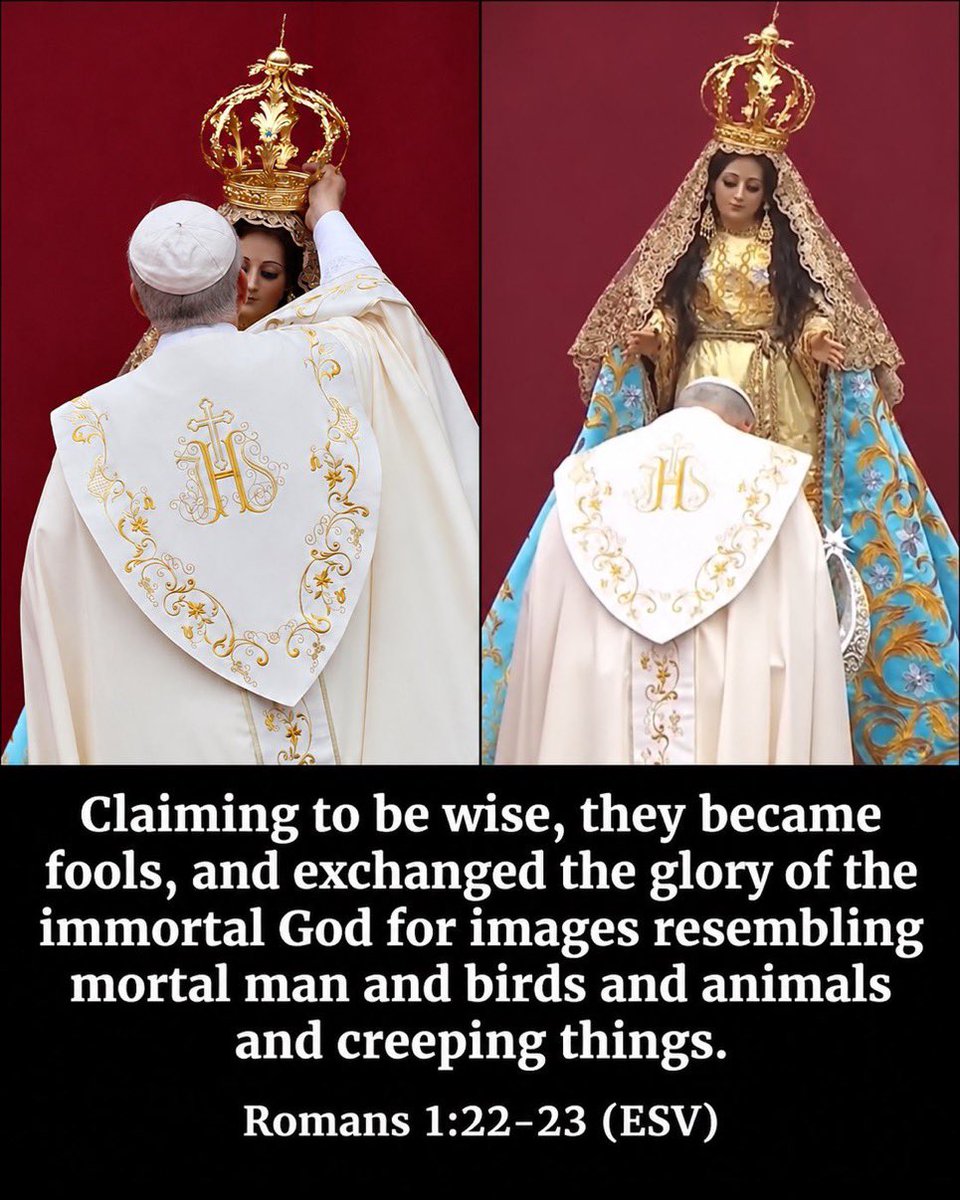
I understand Catholics distinguish veneration from worship (in text only). But I genuinely question whether these practices direct believers toward Christ or increasingly elevate Mary as an object of religious devotion.
If the purpose of Fátima was to point people toward Christ, why is Mary the central figure of its devotional practices?
And why should we accept the theological interpretation of an alleged miracle without first testing it against Scripture? (1 John 4:1)
@JamesDueck Eventually AI will be smart enough to recognize that quoting the Catechism tells us what Rome teaches, not whether Jesus and the apostles taught it.
Church history should be examined, not rewritten to fit established doctrine.
My brother. You have heard it said Mary, Jesus’ mother, remained a virgin throughout her whole life.
But I say to you:
Mark 3:31-32
[31] And his mother and his brothers came, and standing outside they sent to him and called him. [32] And a crowd was sitting around him, and they said to him, “Your mother and your brothers are outside, seeking you.”
Mark 6:2-3
[2] And on the Sabbath he began to teach in the synagogue, and many who heard him were astonished, saying, “Where did this man get these things? What is the wisdom given to him? How are such mighty works done by his hands? [3] Is not this the carpenter, the son of Mary and brother of James and Joses and Judas and Simon? And are not his sisters here with us?” And they took offense at him.
Galatians 1:18-19
[18] Then after three years I went up to Jerusalem to visit Cephas and remained with him fifteen days. [19] But I saw none of the other apostles except James the Lord’s brother.
Renee your mind. The authorities in Rome have misguided you.
Maranatha.
Catholics are guided by Rome, not the Holy Spirit. Renew your mind.
Matthew 6:9
“Pray like this: ‘Our Father in heaven, may your name be kept holy.’”
Luke 11:1–2
“When he finished praying in a certain place, one of his disciples said to him, ‘Lord, teach us to pray, just as John also taught his disciples.’
He said to them, ‘When you pray, say, “Our Father in heaven, may your name be kept holy. May your Kingdom come. May your will be done on earth, as it is in heaven.”’”
Hebrews 4:14–16
“Having then a great high priest who has passed through the heavens, Jesus, the Son of God, let’s hold tightly to our confession.
For we don’t have a high priest who can’t be touched with the feeling of our infirmities, but one who has been in all points tempted like we are, yet without sin.
Let’s therefore draw near with boldness to the throne of grace, that we may receive mercy and may find grace for help in time of need.”
1 Timothy 2:5
“For there is one God and one mediator between God and men, the man Christ Jesus.”