24,064 node identities, 900,000 validators and 11+ years with no chain halt.
No owner, no list, no counterparty risk and no off switch.
@ethereum is the world computer.
Tom Lee on why institutional money HAS to buy $BMNR instead of $ETH directly.
Large asset managers "can't buy ETH, the native token, because they would actually have to maintain a crypto wallet."
But they can buy equities. Bitmine is in the Russell 1000 and trades on NYSE - "the only Ethereum large cap stock they could buy today."
The equity investor universe is $240T. The native crypto investor universe is "a couple hundred billion."
The numbers on where the big money flows is pretty clear.
FT @fundstrat@BitMNR.
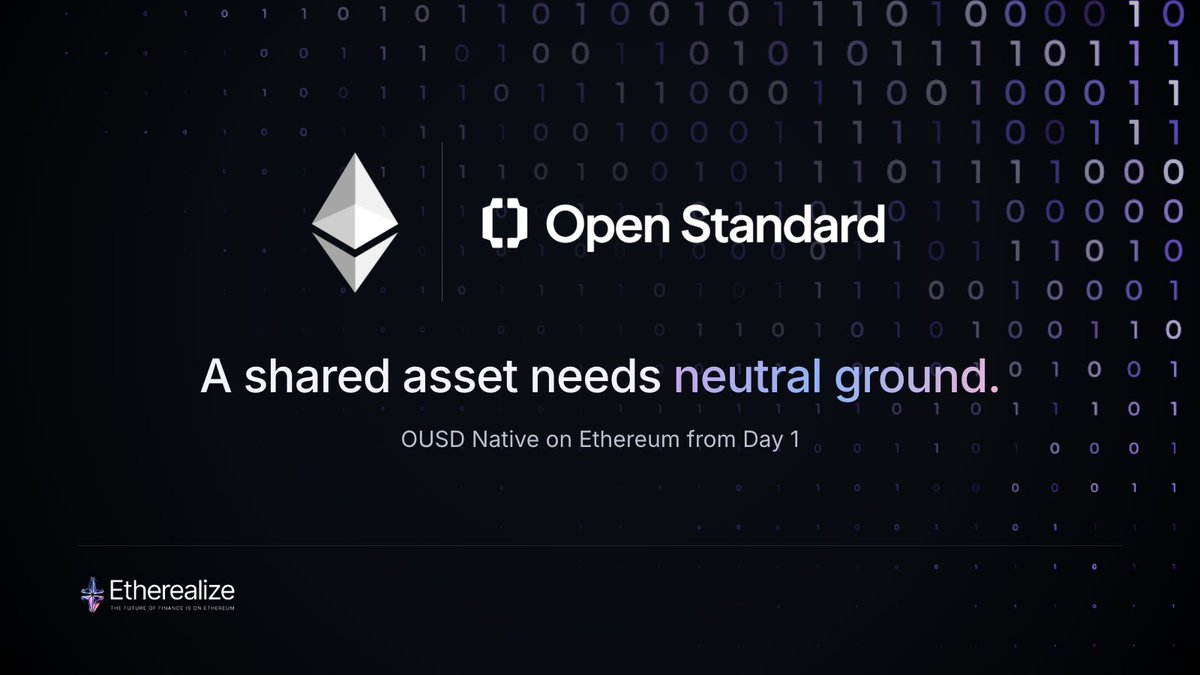
A shared asset needs neutral ground.
That's why @openstandard is launching natively on @ethereum from day 1.
With more than 140 organizations, including Visa, Mastercard, Stripe, BlackRock, and BNY, Open Standard is another example of institutions converging on the network they trust for the future of finance.
Security. Credible neutrality. The deepest stablecoin liquidity. The leading tokenized asset ecosystem. The largest developer community.
Network effects compound and can't be replicated.
Every institution building on Ethereum makes Ethereum the obvious choice for the next institution.
1/ We’re excited to announce the close of @ethereuminsti's initial ecosystem funding round and supporter coalition, with broad participation and support from individuals and entities focused on driving institutional adoption of @ethereum.
Our ecosystem funding round is anchored by @BitMNR, @Sharplink, Ethereum co‑founders @ethereumJoseph , and @MihaiAlisie, alongside a larger group of individuals and crypto‑native institutions.
Ethereum is for shipping.
Here are some of the things the Ethereum ecosystem launched, upgraded, and announced over the past month.
0/ @RobinhoodApp launched Robinhood Chain (@RobinhoodCrypto) on mainnet, an Ethereum Layer 2 built on the @arbitrum stack, enabling 24/7 trading of tokenized stocks and ETFs for users in over 120 countries through Robinhood Wallet. The network surpassed $1B in DEX volume in just over a week.
1/ @aztecnetwork achieved Stage 2 rollup decentralization under @l2beat's framework, removing governance control over its core protocol and taking another step toward trust-minimized infrastructure.
2/ @VitalikButerin shared updates to Ethereum's evolving technical roadmap, outlining the next phase of Lean Ethereum and the protocol's long-term direction.
3/ @ethlabs_org launched as a non-profit R&D lab for Ethereum and ETH. Their mission is to make Ethereum the settlement layer of the global economy.
4/ @ethereuminsti launched as an independent non-profit dedicated to accelerating the institutional adoption of Ethereum, its L2s, applications and overall ecosystem.
5/ @aave introduced Stable Vaults, fixed-rate stablecoin yield vaults designed for seamless integration into consumer applications.
6/ @zama launched the First DeFi Yield Venue for Confidential USDC (cUSDC) in partnership with @Morpho and @SteakhouseFi, bringing private stablecoin lending to Ethereum.
7/ @swissknifexyz launched a new Privacy Protocol Tracker, making it easier to compare fees, wait times, supported chains, and other metrics across Ethereum privacy protocols.
8/ Global tickets for @EFDevcon 8 went live, alongside speaker applications for this year’s conference in Mumbai, India.
9/ @Optimism and @toss__official signed an agreement to explore bringing the Korean Won onchain, expanding blockchain-based financial infrastructure for one of South Korea's largest fintech platforms.
10/ @OctantApp completed Epoch 12, its first full quadratic funding round using a zero-knowledge vote coprocessor and new voting application, distributing 88.1 WETH to Ethereum public goods projects.
11/ @0xprivacypools launched the trusted setup ceremony for Privacy Pools V2 ahead of its next protocol deployment.
12/ Gwei Name Service launched an ownerless, immutable Ethereum naming system built without administrative ownership.
13/ @ammalgam launched on Ethereum mainnet, introducing oracle-free lending without impermanent loss.
14/ @lodestar_eth added support for Fast Confirmations, allowing Ethereum node operators to confirm transactions in a single slot using validator attestations.
15/ @PrivacyBoost introduced preconfirmations for private transfers, allowing transfers to be treated as usable in around one second before final settlement.
16/ The @ethereumfndn published Ethereum Basics for Governments and Institutions, a new primer introducing Ethereum as a credibly neutral digital public utility for policymakers and enterprise leaders.
17/ @OndoFinance launched @OndoPerps, enabling tokenized stocks to be used as collateral for perpetual futures across equities, commodities, and indices.
18/ @base introduced Base Privacy, giving enterprises infrastructure to trade, pay, and settle onchain with built-in confidentiality and compliance features.
19/ @BGDA_UK launched BAGEY, a natively tokenized UK regulated fund on Ethereum where the blockchain serves as the legal register of record.
20/ @sparkfinance launched the Stablecoin FX Layer on @Uniswap v4, introducing shared liquidity infrastructure that lets stablecoins access a common liquidity layer.
21/ @Trueo_ launched user-created prediction markets, allowing anyone to create a market by asking a question and letting participants trade on the outcome through a fully onchain prediction market.
22/ @kpk_io integrated @OpenCover Covered Vaults, allowing depositors to add opt-in onchain insurance to curated vaults, with coverage underwritten by @NexusMutual.
23/ @PropellerSwap launched Turbine on Ethereum mainnet, enabling large trades to settle with lower slippage by sourcing liquidity across onchain, offchain, and peer-to-peer markets.
24/ Hosted by @web3privacy, the Neocypherpunk Summit brought together around 1,000 builders and researchers in Berlin to advance privacy, open-source infrastructure, and human rights.
25/ @eth_systems launched as a company building modular privacy infrastructure for institutional Ethereum.
🔥 ETHSYSTEMS Just Launched — Backed by Major Ethereum Players!
ETHSYSTEMS has officially appeared with strong backing from:
- Bitmine (Ethereum Treasury – BMNR)
- Sharplink (Ethereum Treasury – SBET)
- Joe Lubin (Ethereum Co-founder & ConsenSys CEO)
This continues the trend of big institutional players doubling down on Ethereum infrastructure following Ethlabs.
#Ethereum #ETHSYSTEMS #Institutional
Today we're launching EthSystems.
We build confidential systems for institutional Ethereum.
Institutions want to use Ethereum, but one of the biggest problems is the lack of built-in, modular privacy tools.
We were the Ethereum Foundation's Institutional Privacy Task Force (IPTF) for the past year. We had hundreds of conversations with central banks, regulators, tier-one banks, and asset managers, shipping open source work the whole time.
Wall Street has found crypto as an asset class, but not yet as commercial infrastructure. Institutions want to run real flows on Ethereum: stablecoins, tokenized assets, settlement. These are businesses with billions of dollars on the line, and no bank will operate in full public view. On a public ledger, confidentiality is the hard part: each party to a transaction should see what it has a right to see, and nothing more.
We have a year of proof of work: private bonds, confidential stablecoin transfers, private settlement across chains, the Ethereum Privacy Map, and more. All with protocol specs and security properties, at our website.
We've spent a decade working on privacy in crypto. We know there's no silver bullet. Different use cases need different systems, each designed, specified, and hardened properly, and someone has to do that work. That's why EthSystems exists.
We're an independent, for-profit company, backed by long-term Ethereum-aligned investors. This is a decade-long transition, and we aren't going anywhere.
If you're an institution that wants to build on Ethereum, talk to us. We're hiring: BD in New York, protocol engineers, ops: [email protected]
🔥 Ethereum Staking Continues to Show Strong Momentum!
According to the latest data, Ethereum’s staking ratio has risen to 33.47% over the past 30 days, with total staked value reaching $71.9 billion and more than 40.4 million ETH now locked.
This reflects growing community confidence in Ethereum — more ETH is being staked to secure the network and earn rewards. Staking not only strengthens network security but also helps reduce inflation and supports ETH’s long-term value.
#Ethereum #StakingETH #Crypto
🔥 Ethereum Dominates Stablecoins with 87% Market Share!
Ethereum currently controls 87% of total stablecoin supply.
The Artemis chart shows Ethereum’s massive lead over Solana, Polygon, Avalanche, and others.
This reinforces Ethereum’s position as the primary settlement layer for stablecoins, powering DeFi, RWA, and institutional flows.
#Ethereum #Stablecoins #DeFi
🔥 Vitalik Buterin Updates “Strawmap” — Ethereum’s Long-Term Roadmap
Key Highlights:
• “Lean Ethereum” is not a single upgrade but a collection of improvements rolling out over 3-4 years.
• This is Ethereum’s third major iteration (after The Merge).
• Almost every major protocol component will be replaced
Major Changes:
• Authentication via STARKs (instead of direct execution) — becoming the first enshrined core component.
• Full quantum resistance upgrades.
Ethereum is building a clear, ambitious long-term vision. What do you think will be the biggest impact?
#Ethereum #VitalikButerin #Strawmap #CryptoVN
Two weeks ago, Ethereum researchers met in Berlin to continue charting the protocol's long-term trajectory, following along discussions with client teams in Svalbard in April.
The updated strawmap is at https://t.co/9e2AQ6rhz6, and I attached a picture of it to this post.
My own high-level takeaways:
* "Lean Ethereum" is not a single one-shot upgrade, it is a collection of improvements that will come online to the Ethereum network over the course of three or four years. But make no mistake, this IS the third major iteration of Ethereum in the same way that the Merge was the second. Almost every major piece of the protocol will be replaced:
- Verification through recursive STARKs, rather than direct re-execution. Recursive STARKs become an enshrined first-class core component of the protocol
- Replacing everything quantum-vulnerable with quantum-safe alternatives
- Consensus: decoupled available chain and finality, one or two-round finality. Theoretically optimal security properties, simpler than today, and faster than today
- Multidimensional gas
- State: not just tree structure, but what *types* of state are available
- Changes to client architecture
...
At the same time, simplification, cleanup and future-proofing. And this will all be done in a way that minimizes disruption to existing application. We've done this before (the Merge), we can do it again.
* H-star (aka Hegota) is probably Ethereum's last thematically "pre-Lean" fork. Starting from I-star, most of everything we do will have a very strong "Lean" feel to it in one way or another.
* Privacy is no longer an afterthought, it is a first class goal. When designing Frames, the mempool, additions to the state tree, we explicitly ask the question "okay, how do quantum-safe, intermediary-free privacy protocol transactions go through this, and what is the overhead?"
* Formal verification of everything for security.
* FV also makes us much more comfortable with canonicalization (having pieces of the protocol that are directly defined as a piece of bytecode expressed in some language). evm-asm is being written in part to become a canonical proof system for the EVM.
* Quantum safety has shifted up a LOT in priority. This adds a lot of work (eg. finalizing a quantum-safe blobs design has become urgent; this work has already been ongoing for months)
* Probably the single most disruptive part of the plan is the changes to state. There is growing consensus around leaving present-day-style "dynamic state" mostly unchanged, but scaling it only a medium amount, and adding new types of state that are more scalability-friendly (eg. no need for builders to sync/store all of it) but more restrictive, and that will scale a large amount.
eg. possible Ethereum in 2030: 2 TB of present-day-style (dynamic) state, and 100 TB of new-style (scalable but restrictive) state
This "new-style" state would work very well for ERC20s, NFTs, many defi use cases, but not eg. highly "central" objects like Uniswap contracts, or onchain order books, or other complex things (which are crucial for Ethereum but which only take up a small percentage of state)
Hence, it will not be *necessary* to rewrite any apps, but it will be *very cost-effective* to eg. rewrite an ERC20 token into a newer design that uses a new type of UTXO storage that is currently being explored, so that it will have >10x lower txfees.
Design of these new state types (current ideas: keyed nonces, ring buffers, UTXOs, statically accessible state, temp state) is an area where we will need a lot of feedback from application developers (incl. privacy-friendly application developers) and probably several rounds of rethinking and iteration.
* In the context of a much larger total state size, we need to figure out the incentive issues around who stores this state and what motivates them to. Even saying "each node stores 1%" is not good enough - why do they store that 1% and why are they willing to serve it? This is being elevated as a first-class research area.
* Ethereum will need to have a "VM" other than EVM in one form or another - at the very least, we need something like leanISA for recursive STARKs - and the gains are large in exposing it to users so that we support programmable privacy and better scalability. Right now, the most likely contenders are leanISA and RISC-V.
My own ideal is that in this world, we adjust the protocol so that the EVM becomes a high-level-language compiler-level feature, and the protocol only "sees" RISC-V / leanISA directly. But this is still far away.
* Gas limit increases, blob increases and slot time decreases will happen many times over the next ~5 years. We expect a large gas limit increase with Glasterdam. Each step of increased scale or decreased slot time is a matter of getting to the point where it is safe to do it, which comes from a combination of client optimization and protocol changes.
Ethereum is CROPS.
Ethereum is scaling.
Ethereum is reinventing itself.
Onward.
🔥EthLabs is focused on building Ethereum into the safest, most neutral, and most sustainable settlement layer — the reliable hub where every chain, L2, RWA, stablecoin, and more can connect with confidence.
🔥This is exactly why EthLabs (and many builders) are all-in on Ethereum. Not to compete with other chains, but to create the unbreakable core foundation for the entire tokenized global economy!
#Ethereum #EthLabs #SettlementLayer #TokenizedEconomy
EthLabs Co-founder Ansgar Dietrichs on why Ethereum must be the central node of the on-chain global economy
“When we say the global economy is coming on-chain, I believe there are two very different ways that can play out. What I see as the default is you have this world of all these different, independent chains [with different use cases] and then you tie them all together with brittle links. Over time you try to derisk these links, but we’ve seen this multiple times in the past — bridges keep failing. Bridges between independent chains can only ever be so secure/robust because ultimately these chains don’t have a shared state.”
Ansgar continues:
“The alternative outcome is one where the global economy has one central node — that doesn’t mean that all the activity is on that node or Ethereum L1, but it means that there’s one central node that everything links back into. We are in a fundamentally better state for the world, when all these different parts of the economy can talk to each other trustlessly and without friction. And we really believe that it’s only Ethereum that can play that role. There is no second-best, neutral chain that actually has a shot at this. But that doesn’t mean it’s inevitable. We could just end up in the worse world.”
This is why EthLabs is focused on, as Ansgar puts it, “talking to the builders in Ethereum, figuring out what are the friction points — especially as we build toward bringing finance and these economic flows on-chain — and iteratively removing them and strengthening Ethereum.”
🔥Ethereum Institutional Just Launched — New Non-Profit to Accelerate Institutional Adoption!
@ethereuminsti officially announced:
Ethereum Institutional is an independent non-profit dedicated to driving Ethereum adoption across institutions, L2s, applications, and the entire ecosystem.
Mission: Bridge Ethereum with traditional finance, enterprises, funds, and banks — making ETH the go-to infrastructure for institutional finance.
This is a major bullish development for Ethereum, especially alongside:
- New stablecoins like OUSD building on Base & Ethereum ecosystem
- Growing RWA and tokenized assets
- Independent R&D labs like Ethlabs
Ethereum is building serious institutional-grade infrastructure. The institutional supercycle narrative just got stronger! 🔥
#Ethereum #InstitutionalAdoption #ETH
1/ Announcing Ethereum Institutional
An independent non-profit dedicated to accelerating the institutional adoption of Ethereum, its L2s, applications and overall ecosystem.
🔥🔥ETH Bull Case Summary – Right Now
ETH reserves on exchanges just hit All-Time Low: only 14.5 million ETH left.
Staking ratio hits ATH 32.7%, validator entry queue now ~49 days long
ETH/BTC at its lowest level since 2016
Glamsterdam devnet benchmarks 1.96 Ggas/s with parallel execution running smoothly, targeting 200 million gas per block (3.3x current capacity) in Q3 2026
UBS + Nethermind successfully complete compliant PoC on Sepolia for tokenized securities settlement
Ethlabs just launched — new independent R&D lab for Ethereum
Ethereum Foundation completes major reorganization and rolls out new Mandate & Treasury Policy
BitMine updates treasury holdings: 5,672,956 ETH (~4.7% of total supply)
Ethereum is currently in its strongest “supply shock + tech leap + institutional readiness” phase of all time...
#Ethereum #ETH #Crypto #Altcoin #Web3
🔥Ethereum Foundation Officially Announces New & Leaner Structure
Yesterday (June 23), @ethereumfndn released the official post: “The EF’s new structure”.
Key Changes:
Completed a months-long reorganization process
Reduced 54 people (approximately 20% of the EF workforce)
New structure consists of 5 main clusters:
- Protocol layer
- Access layer
- User layer
- Community layer
- Institutional layer
Goal: Focus resources more effectively on core missions, improve execution of Mandate & Treasury Policy (significant budget reduction for 2026 and shift toward an endowment model).
This marks a major restructuring to make the Ethereum Foundation leaner and more efficient as Ethereum continues to grow strongly in Layer 2, institutional adoption, and the upcoming Glamsterdam upgrade.
#Ethereum #EthereumFoundation #EF #CryptoVN
🚀Hot News: Ethlabs Just Launched — New Independent R&D Lab for Ethereum!
Yesterday, five former senior Ethereum Foundation researchers officially launched Ethlabs — a new non-profit organization focused on research & development to turn Ethereum into the global economic settlement layer.
Backed by @BitMNR , @Sharplink , @ethereumJoseph (Ethereum co-founder & ConsenSys CEO), and other major institutions.
Founders include: Ansgar Dietrichs, Barnabé Monnot, Caspar Schwarz-Schilling, Josh Rudolf, Julian Ma… (veterans who worked on major Ethereum upgrades).
Mission: Accelerate institutional adoption, improve core protocol, advance cross-chain, tokenized assets, AI + DeFi, and help ETH better capture value from Layer 2 activity.
This is a significant move, especially as the Ethereum Foundation undergoes personnel and funding changes. Many see it as a strong catalyst for Ethereum’s institutional supercycle narrative 🔥
#Ethereum #Ethlabs #InstitutionalAdoption