Most people watch Binance Blockchain Week for the next big crypto narrative.
They are busy watching prices, tokens, trading but they miss the bigger story.
The real shift happening in finance isn't necessarily another coin going up.
It's the infrastructure underneath money itself.
While retail investors obsess over whether Bitcoin is up or down today, major financial institutions are exploring blockchain, stablecoins, and tokenization to solve a much older problem:
Moving money is still painfully slow.
Cross-border transfers can involve multiple intermediaries, outdated systems, operating-hour restrictions, and settlement delays.
Blockchain-based rails can potentially change that by enabling money and assets to move and settle digitally, around the clock.
When banks start looking at blockchain as financial infrastructure, the conversation changes completely.
This isn't about replacing your banking app with a crypto wallet.
It's about asking whether the pipes underneath the global financial system still make sense in a world that operates 24/7.
And if institutions can use stablecoins and tokenized assets to make settlement faster, more programmable, and more accessible across borders, that's a much bigger development than another token making headlines.
This is why the quieter announcements at major industry events can matter more than the loud ones.
The flashy stuff gets the attention.
Infrastructure gets adopted.
And infrastructure is what eventually changes how money moves.
So if you're only watching crypto prices, you're watching the least interesting part of the transformation.
The bigger story is happening underneath the charts.
Do your own research.
#Binance #BinanceBlockchainWeek #LearnWithBinance #binanceacademy
What if Gen Z didn't actually plan on becoming investors so early in life?
Everyone says young people suddenly became obsessed with financial markets out of nowhere. But the real truth is:
Investing just bumped into them while they were scrolling on their phones.
When was the last time a physical bank branch actually convinced anyone to start investing?
The old walls completely broke down.
Thanks to mobile-first platforms and fractional investing; where you can buy a tiny $5 piece of a giant stock instead of paying hundreds for a full share.
That's how getting into the market became as easy as tapping a screen.
Younger people didn't magically transform into financial experts overnight. Financial markets just moved directly into their daily social media feeds and everyday apps.
And did you make a planned, traditional choice to start growing your wealth, or did an algorithm just introduce you to it first?
Share your story. Always do your own research.
#Binance #BinanceAcademy #LearnWithBinance #FinancialLiteracy
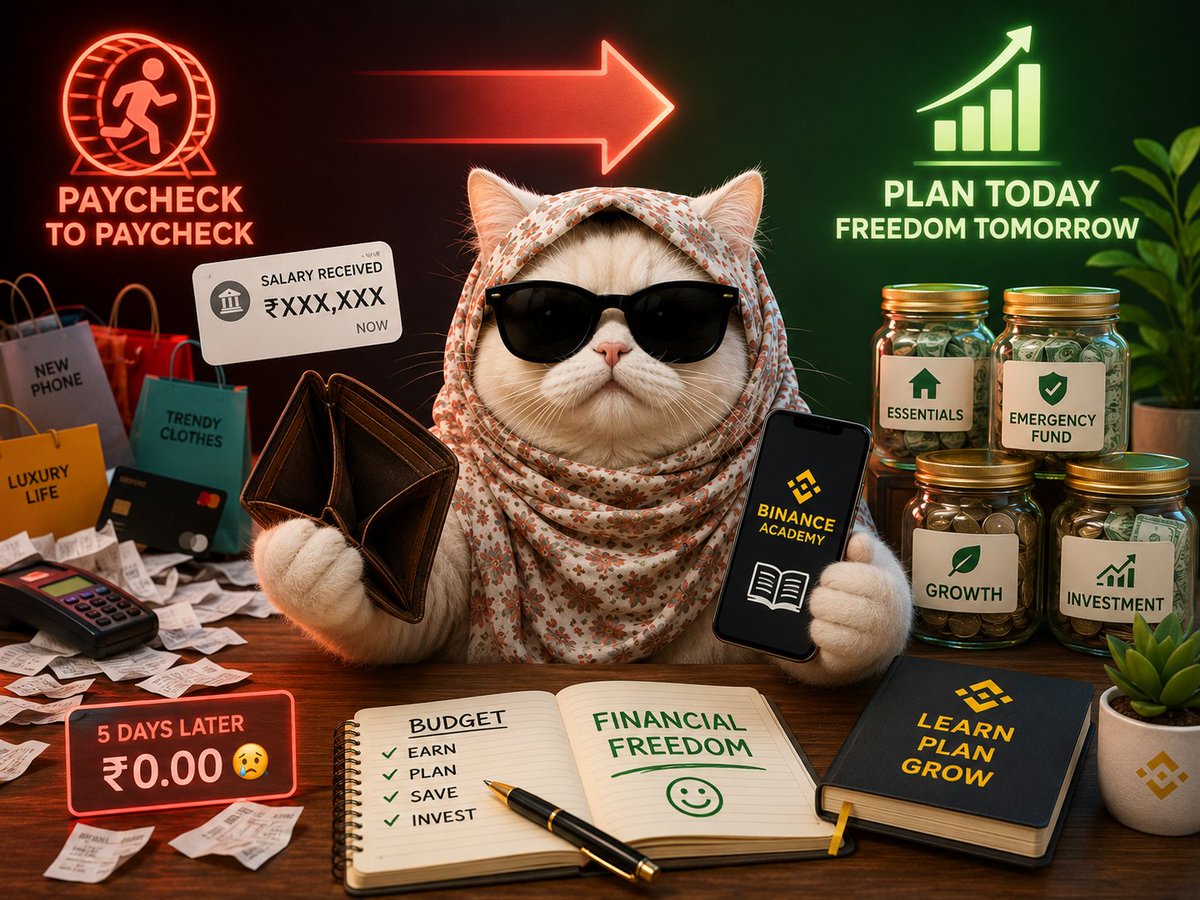
Why work 160 hours a month just to be completely broke five days after payday?
That first salary notification feels incredible, but blowing it instantly on an upgraded lifestyle keeps you trapped on a financial treadmill forever.
Divide your income the moment it hits your bank account.
Cover real essentials first, lock away an emergency fund, and set aside a tiny portion for long-term growth.
Spreading your cash prevents a total collapse when one area fails, while spending without learning risk rules is just giving your hard work away.
Want to stop surviving paycheck to paycheck and actually build real independence?
Head over to @BinanceAcademy for free, simple guides on smart budgeting and risk management before making big moves.
Make your income buy your future freedom, always!
#Binance #BinanceAcademy #LearnWithBinance #FinancialLiteracy
Think buying Bitcoin will make you rich overnight?
That single belief ruins more beginners than market crashes ever will.
Rushing in just because your feed is full of green charts isn't investing, it is blind gambling.
Crypto prices swing wildly on a daily basis. Buying during extreme social media hype usually means you are purchasing at the absolute peak out of pure fear.
Real research is your only shield against heavy losses, so never trade money you need for rent.
Ready to make your first move without the panic?
Check out Binance’s My First Bitcoin campaign, where eligible first-time trades get seven day price protection to help you step in safely.
Are you placing trades based on real understanding, or just following the herd?
Do your own research first.
#Binance #BinanceAcademy #LearnWithBinance #CryptoForBeginners
Ever hand your entire bank statement to a landlord just to prove you can pay rent, feeling like your privacy just took a hit?
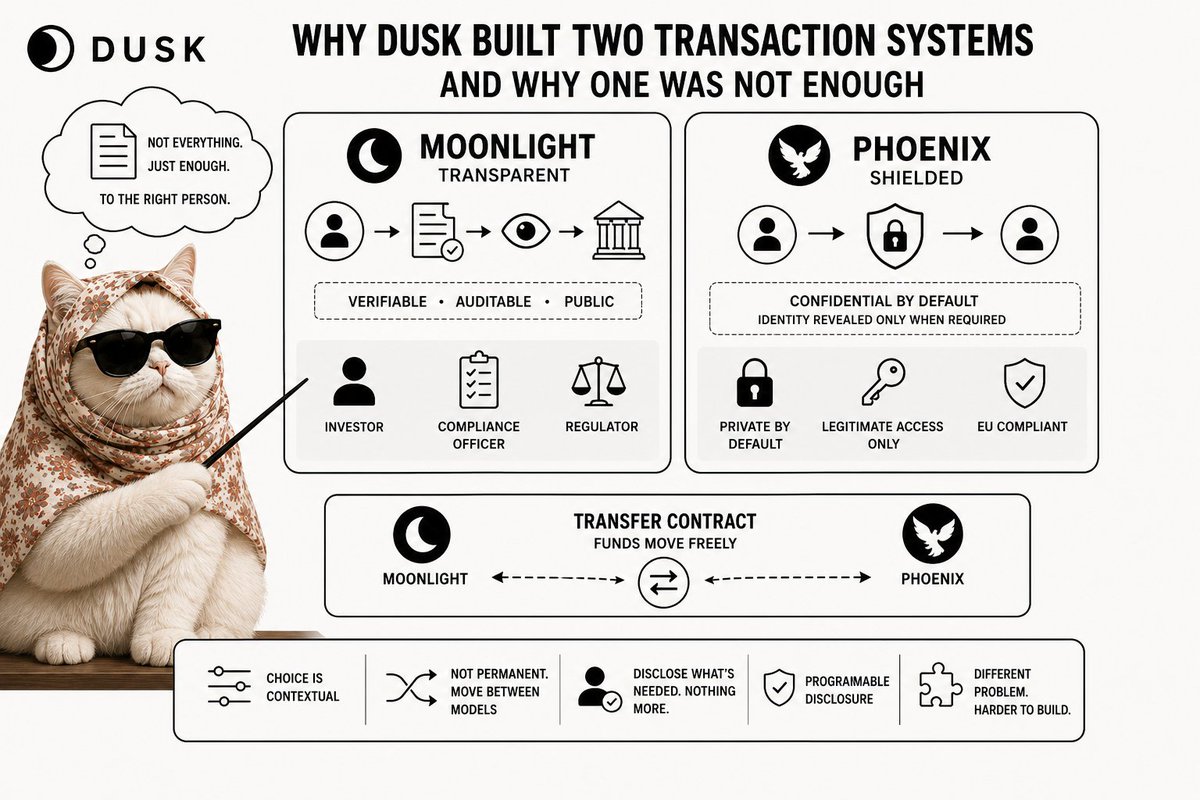
That awkward overexposure is why traditional finance and public chains feel so broken. But $DUSK solves this by refusing to choose between total exposure and total blackouts.
With its dual-model design, #Dusk separates public accountability from private ownership. Moonlight handles the transparent side, while Phoenix acts as a shielded layer that proves compliance without leaking your entire financial history.
This is programmable disclosure. You share the right key with the right person at the right time.
If crypto wants real institutional money, hiding everything doesn't work. Controlling what gets seen does.
@DuskFoundation
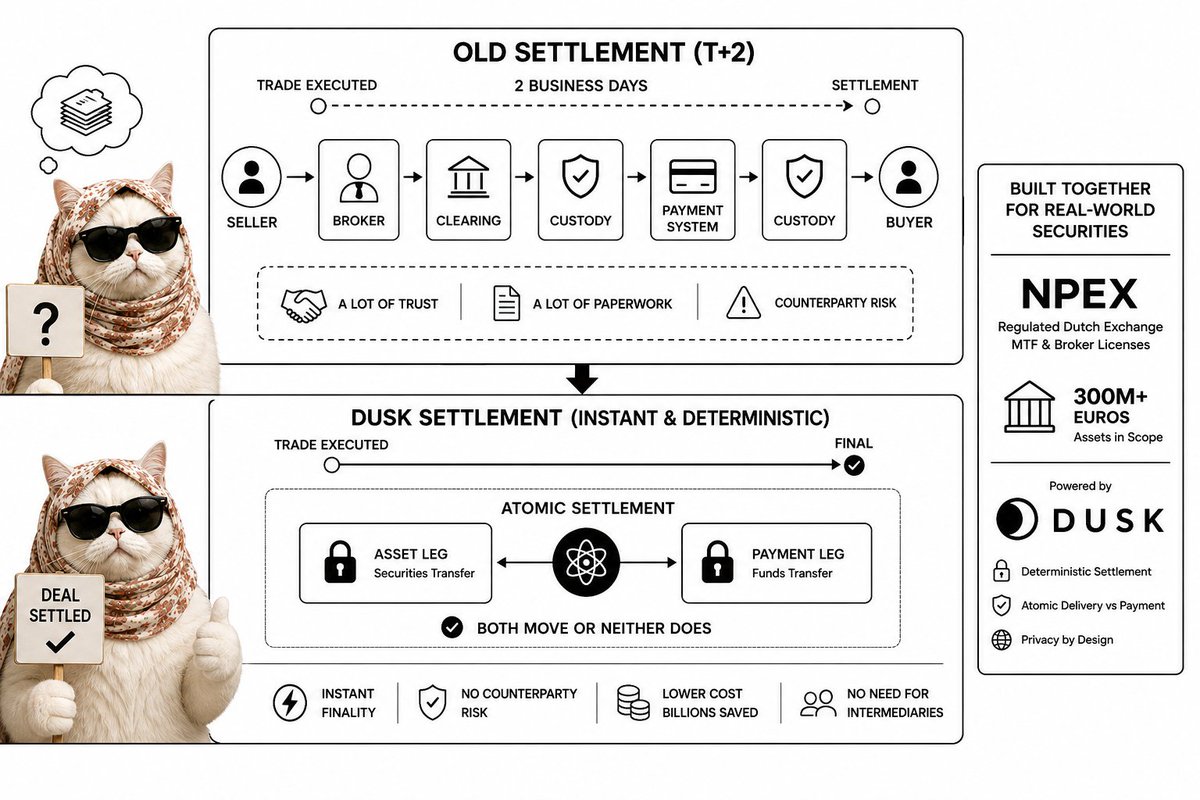
Ever wait two whole business days for a stock trade to settle and wonder why your money is stuck in digital limbo?
We tolerate an army of middlemen and paperwork because traditional finance treats settlement risk like a law of nature. But it is not. It is just bad infrastructure.
This is where #Dusk changes the conversation completely.
Instead of probabilistic guesses or waiting on confirmations, $DUSK delivers deterministic settlement. When a trade clears, it is final instantly. No gaps, no counterparty risk, and atomic execution meaning both sides move together or nothing happens at all.
Real institutional adoption is already testing this. Look at NPEX, a regulated Dutch exchange moving over 300 million euros of securities directly onto Dusk's infrastructure. Legal compliance and technical rails are solved as one single unit.
Dusk isn't just making finance faster. It is rebuilding the foundation.
@DuskFoundation
Ever realize your entire financial life is sitting on a glass billboard?
We hate when people peek at our receipts, yet crypto proudly broadcasts every wallet balance and transfer for competitors to stalk. That transparent trap is why Wall Street keeps running away.
#Dusk isn't just shouting about privacy like everyone else. Through Hedger, they are tackling the ultimate crypto boss fight: making smart contracts actually compute on encrypted data without breaking a sweat or exposing your trades.
Sure, staying skeptical makes total sense. Running math on hidden data has haunted cryptographers for a decade. But if $DUSK actually delivers on private lending books and institutional settlement, they change the rules of the game.
The glass billboard finally gets a wall. Are you betting on Dusk to pull this off, or is confidential EVM just another industry buzzword?
@DuskFoundation
Imagine handing your loan officer a sealed envelope instead of your whole bank statement; they only get to open the one page they actually need to see.
That's basically what Dusk Network is doing on-chain.
Most crypto privacy is all-or-nothing. Monero, Zcash; total stealth mode, but useless when a regulator needs proof. Dusk flips it: everything's encrypted by default, but a trusted party (auditor, regulator) holds a key that unlocks just one field. Public sees "valid trade happened." Auditor alone confirms KYC. Nobody else sees anything.
Old private chains like Corda just lock everyone out entirely. Dusk stays public and gets selective instead. Bigger unlock than it sounds.
The risk? Trust shifts from "is the code safe" to "who's holding the key." That's a people problem now.
Bet: institutions quietly adopt this before retail notices. Real tipping point; the day a regulator says this counts as proof.
#dusk @DuskFoundation $DUSK
Bitcoin doesn't know it's Saturday or Sunday.
Seriously.
Try opening a stock market on Sunday and you'll be waiting.
Open a crypto exchange instead and the market is still moving.
Why?
Because crypto wasn't built around the same market-hours system as traditional stock exchanges.
But here's the part that's easy to miss:
Why does the stock market close at all?
A stock market isn't just an app where buyers and sellers meet. It runs through a traditional financial system involving exchanges, brokers, banks, custodians and other institutions.
These institutions need scheduled operating hours to process trades, settle transactions, manage records and coordinate with each other. So stock exchanges have defined trading sessions, with opening times, closing times, weekends and holidays.
When the exchange closes, regular stock trading stops.
Crypto works differently.
Bitcoin runs on a global blockchain network. There isn't one central exchange that controls the entire Bitcoin market and says, “Okay everyone, we're done for today.”
The network keeps running.
Crypto exchanges can therefore continue offering trading around the clock.
So at 2 PM on Tuesday or even Sunday?
It's still trading.
That's why crypto markets operate 24/7.
And this changes something important for beginners.
In traditional markets, there is usually a period when trading stops and everyone gets a break.
Crypto doesn't give you that pause.
A major event can happen on a Sunday. Prices can react while you're asleep. You don't get to wake up and say, “Wait for the market to open.”
It never closed.
That's the convenience of a market that never sleeps.
It's also the reason you don't need to watch it every second.
The market is always open.
You don't have to be.
Educational only. Not financial advice. DYOR.
#Binance #BinanceAcademy #LearnWithBinance