BREAKING: Dozens of Christians were massacred in Ethiopia over the course of the last week by Islamists.
Tens of thousands of Christians have been slaughtered by Islamists across Africa, and the world doesn’t seem to care.
Would you vote to ban Islam in the USA permanently?
1. Yes
2. No
3. Unsure
ÚLTIMA HORA: La iglesia Telata Chef St. Gabriel, de 101 años de antigüedad, ha sido incendiada por islamistas en Etiopía.
Además de quemar la iglesia, asesinaron a decenas de cristianos inocentes.
¿Dónde está la indignación mundial?
🚨 Solo en junio otros 49 cristianos (incluyendo mujeres y niños) sufrieron genocidio en Etiopía. Se quemaron 280 casas y varias iglesias (incluida St. Gabriel de Teleta, de más de 100 años). Cientos de desplazados y desaparecidos. ¿Por qué los medios solo te informan de Gaza?
Ethiopia: The 101-year-old Telata Chef St. Garbriel Church has been burned to the ground by ethnic militants in Oromo.
Dozens of Christians were also killed.
Hundreds of Christian homes were destroyed, along with livestock, in the large-scale attack that saw roughly 3,000 armed extremists target the Orthodox Christian community.
The Christians of Ethiopia’s Oromo region need immediate help and prayers.
The cries of families mourning innocent civilians targeted and killed in Oromia for being Orthodox Christians should shake the conscience of the world. The ongoing failure to protect citizens under @AbiyAhmedAli is unacceptable. @UNHumanRights
Inflation is at a three-year high. Everything costs more — groceries, gas, healthcare, a plane ticket.
The math is simple. Every American dollar spent overseas on war is a dollar that could’ve been spent here at home to pay for a dignified life. It's time we change the equation.
It is time for the U.S. to end military aid to Israel.
But we're not going to wait 10 years to do it.
The time to stop arming Netanyahu and hold him accountable for his crimes against humanity is NOW.
Wendium Alex: your analogy collapses under even minimal scrutiny because you are conflating administrative rearrangement with wartime annexation, and the two are not remotely comparable. The cases you list: Afar–Wollo, Benishangul–Welega, Afar–Tigray, involved internal administrative reshuffling in areas where populations were already intermingled and where no ethnic group was forcibly expelled [The Amhara being the exception again]. They were not the product of an armed movement seizing territory during an insurgency and later legalizing it through unilateral federal restructuring.
By contrast, the TPLF’s takeover of northwestern Gondar was the only instance in post-1991 Ethiopia where a liberation front captured territory by force, displaced the indigenous population, and then retroactively declared it its own. Even Laura Hammond, who conducted fieldwork with the TPLF in its formative era and later after it assumed central power, acknowledged in This Place Will Become Home that Adebay and its surroundings had historically been administered as Gondar, and that returning Tigrayan refugees were, in her words, “returning to a strange place.” Her ethnographic account inadvertently confirms what the land’s inhabitants already knew: this was not Tigrayan territory but Amhara land annexed under the fog of war.
Your argument also collapses constitutionally. The 1995 Constitution cannot justify the seizure because the annexation preceded the Constitution. What is taken by force before a legal framework exists cannot be legalized after the fact by invoking that very framework. Retroactive legitimacy is not a legal doctrine, in Ethiopia or anywhere else.
Finally, geography is stubborn: the Tekeze has been the natural and civilizational boundary between Gondar and Tigray for centuries, a point repeatedly affirmed by scholars like the late Professor Mesfin Woldemariam. The river is not moved by political fashion or propaganda.
In short, your attempt to equate ordinary administrative adjustments with a singular act of wartime territorial expansion is not simply incorrect, it erases the lived history of a people who were forcibly uprooted. History, geography, demography, and scholarship all align on one point: northwestern Gondar was taken, not inherited.
Ethio diaspora organizers, please change direction NOW! You can do more than one thing!
THESE ARRESTS are something Western media can/will want to cover!
Focus on them and make rallies for May into art & music protests!
Incorporate #AmharaGenocide into 4 Teddy Afro protests!
For those of you who would like to support Ermias Mekuria as he finds his way back into stability in exile, you can use the following GoFundMe link organized by his friend Biruk Mamo.
https://t.co/b5m19ht6D2
Learn about his ordeal as a human rights defender who is now exiled from Ethiopia here: https://t.co/h6RHOU6EUe
- End #AmharaGenocide in #Ethiopia
- Stop targeting Amharas in Ethiopia.
Three years ago, on May 6, Voice of Amhara journalist Gobeze Sisay was arrested in #Djibouti and transferred to #Ethiopia under unclear circumstances in a sweeping crackdown on reporting about conflict in the Amhara region. He remains behind bars on terrorism charges that carry a potential death sentence.
Gobeze is due to present his defense this month.
Gobeze’s continued detention, along with three other journalists also accused of terrorism — Genet Asmamaw, Meskerem Abera, and Dawit Begashaw — underscores the risks facing independent media in Ethiopia and the criminalization of reporting on matters of public interest.
@pressfreedom calls for Gobeze’s immediate release and for Ethiopian authorities to stop criminalizing journalism.
Read more: https://t.co/5Hjh5D3IXa
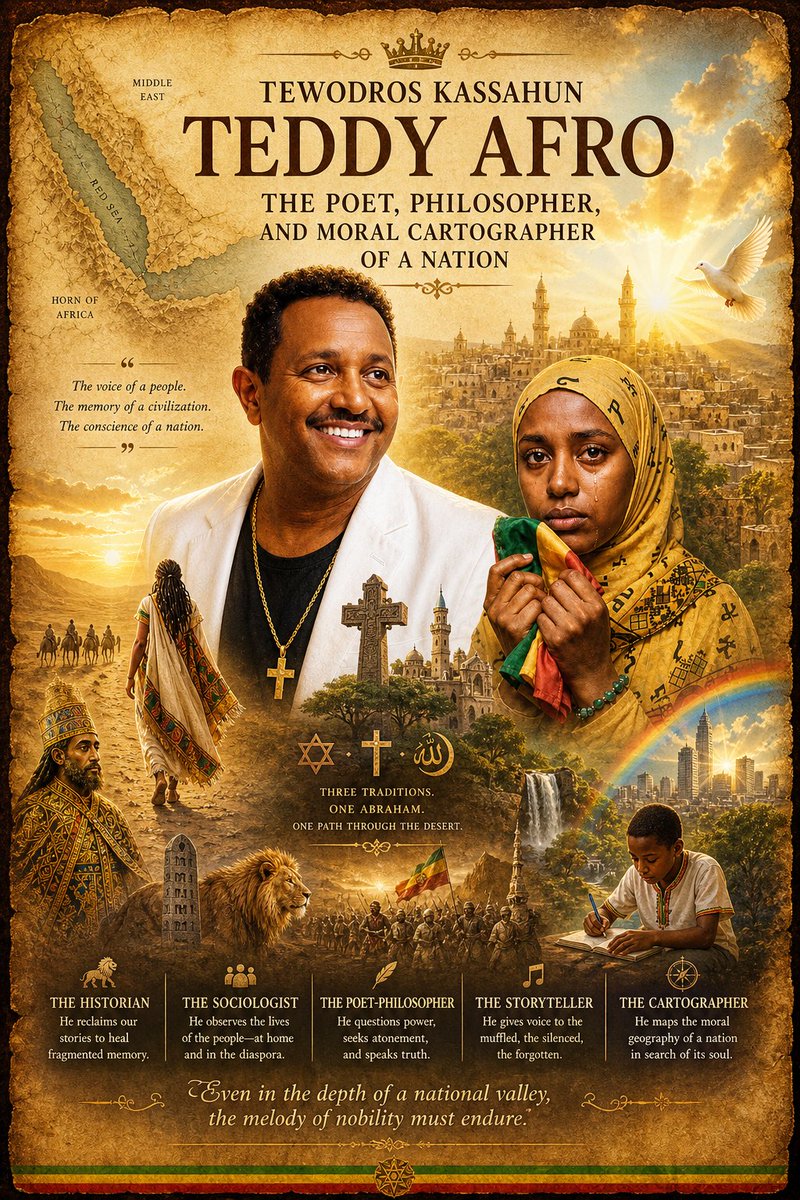
Teddy Afro: The Poet–Philosopher and the Moral Cartographer of a Nation #Ethiopia@teddyafromuzika
Over the past quarter century, #Tewodros_Kassahun, known to the world as #Teddy_Afro, has undergone a quiet yet profound transformation, from a celebrated musician into something far rarer, a civilizational voice, a custodian of memory, and an interpreter of the Ethiopian condition. His work does not merely mirror society; it interrogates it, refracts it, and, at times, redeems it. In his hands, music becomes a form of inquiry, a ledger of sacrifice, a register of longing, and a moral cartography of a nation navigating its own fractures. He is, in a sense, less a singer than a chronicler of the Ethiopian soul, attentive to its silences as much as its utterances.
In his early phase, Teddy Afro articulated what might be called a civilizational baseline. Emerging in the aftermath of a turbulent decade, his music reanimated a sense of Ethiopianism rooted in Pan-African consciousness and historical continuity. Figures such as Emperor Haile Selassie and the broader symbolic universe of Black liberation were not invoked as relics, but as living coordinates within a larger moral geography. Here, history was not yet an instrument of critique, but a source of affirmation, a reminder that dignity, like memory, could be recovered and reinhabited.
The rupture of the mid-2000s, however, marked a decisive shift. With works such as Yasteseryal, Teddy Afro moved from cultural affirmation to political interlocution. He began to question not only the direction of the state, but the moral architecture underpinning it. His intervention was neither strident nor doctrinaire; it was, rather, philosophical. He suggested that political transformation, absent moral reckoning, merely reproduces the cycles it seeks to escape. In this, he assumed the role of a public philosopher, challenging the monopolies of narrative and inviting a more introspective form of civic engagement.
In the years that followed, his attention turned toward history, not as nostalgia, but as resource. Through works such as Tikur Sew, the past was reassembled as a counterweight to fragmentation. The Battle of #Adwa was not simply commemorated; it was reinterpreted as a civilizational moment, a template for unity in diversity. Yet even here, one encounters the enduring tension of Ethiopian historiography, the delicate interplay of wax and gold, where narratives of unity are, for some, inseparable from memories of exclusion. Teddy does not resolve this tension; he inhabits it.
Running through his entire oeuvre is a persistent commitment to syncretic harmony. The interweaving of Christian and Muslim imaginaries is not presented as a modern accommodation, but as an ancient inheritance. Ethiopia, in this telling, is sustained not by uniformity, but by coexistence, by the quiet intimacy of shared spaces where the liturgy and the call to prayer are not adversaries but echoes. This vision stands as both description and aspiration, a bulwark against the centrifugal forces of extremism and division.
In his most recent work, the tone more somber. The register shifts from reconstruction to mourning. The songs become, in effect, elegies for a nation unsettled by conflict, dislocation, and moral uncertainty. Here, Teddy Afro emerges as a chronicler of rupture, attentive to the slow erosion of social fabric and the quiet disorientation of a people who find themselves estranged within their own landscape. The metaphors grow heavier, the questions more existential. What does it mean for a nation to endure when its foundations appear unstable? Where does grief reside when it can no longer be contained?
It is within this register that #መሬማ assumes its full significance. The song moves beyond the state and into the intimate geography of displacement. It is not merely about migration; it is about the condition of being unmoored, of inhabiting a space between worlds. The figure of the Ethiopian woman in exile, whether in Sana’a, Beirut, or beyond, becomes emblematic of a broader civilizational dislocation. She is present yet distant, visible yet withdrawn, carrying within her the quiet burden of a homeland that persists as memory, as ache, as unfinished conversation. In this sense, #መሬማ is less a narrative than a condition, a meditation on dignity under strain, on the persistence of identity even when uprooted.
Across these phases, Teddy Afro reveals himself as more than an artist. He is, at once, a historian reclaiming narrative, a sociologist observing the textures of lived experience, a philosopher probing the moral limits of political life, and a poet giving voice to what often remains unspoken. He attends to the muffled, the silenced, the deferred, and in doing so, renders audible the inner life of a society in motion.
To speak of Teddy Afro, then, is to speak of a figure who has come to occupy a rare position in public life. He does not simply entertain; he interprets. He does not merely reflect; he refracts. And in an age marked by noise and haste, his work insists on something more enduring: that memory matters, that dignity can be carried even in displacement, and that the unfinished story of a people may yet find its voice in the quiet persistence of song.
@EmishawEskedar@YilmaYada@ze_gelila@helina_azeze
Teddy Afro: The Poet–Philosopher and the Moral Cartographer of a Nation #Ethiopia@teddyafromuzika
Over the past quarter century, #Tewodros_Kassahun, known to the world as #Teddy_Afro, has undergone a quiet yet profound transformation, from a celebrated musician into something far rarer, a civilizational voice, a custodian of memory, and an interpreter of the Ethiopian condition. His work does not merely mirror society; it interrogates it, refracts it, and, at times, redeems it. In his hands, music becomes a form of inquiry, a ledger of sacrifice, a register of longing, and a moral cartography of a nation navigating its own fractures. He is, in a sense, less a singer than a chronicler of the Ethiopian soul, attentive to its silences as much as its utterances.
In his early phase, Teddy Afro articulated what might be called a civilizational baseline. Emerging in the aftermath of a turbulent decade, his music reanimated a sense of Ethiopianism rooted in Pan-African consciousness and historical continuity. Figures such as Emperor Haile Selassie and the broader symbolic universe of Black liberation were not invoked as relics, but as living coordinates within a larger moral geography. Here, history was not yet an instrument of critique, but a source of affirmation, a reminder that dignity, like memory, could be recovered and reinhabited.
The rupture of the mid-2000s, however, marked a decisive shift. With works such as Yasteseryal, Teddy Afro moved from cultural affirmation to political interlocution. He began to question not only the direction of the state, but the moral architecture underpinning it. His intervention was neither strident nor doctrinaire; it was, rather, philosophical. He suggested that political transformation, absent moral reckoning, merely reproduces the cycles it seeks to escape. In this, he assumed the role of a public philosopher, challenging the monopolies of narrative and inviting a more introspective form of civic engagement.
In the years that followed, his attention turned toward history, not as nostalgia, but as resource. Through works such as Tikur Sew, the past was reassembled as a counterweight to fragmentation. The Battle of #Adwa was not simply commemorated; it was reinterpreted as a civilizational moment, a template for unity in diversity. Yet even here, one encounters the enduring tension of Ethiopian historiography, the delicate interplay of wax and gold, where narratives of unity are, for some, inseparable from memories of exclusion. Teddy does not resolve this tension; he inhabits it.
Running through his entire oeuvre is a persistent commitment to syncretic harmony. The interweaving of Christian and Muslim imaginaries is not presented as a modern accommodation, but as an ancient inheritance. Ethiopia, in this telling, is sustained not by uniformity, but by coexistence, by the quiet intimacy of shared spaces where the liturgy and the call to prayer are not adversaries but echoes. This vision stands as both description and aspiration, a bulwark against the centrifugal forces of extremism and division.
In his most recent work, the tone more somber. The register shifts from reconstruction to mourning. The songs become, in effect, elegies for a nation unsettled by conflict, dislocation, and moral uncertainty. Here, Teddy Afro emerges as a chronicler of rupture, attentive to the slow erosion of social fabric and the quiet disorientation of a people who find themselves estranged within their own landscape. The metaphors grow heavier, the questions more existential. What does it mean for a nation to endure when its foundations appear unstable? Where does grief reside when it can no longer be contained?
It is within this register that #መሬማ assumes its full significance. The song moves beyond the state and into the intimate geography of displacement. It is not merely about migration; it is about the condition of being unmoored, of inhabiting a space between worlds. The figure of the Ethiopian woman in exile, whether in Sana’a, Beirut, or beyond, becomes emblematic of a broader civilizational dislocation. She is present yet distant, visible yet withdrawn, carrying within her the quiet burden of a homeland that persists as memory, as ache, as unfinished conversation. In this sense, #መሬማ is less a narrative than a condition, a meditation on dignity under strain, on the persistence of identity even when uprooted.
Across these phases, Teddy Afro reveals himself as more than an artist. He is, at once, a historian reclaiming narrative, a sociologist observing the textures of lived experience, a philosopher probing the moral limits of political life, and a poet giving voice to what often remains unspoken. He attends to the muffled, the silenced, the deferred, and in doing so, renders audible the inner life of a society in motion.
To speak of Teddy Afro, then, is to speak of a figure who has come to occupy a rare position in public life. He does not simply entertain; he interprets. He does not merely reflect; he refracts. And in an age marked by noise and haste, his work insists on something more enduring: that memory matters, that dignity can be carried even in displacement, and that the unfinished story of a people may yet find its voice in the quiet persistence of song.
@EmishawEskedar@YilmaYada@ze_gelila@helina_azeze



![HOAAffairs's tweet photo. Wendium Alex: your analogy collapses under even minimal scrutiny because you are conflating administrative rearrangement with wartime annexation, and the two are not remotely comparable. The cases you list: Afar–Wollo, Benishangul–Welega, Afar–Tigray, involved internal administrative reshuffling in areas where populations were already intermingled and where no ethnic group was forcibly expelled [The Amhara being the exception again]. They were not the product of an armed movement seizing territory during an insurgency and later legalizing it through unilateral federal restructuring.
By contrast, the TPLF’s takeover of northwestern Gondar was the only instance in post-1991 Ethiopia where a liberation front captured territory by force, displaced the indigenous population, and then retroactively declared it its own. Even Laura Hammond, who conducted fieldwork with the TPLF in its formative era and later after it assumed central power, acknowledged in This Place Will Become Home that Adebay and its surroundings had historically been administered as Gondar, and that returning Tigrayan refugees were, in her words, “returning to a strange place.” Her ethnographic account inadvertently confirms what the land’s inhabitants already knew: this was not Tigrayan territory but Amhara land annexed under the fog of war.
Your argument also collapses constitutionally. The 1995 Constitution cannot justify the seizure because the annexation preceded the Constitution. What is taken by force before a legal framework exists cannot be legalized after the fact by invoking that very framework. Retroactive legitimacy is not a legal doctrine, in Ethiopia or anywhere else.
Finally, geography is stubborn: the Tekeze has been the natural and civilizational boundary between Gondar and Tigray for centuries, a point repeatedly affirmed by scholars like the late Professor Mesfin Woldemariam. The river is not moved by political fashion or propaganda.
In short, your attempt to equate ordinary administrative adjustments with a singular act of wartime territorial expansion is not simply incorrect, it erases the lived history of a people who were forcibly uprooted. History, geography, demography, and scholarship all align on one point: northwestern Gondar was taken, not inherited.](https://pbs.twimg.com/media/G64kbpjWEAAWudw.png)






![HOAAffairs's tweet photo. Wendium Alex: your analogy collapses under even minimal scrutiny because you are conflating administrative rearrangement with wartime annexation, and the two are not remotely comparable. The cases you list: Afar–Wollo, Benishangul–Welega, Afar–Tigray, involved internal administrative reshuffling in areas where populations were already intermingled and where no ethnic group was forcibly expelled [The Amhara being the exception again]. They were not the product of an armed movement seizing territory during an insurgency and later legalizing it through unilateral federal restructuring.
By contrast, the TPLF’s takeover of northwestern Gondar was the only instance in post-1991 Ethiopia where a liberation front captured territory by force, displaced the indigenous population, and then retroactively declared it its own. Even Laura Hammond, who conducted fieldwork with the TPLF in its formative era and later after it assumed central power, acknowledged in This Place Will Become Home that Adebay and its surroundings had historically been administered as Gondar, and that returning Tigrayan refugees were, in her words, “returning to a strange place.” Her ethnographic account inadvertently confirms what the land’s inhabitants already knew: this was not Tigrayan territory but Amhara land annexed under the fog of war.
Your argument also collapses constitutionally. The 1995 Constitution cannot justify the seizure because the annexation preceded the Constitution. What is taken by force before a legal framework exists cannot be legalized after the fact by invoking that very framework. Retroactive legitimacy is not a legal doctrine, in Ethiopia or anywhere else.
Finally, geography is stubborn: the Tekeze has been the natural and civilizational boundary between Gondar and Tigray for centuries, a point repeatedly affirmed by scholars like the late Professor Mesfin Woldemariam. The river is not moved by political fashion or propaganda.
In short, your attempt to equate ordinary administrative adjustments with a singular act of wartime territorial expansion is not simply incorrect, it erases the lived history of a people who were forcibly uprooted. History, geography, demography, and scholarship all align on one point: northwestern Gondar was taken, not inherited.](https://pbs.twimg.com/media/G64kcLkW4AAmgEI.png)