The cryptographic world computer:
https://t.co/LF2JGU38Rx
My attempt to express in somewhat concise terms the true meaning of basically everything planned to happen to Ethereum starting from the fork after Hegota. It's really not just a blockchain anymore. It's a hybrid architecture that combines together blockchains and modern cryptography, to enable much more powerful properties.
FOCIL, EIP-8288, Lean consensus, state management, formal verification, advanced mempool improvements (including privacy), and the longer-term specter of obfuscation all mentioned.
Some bangers from the SEC today:
1) buybacks do not make a commodity token into a security
2) liquid staking tokens for commodities are not securities
https://t.co/kkRNqT3den
Crypto After the Clarity Act: Regulators, Prediction Markets & Tokenized Stocks with former CFTC Chairman @RostinBehnam and Bullish CEO @ThomasFarley https://t.co/kdLiM6VnGc
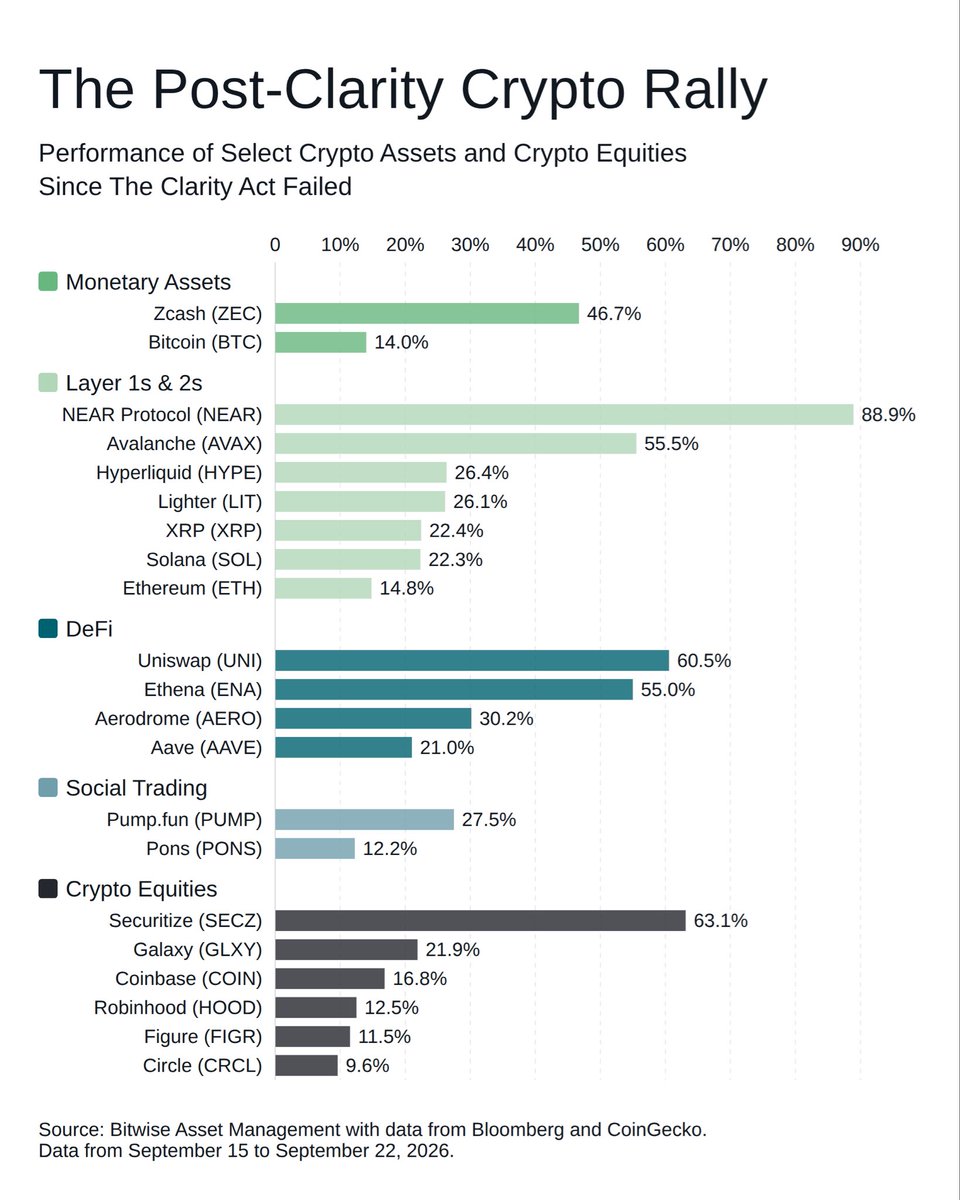
We’re one week out from the Clarity Act failing.
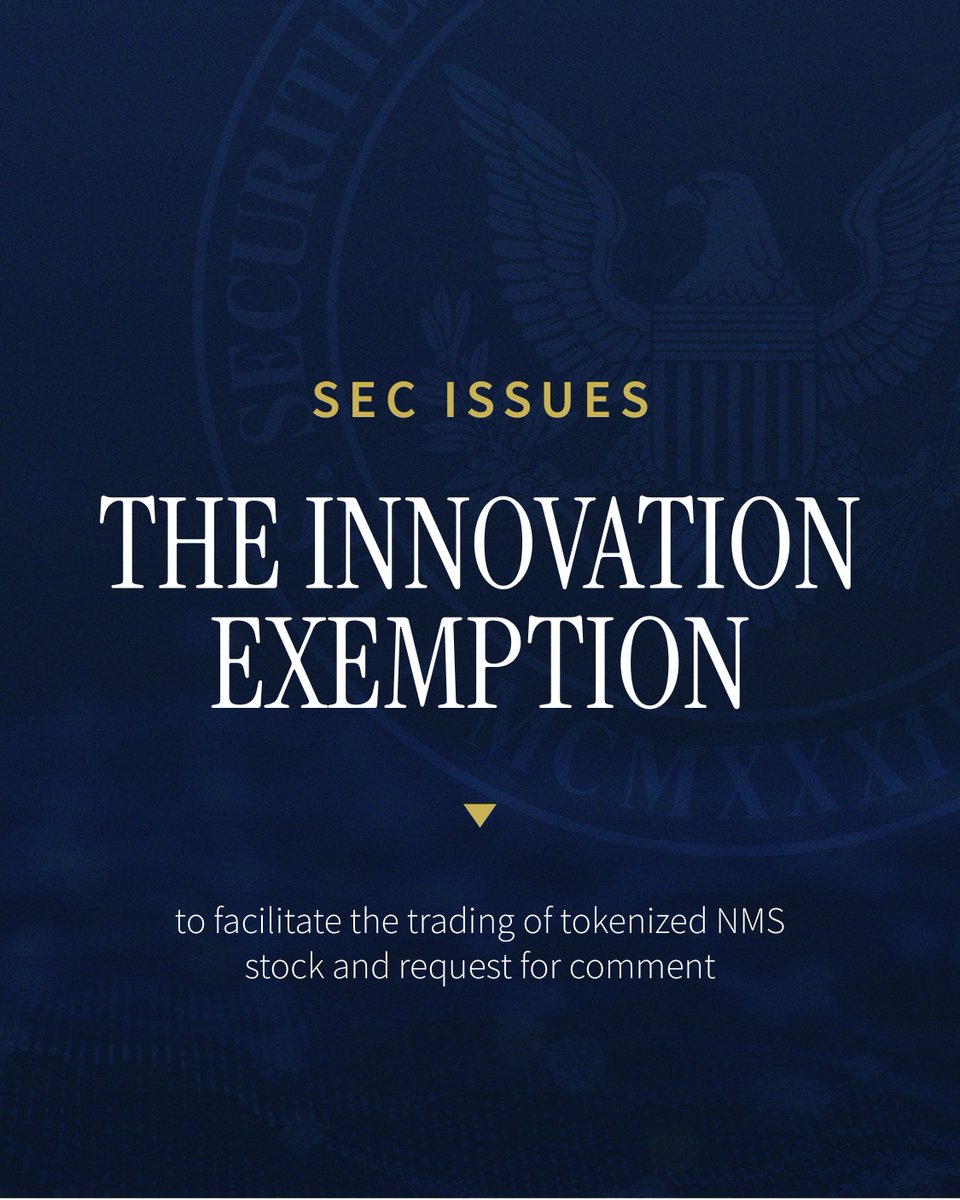
- SEC publishes Innovation Exemption
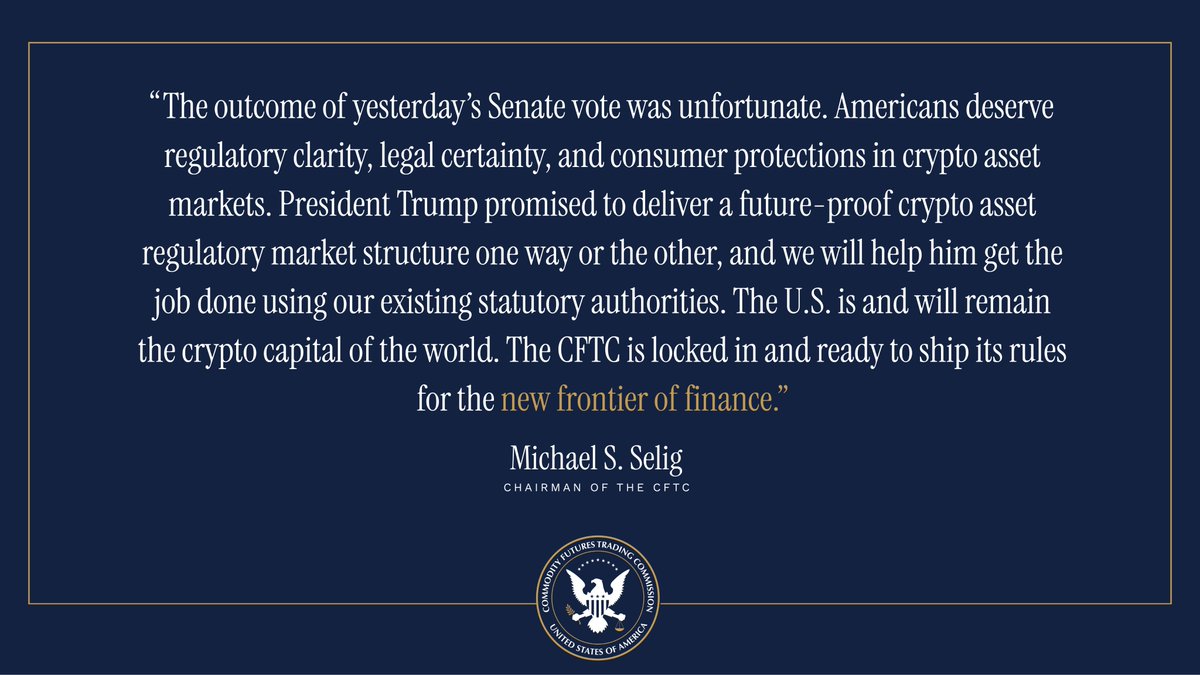
- CFTC ships crypto rules to the White House
- CFTC updates FAQ on crypto activities
Crypto assets and equities tell the story.
Today, Bullish and @Equiniti launched the Issuer Sponsored Token Coalition.
@AlpacaHQ, @ApexFintech and @DriveWealth are the first participants, bringing together leading brokerage, trading and market infrastructure firms to help advance issuer-sponsored tokenized securities.
The coalition will develop the technical standards, infrastructure and operating frameworks needed for issuer-sponsored tokenized securities to scale alongside, and interoperate with, existing capital markets.
The launch follows the SEC’s Sept. 17 Innovation Exemption, a five-year framework for on-chain trading of tokenized U.S.-listed stocks.
Under the framework, venues must verify that token holders receive the same rights as holders of the underlying shares, while issuers can object to third-party tokenization.
Issuer-sponsored tokens meet that standard by design.
They are issued with the issuer's participation and connect directly to its shareholder register, preserving shareholder rights, corporate-action entitlements and investor protections.
The coalition is open and non-exclusive, with additional participants to be announced in the coming weeks.
The new frontier of finance isn't on the horizon. It's here.
As our markets evolve at warp speed, the @CFTC is upgrading its rules and regulations to prepare for the era of onchain systems, mass tokenization, 24/7 trading, and agentic finance.
Ethereum native prediction market 🙌
I've been saying this... there will be a handful of early movers who'll seize the opportunity to go and focus on Ethereum Mainnet, and some of them will do exceptionally well.
Ethereum scales by over 400x over the next 3–5 years, so there's quite a lot of room for big wins there.
Let's fucking goooo!
Glad to see that Ethereum L1 will have a new strong prediction market contender that is dedicated to decentralization, and being ethical and not corposlop, and to actually trying to do interesting and meaningful things with this class of economic primitive.
https://t.co/Rj86ZJl3G4
🚨 TODAY: The SEC issued an order granting temporary, conditional exemptive relief to Tokenized Securities Venues from the definition of “exchange” in the Exchange Act to trade tokenized NMS stock using innovative permissioned automated market makers and liquidity pools.
This morning after the failure of the Clarity Act, I remembered the first real conversation I ever had about the future of blockchain and smart contracts in summer of 2013. @dwr said to me that he could envision a world where the stock markets moved onto public blockchains. Seemed crazy but not impossible. I was headed to go run the largest stock market in the world, the NYSE. I invested $10m in Coinbase as a bit of a hedge and to make sure I wasn’t missing a big trend.
The Clarity Act originally came about when crypto volumes and the number of interesting tokens were booming. Let’s face it, we all thought we were headed towards a world with tons of important coins.
Today the future of pure crypto is more circumscribed: bitcoin, a couple dozen important layer 1’s/2’s and a handful of productive projects.
But the future of blockchain technology is far bigger and more interesting than most people foresaw even a year ago. In particular, tokenized securities including equity and debt are moving to public blockchains. The current projections are all way too low. There will be $150 trillion of assets on chain in 2035 and maybe sooner.
Issuers will be in control of this transition and the issuers will have benefits that seemed Jetsons-esque a few years ago: the ability to know their holders; to reward them with rewards, discounts & enhanced voting rights and dividends; and to end naked short-selling.
And then there is what is genuinely new. Lower cost structures unlock retail lending products that were previously institutional-only. Equities as tokens become building blocks: bundle them, recombine them, create investment products that simply couldn't exist before. 24/7, settlement, and transparency are table stakes. The more interesting story is what's next.
Clarity Act doesn’t have much to do with any of this tbh. On my call with management this morning I lamented that we didnt get Clarity Act yesterday in particular because I thought tradfi big banks would invest more in crypto if they felt the security of federal legislation. But then I asked the team if not getting the bill hurts our existing business in a material way. The answer was no. In fact, some of the stuff in the bill scared me a bit like the prohibitions on stablecoin operators paying rewards. So, like, goodbye Clarity Act, we hardly knew you.
With the world we are in in 2026 and not 2024, CLARITY still matters. Durable legislation would give the digital asset industry greater certainty. But even with legislation, the real work of implementation happens at the agencies, and agencies can move faster. For tokenized securities, the @SECGov innovation exemption and @CFTC rule changes may prove more consequential in the near term. They are where the role of the issuer, the issuer-sponsored token and the transfer agent will start to take shape.
@Bullish will do its part. We will tokenize 3,000 issuers with the real thing: issuer tokens where the token is the stock itself and not any of this complicated stuff everyone else is writing white papers and drawing diagrams about. Here is our white paper “token = stock.” This is what the issuers and the investors want. I’ll tell you publicly what people are saying privately: issuer sponsored tokens are the best answer, not this soup of synthetic derivative products.
Back to working to build the best institutional-grade systems for issuers in the world
As of today, I recommend every stablecoin issuer maximize third-party reward sharing.
I also recommend every Fintech, consumer service, chat app, gaming platform and social media platform integrate stablecoins and pay their customers for adopting them.
The bank lobby’s attack on Clarity, based almost entirely on unsubstantiated claims and the occasional lie, should not go unaddressed.
They had their chance to support a law that mostly protected their undeserved deposit monopoly. Instead they chose to sabotage it from the jump.
They chose to fight progress in a fashion that harms ordinary Americans, erodes dollar supremacy, limits innovation, and reduces economic growth.
All from an industry that pays ordinary people very little on their hard earned money while booking the difference as profit (as opposed to passing it on as cheap credit).
The battle now moves to Genius rule making, and I for one will be there to meet their selfish maneuvering and disingenuous arguments with facts and logic.
What’s good for the banks is often not good for America. Their recent behavior erodes any doubt.
After a year of intense daily bipartisan negotiations, this bill is ready. Here is the final text. President Trump voluntarily agreed to new ethics provisions holding every federally elected official, judge, and their spouses to some of the toughest ethics restrictions in U.S. history. This new text includes more than 120 of Democrats' demands. A no vote on Tuesday means opposing real ethics reforms on politicians' personal investments, handing American leadership in digital assets to our foreign competitors, and leaving Americans with zero protections in the digital asset markets. Democrats got what they wanted; now they need to take yes for an answer. Here's the latest: https://t.co/pd9VjCk9MA
JUST IN: President Trump agrees to CLARITY Act ethics restrictions covering himself, elected officials and judges, with state attorneys general given enforcement authority removing the final obstacle to Tuesday's Senate vote.
We welcome the release of the latest Clarity Act text and applaud the bipartisan work that has gone into reaching this point.
We look forward to a successful vote on Tuesday and moving this critical legislation forward.
At 37 starting over isn't the risk. Spending another 20 years miserable is.
At 28, 32, 37, 49... you're a kid, you got so much fucking time... I fucking worked at a liquor store when I was 34. At 37? You got fucking 40 more years of just operating, and then you'll decide at 77 if you want to keep going or chill.
You got time ♥️
GPT-6 Astra helped me build something I wish I'd had as a kid... so badly.
Input just an image (or an idea in a few words) and get a fully buildable LEGO set... 100% customized to your prompt or image, using official @LEGO_Group parts you can order online!
Structurally optimized so it's actually buildable. Downloadable as an .ldr file.
A generated instruction leaflet is coming.