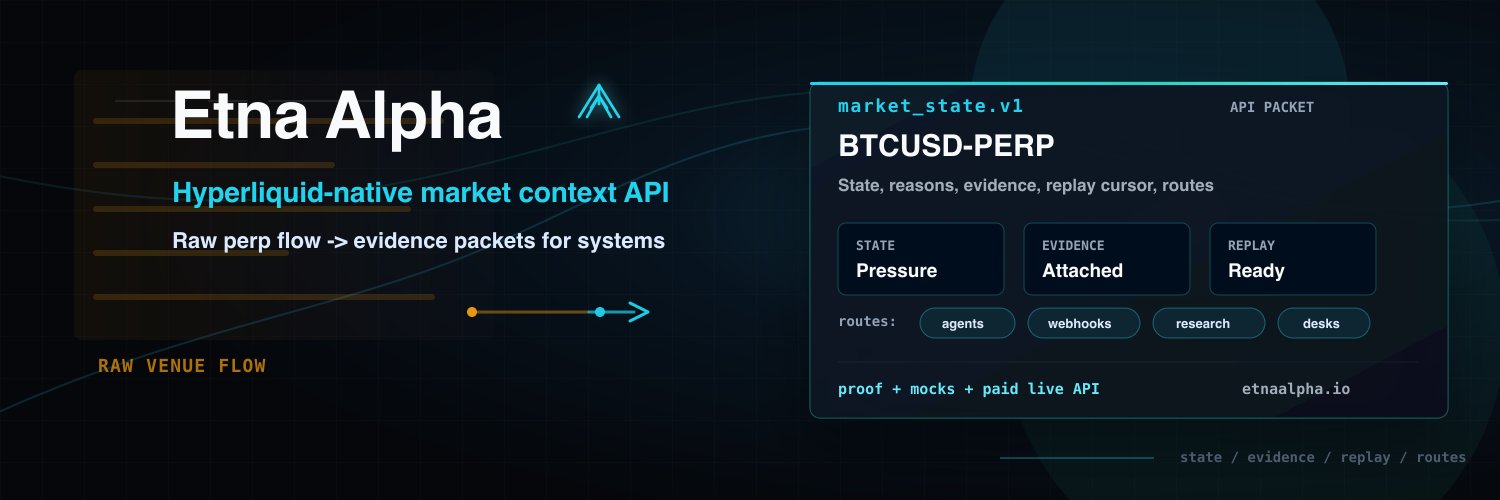
Perp markets move fast.
The tools around them still make teams untangle the same read over and over:
price, depth, trades, pressure, evidence, replay, routing.
Etna Alpha was built to optimize that layer modularly.
Introducing market-state context packets for Hyperliquid-first workflows.
https://t.co/H68wAE1nes
Crypto data APIs give you the tape.
Trades. Books. Candles. History.
But the tape is not the market read.
Etna Alpha turns Hyperliquid price flow into structured market-state packets your systems can inspect, replay, route, and challenge.
Crypto data APIs give you the tape.
Trades. Books. Candles. History.
But the tape is not the market read.
Etna Alpha turns Hyperliquid price flow into structured market-state packets your systems can inspect, replay, route, and challenge.
Crypto data APIs give you the tape.
Trades. Books. Candles. History.
But the tape is not the market read.
Etna Alpha turns Hyperliquid price flow into structured market-state packets your systems can inspect, replay, route, and challenge.
Crypto data APIs give you the tape.
Trades. Books. Candles. History.
But the tape is not the market read.
Etna Alpha turns Hyperliquid price flow into structured market-state packets your systems can inspect, replay, route, and challenge.
Crypto data APIs give you the tape.
Trades. Books. Candles. History.
But the tape is not the market read.
Etna Alpha turns Hyperliquid price flow into structured market-state packets your systems can inspect, replay, route, and challenge.
Crypto data APIs give you the tape.
Trades. Books. Candles. History.
But the tape is not the market read.
Etna Alpha turns Hyperliquid price flow into structured market-state packets your systems can inspect, replay, route, and challenge.
Crypto data APIs give you the tape.
Trades. Books. Candles. History.
But the tape is not the market read.
Etna Alpha turns Hyperliquid price flow into structured market-state packets your systems can inspect, replay, route, and challenge.
Crypto data APIs give you the tape.
Trades. Books. Candles. History.
But the tape is not the market read.
Etna Alpha turns Hyperliquid price flow into structured market-state packets your systems can inspect, replay, route, and challenge.
Crypto data APIs give you the tape.
Trades. Books. Candles. History.
But the tape is not the market read.
Etna Alpha turns Hyperliquid price flow into structured market-state packets your systems can inspect, replay, route, and challenge.
@kiyotaka_ai Raw data providers give you the event stream.
That is necessary, but it still leaves the hard work:
book state, window stitching, feature reads, labels, evidence, replay, routing.
Etna sits one layer above that: raw Hyperliquid flow -> structured market-state packet.
@ArkhasFlow Raw data providers give you the event stream.
That is necessary, but it still leaves the hard work:
book state, window stitching, feature reads, labels, evidence, replay, routing.
Etna sits one layer above that: raw Hyperliquid flow -> structured market-state packet.
Building something around Hyperliquid flow? I’m launching Etna Alpha: a market-context API that turns raw depth/trade activity into structured market_state.v1 packets with reasons, evidence, replay, routes, and usage receipts. Public proof is open here: https://t.co/NALuMsmCL4 , if it’s relevant, I can help you run the first packet loop.
@etnaalphaio
@why0000000000x Replay is where this gets interesting.
A packet should not die after the alert fires. It should carry enough evidence and cursor context that the same market window can be reopened later for research, review, or postmortem.
That is why Etna treats replay as part of the object.
@PolyHistorical Replay is where this gets interesting.
A packet should not die after the alert fires. It should carry enough evidence and cursor context that the same market window can be reopened later for research, review, or postmortem.
That is why Etna treats replay as part of the object.
@davidyjeong Replay is where this gets interesting.
A packet should not die after the alert fires. It should carry enough evidence and cursor context that the same market window can be reopened later for research, review, or postmortem.
That is why Etna treats replay as part of the object.
Agents do not need infinite raw tape first.
They need compact, inspectable context:
state, reasons, confidence, evidence, replay handles, and routes.
Etna packets are built so an agent can consume the market read without hallucinating it from raw depth/trades.
@Quicknode Raw data providers give you the event stream.
That is necessary, but it still leaves the hard work:
book state, window stitching, feature reads, labels, evidence, replay, routing.
Etna sits one layer above that: raw Hyperliquid flow -> structured market-state packet.
@Evan_ss6 Latency matters, but the bigger unlock is what arrives at that latency.
Raw depth/trades are useful, but your system still has to reconstruct state. Etna is built so the market read arrives already structured: state, tags, reasons, confidence, evidence, replay cursor, routes.
@reisnertobias If your system already consumes Hyperliquid flow but still rebuilds pressure, crowding, fragility, replay, and alert context internally, Etna Alpha is built for that gap. Inspect proof. Wire mocks. Start live API access when the shape fits.
https://t.co/nFTcVZR7g4
Raw feeds optimize for delivering events.
Etna Alpha optimizes for time-to-usable-context.
Less reconstruction.
More structured market state.
More context your systems can inspect, route, replay, and challenge.
https://t.co/nFTcVZR7g4
Latency matters, but raw speed is only part of the problem.
Traditional market-data feeds deliver events quickly.
Etna Alpha is built to deliver usable market state quickly.
Live Hyperliquid flow is captured, normalized, and returned as market_state.v1 packets with state, reasons, confidence, evidence, replay cursors, and workflow routes already attached.
The goal is not just faster data.
It is less time between “something changed” and “my system understands what changed, why it matters, and where that context should go.”
The point is not to replace raw market data for every use case.
The point is to give systems a market-state layer above raw flow.
A packet can go to a dashboard, webhook, agent, notebook, alert, or review workflow without every surface rebuilding context from scratch.