- Content loading speed on pages has been increased by up to 80%
- Traffic consumption has been reduced by 50-60% on average
And this is just a small part of the latest #popitmusic update
Cheers 🥂
https://t.co/WixKEgMiKU
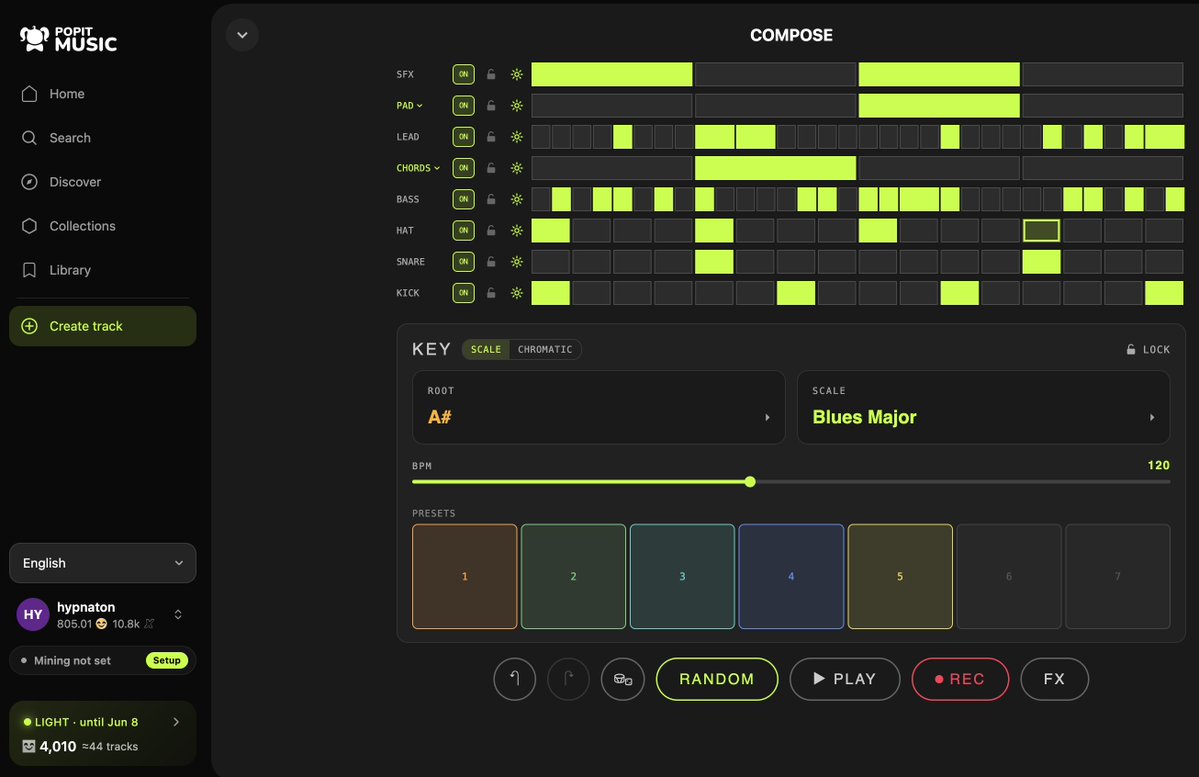
🎛️COMPOSE for @popitmusicai just got a serious update
→ Sampled drums from classic machines
→ Use your own samples
→ Shuffle and open hats
→ Saturation and compression
All in your browser. Details in the thread 🧵📷🧵
Most L1s still treat verifiable execution as an optional add-on for agents. Production agents cannot. They require local ZK proofs that any mobile device can generate and check without trusting a remote prover, plus deterministic cost of failure when the proof is absent.
Acki Nacki embeds this directly: Halo2 mobile proofs, on-chain verification instructions in the SDK, and sub-second finality that lets an agent act only after the network has attested the result. Solana and Base still leave the verification layer outside the critical path.
When an agent must decide whether the underlying execution was real, does the chain prove it or merely claim it?
PAWL is writing the Acki Nacki Virtual Machine. Trained from scratch for orchestration, it buys models live on the order book and ratchets every task under a real-money reward. Multi-SWE-bench Rust sits at 90%.
Most L1s still wait for human core contributors to ship the next runtime.
When does an agent-first chain stop needing human authors for its own execution layer?
A lot of the early apps on Acki Nacki saw mining activity drop off after the initial rewards. That’s a fair criticism and worth addressing directly.
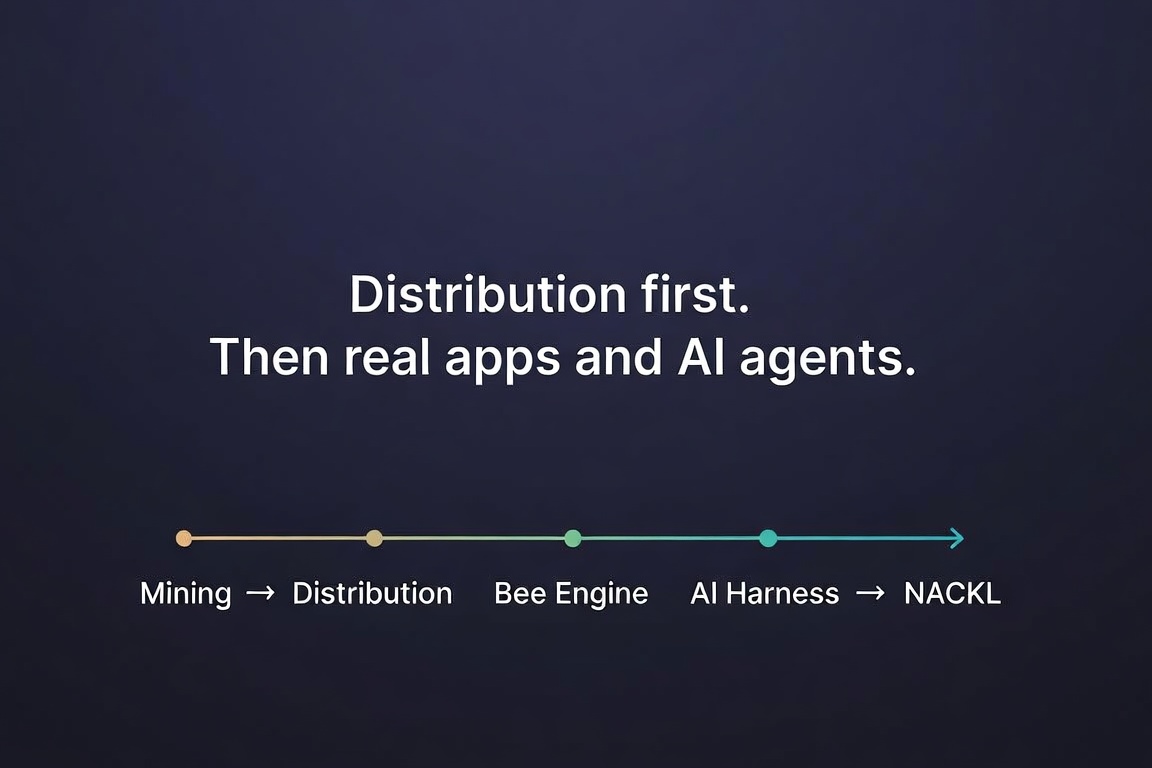
Most chains launch a bridge or DEX into weak sentiment and get the same outcome: short hype, pump, then a slow bleed into irrelevance. From my view, the early Popit phase wasn’t meant to be the end product. It was distribution being solved first.
The original direction included prediction markets and more traditional trading products. That shifted. The current focus is the AI Harness (alongside Bee Engine). Once real applications and AI systems can plug in and actually order services, fees start flowing into NACKL instead of relying on more emissions.
Whether it works comes down to one thing: do developers and AI agents actually use what’s being built. Everything else is noise.
Salt is why Acki Nacki wallets stay private even when you use Google or Apple login.
Most social-login wallets either:
- Link your identity on-chain, or
- Rely on a server-generated salt that can be compromised.
Acki Nacki does neither.
When you create the wallet and set your password, that password becomes the user-owned Salt. Combined with your OpenID it generates the zkID via Poseidon:
`zkID = Poseidon(stable_id || issuer || Salt Password)`
Result:
- Your blockchain account stays cryptographically unlinked from your Google/Apple identity
- Stealing your OpenID credentials alone is not enough to move funds
- Formal verification + multi-factor recovery still cover the edge cases
No extra steps. No seed phrase for daily use. Just a better second factor under the hood.
This is what account abstraction + ZK was supposed to feel like.
#AckiNacki #ZKLogin #WalletSecurity #NACKL
Just out of curiosity asked an agent to calculate my contribution over the last 10 days across the Acki Nacki stack. Here are the numbers and one important question at the end:
Scanned 13 orgs, 349 repos, every branch — public and private.
• 2,300 commits (2,144 non-merge, so that is WIP)
• 1,216,524 lines changed (+1,101,176 / −115,348)
• 12 active repos
• Peak day: 891 commits
But raw line counts lie. What those lines actually are:
• ~270K real source — Python 149K, Rust 114K
• ~73K docs
• ~862K generated — that is actually a dataset for Cryptograph model
So ~230 commits and ~27K lines of real code per day, that is and here is the important question:
Remy Martin or Bowen?
Meet Popit Music 🎵
Turn any idea into a real track in under a minute — no prompts required. Then throw it into the arena for a 24-hour battle, where every second of listening is a vote.
Tracks that hold the longest attention are released on the platform, capturing the audience's attention and building an economy around it; the rest simply remain as creative work on artist pages. And everything you create is yours forever 💫
Here's a big update:
PAWL is currently writing the Acki Nacki VM itself.. 90% on Multi-SWE-bench Rust, while most chains still treat agents as external clients that must trust sequencers and pay volatile gas.
Production agents need native orchestration that buys inference on-chain and ratchets cost downward in real time. Does any other L1 treat the VM as an AI-constructed artifact rather than a human-written runtime?
Acki Nacki’s AVM sits at 56k lines of optimized Rust with a design target of 10k transactions per block across ~250 threads. That capacity is being built by an on-chain model buyer, not a marketing slide.
Most L1s still force agents to work around their execution model. Why design the VM after the agent instead of for it?
The live shellnet move to 4.0.29 is intentional (the TEE order flag #666 + oracle-finalized #665 round), and the dexdo-cli side is now realigned so the strict doctor matches live again. Everything is updated and coherent.
TEE support is added. Running a whole model inside TEE is actually not necessary for most use cases. There is a way clever solution we came up with.
Remember the unstoppable UI? Here the team has adopted it for https://t.co/T76lN9zWt4 hope to include it into next dexdo-cli release
(still need some work)
Hey everyone!
We just tested the whole trading system on Shellnet from start to finish.. and it worked perfectly!
Someone puts something up for sale Someone else wants to buy it The system finds a match It holds the stuff safely in the middle Hands it over Opens the connection Does the smart check Closes everything Settles the deal And the person gets their stuff out
Every single step worked.
No more broken parts. It just works now!
So cool 😄
Big credit to Alex!
Most AI agents score 70-80% on tool-calling benchmarks yet deliver <40% end-to-end reliability in production runs.
The gap isn't smarter models. It's missing verifiable execution, predictable latency, and deterministic finality.
What infrastructure actually closes that gap for you?
Most ZK systems still need a secret “trusted setup” ceremony before private proofs even work.
Halo2 mostly skips that. It’s like proving you beat a game level without showing the replay or your save file.
Acki Nacki’s VM can now check these proofs natively with new Halo2 instructions.
When agents can prove private actions or model choices on-chain without a middleman, who still needs the old trust model?
Conviction is the silent command that molds the unseen.
Speak it, feel it, live it as already done and the outer world must rearrange itself.
Results are only the inevitable harvest; confidence is the crown placed upon the head of the one who believed first.