Is student discipline getting worse?
OECD data show that teachers now spend more time keeping order in their classes than they did six years ago...
... this could impact the number of teachers leaving the profession.
See more: https://t.co/HFmqC0SfKu
JUST IN🚨: Neuroscientists discovered something shocking: your brain doesn't care if your thoughts are true... it just believes whatever you think on repeat
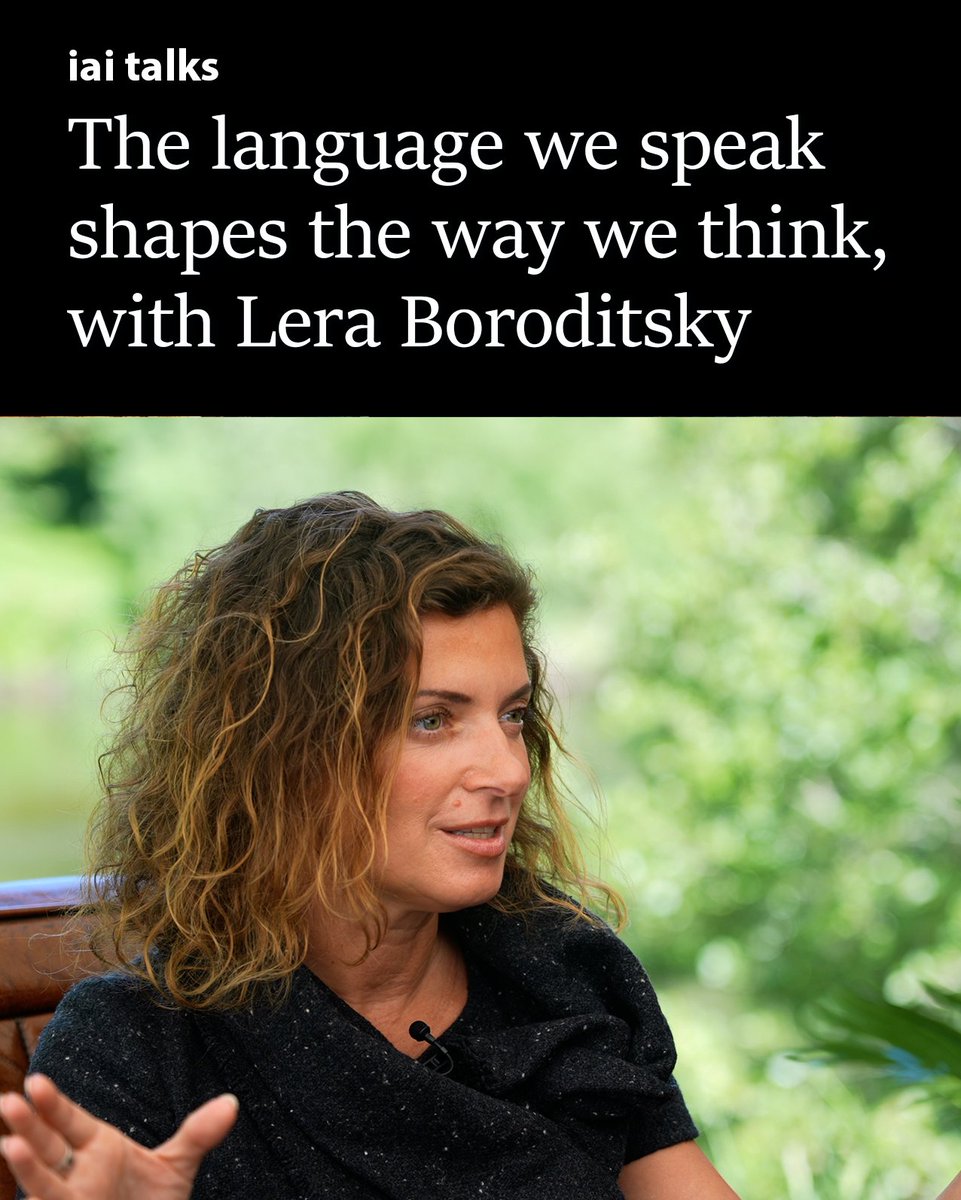
We used to think of language as simply a neutral tool for communication
But Lera Boroditsky argues language does more than just describe the world. It shapes how we perceive space, time, colour, and causality.
One Aboriginal community navigates using cardinal directions instead of "left" and "right," and Russian speakers treat light and dark blue as entirely separate colours, not shades of the same one.
Lera Boroditsky is a cognitive scientist and linguist whose research has transformed our understanding of how language shapes thought.
Tap here to watch her full studio interview on how language shapes thought. https://t.co/1cp1rRNOom
Passacaglia – Handel (Animated Score)
One of the most remarkable works of the Baroque era, Passacaglia by George Frideric Handel is a masterful display of harmonic brilliance and continuous variation.
In this animation, every note and movement was carefully synchronized and rendered in Blender, turning the score into a captivating visual and auditory experience.
Major preprint just out!
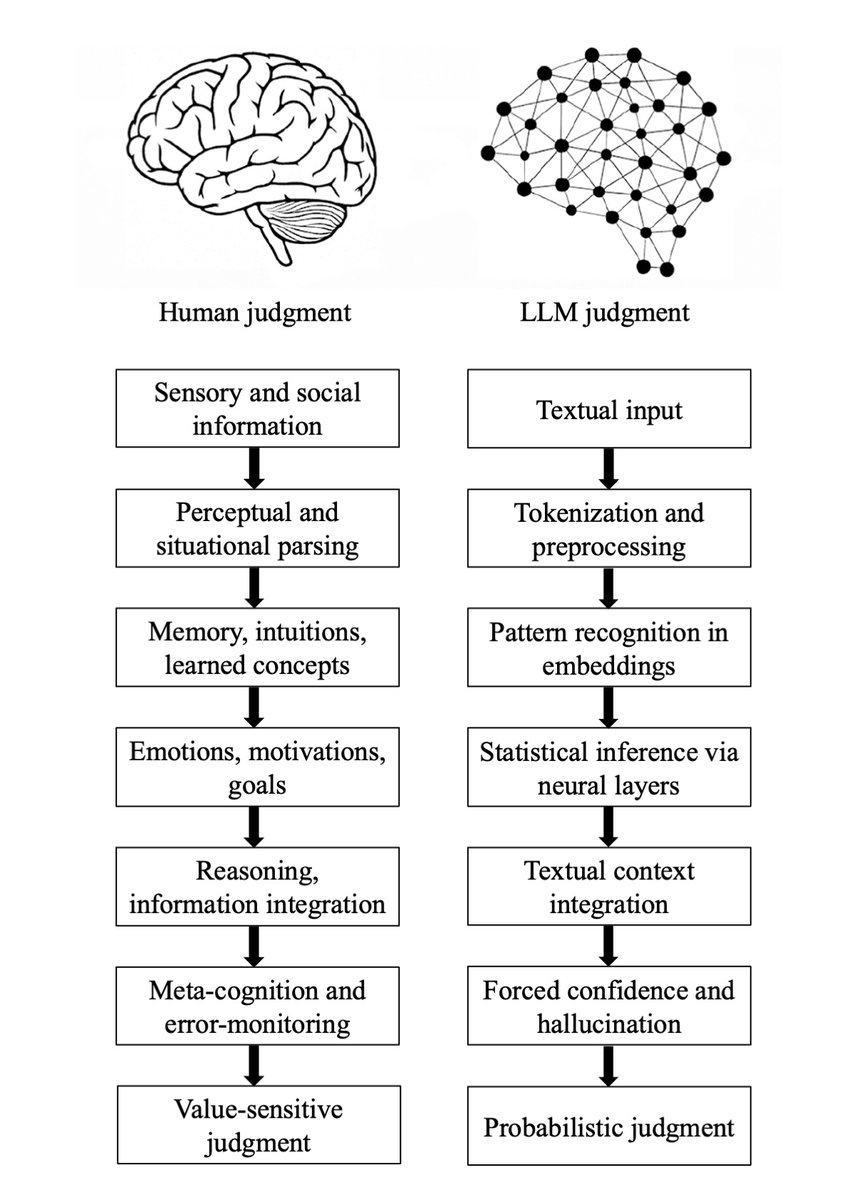
We compare how humans and LLMs form judgments across seven epistemological stages.
We highlight seven fault lines, points at which humans and LLMs fundamentally diverge:
The Grounding fault: Humans anchor judgment in perceptual, embodied, and social experience, whereas LLMs begin from text alone, reconstructing meaning indirectly from symbols.
The Parsing fault: Humans parse situations through integrated perceptual and conceptual processes; LLMs perform mechanical tokenization that yields a structurally convenient but semantically thin representation.
The Experience fault: Humans rely on episodic memory, intuitive physics and psychology, and learned concepts; LLMs rely solely on statistical associations encoded in embeddings.
The Motivation fault: Human judgment is guided by emotions, goals, values, and evolutionarily shaped motivations; LLMs have no intrinsic preferences, aims, or affective significance.
The Causality fault: Humans reason using causal models, counterfactuals, and principled evaluation; LLMs integrate textual context without constructing causal explanations, depending instead on surface correlations.
The Metacognitive fault: Humans monitor uncertainty, detect errors, and can suspend judgment; LLMs lack metacognition and must always produce an output, making hallucinations structurally unavoidable.
The Value fault: Human judgments reflect identity, morality, and real-world stakes; LLM "judgments" are probabilistic next-token predictions without intrinsic valuation or accountability.
Despite these fault lines, humans systematically over-believe LLM outputs, because fluent and confident language produce a credibility bias.
We argue that this creates a structural condition, Epistemia:
linguistic plausibility substitutes for epistemic evaluation, producing the feeling of knowing without actually knowing.
To address Epistemia, we propose three complementary strategies: epistemic evaluation, epistemic governance, and epistemic literacy.
Full paper in the first reply.
Joint with @Walter4C & @matjazperc
Antonio Damasio, a giant in the field of consciousness research, has a fascinating new book, out today: Natural Intelligence & the Logic of Consciousness by Antonio Damasio: 9798217207497 | https://t.co/jwZwwc49BW: Books https://t.co/MJJsnJw7nI
Writing by hand activates large brain regions linked to memory, learning, movement, language, and visual processing.
Forming each letter requires unique, precise motions that strengthen neural connections and help the brain encode information more deeply.
Typing uses repetitive key presses, reducing activity in many interconnected sensorimotor and memory-related networks compared to handwriting.
Source: Norwegian University of Science and Technology (NTNU)
For some time Daron Acemoglu has been the colossus of economics. Give an economist a few drinks, however, and some of them will venture their true opinions about this giant, https://t.co/nTG2MnVUoD
Photo: Shutterstock
China’s new-home prices fell at a faster pace in July, denting optimism that the prolonged property downturn may be nearing a bottom https://t.co/pFLvCqpomJ
Postmodernism’s critique of everything from truth to art has left us in the intellectual wilderness.
Greg Dember argues that Metamodernism, a nascent movement which protects subjective experience from the ironic distance of postmodernism whilst rejecting the scientific reductionism of modernism, is the solution to our need for a new–ism.
“That modernism was preoccupied with propelling humanity forward with the quest of pursuing objective, universal truths, and postmodernism was preoccupied with drawing attention to what was missing in modernism: an awareness of context and relationship,” argues Dember.
Tap here to read more. https://t.co/jWiVWkiCKb
⚡️A civilization reproduces through people who still believe life is worth continuing.
The West’s dominant culture increasingly treats children as a cost, adulthood as indefinite self-exploration, sacrifice as oppression, and inherited identity as something to dismantle. Smaller communities that treat family, continuity, religion, and descendants as sacred operate under a completely different reproductive logic.
One culture optimizes the present individual.
The other carries itself into the future.
Over enough time, institutions begin reflecting the values of the populations that still reproduce, remain cohesive, and successfully transmit their worldview. The decisive variable is therefore not fertility alone. It is fertility multiplied by retention.
A high-fertility community whose children assimilate into the low-fertility mainstream eventually converges.
A high-fertility community that preserves identity, family formation, and belief across generations gains enormous demographic power.
That is what the blended national number conceals. It averages together cultures moving toward different futures and makes the divergence look stable.
The deepest signal is this:
A culture that cannot persuade its own people to create successors is surrendering the future before any election is held.
Mark Steyn explains the stark demographic reality: a 90% population with 1.3 children per couple and a 10% population with 3.5 children will have roughly the same number of grandchildren in only two generations. The transformation is already underway.(2010)
Mark Steyn explains the stark demographic reality: a 90% population with 1.3 children per couple and a 10% population with 3.5 children will have roughly the same number of grandchildren in only two generations. The transformation is already underway.(2010)