Conclusions from Tivat 🇪🇺🇲🇪 - strong support for Montenegro's 2028 EU ambition, renewed commitment to the Western Balkans' EU future, and growing focus on advancing integration before accession.
Faster where reforms are delivered, but still fair, credible and merit-based.
The work towards ending roaming charges for our candidate countries in the Western Balkans is clear evidence of how we are integrating them while they negotiate their full EU membership.
Citizens will see the difference this makes immediately when it comes into effect. And at the end of the day, all our work in the accession process is focused on making people’s lives better.
I’m delighted to see EU member states adopt our proposal to give the European Commission a mandate to discuss the practical steps for removing roaming charges with the telecommunications operators.
As Kosovo heads toward its third election in 16 months – with few signs that it will resolve the political deadlock – acting PM Kurti faces accusations of using public money to swing voters.
Read more:
https://t.co/qvPDwt8Qou
While the final vote awaits the July plenary, the AFET vote sends a clear message: democratic backsliding cannot be ignored. A credible enlargement policy requires accountability, and support for those working to defend democracy and the rule of law. 🇪🇺🇷🇸 (🧵6/6)
We welcome the adoption of the Serbia Report by the European Parliament's Foreign Affairs Committee (@EP_ForeignAff ): one of the strongest messages the Parliament has sent on Serbia in recent years. 🇷🇸
(🧵1/6)
Equally significant is the call to reassess further disbursements under the #ReformandGrowthFacility if Serbia fails to meet key commitments on democracy and the rule of law.
Accountability and conditionality are essential to a credible enlargement process. (🧵5/6)
Serbia’s government continues to say EU membership is its strategic goal, but this has often not been reflected in its actions, MEPs warn in a new report. 🇪🇺🇷🇸
Press release 👉https://t.co/WjOuital5T
Rapporteur @TPicula
It seems readily apparent what the sequence of events in Bosnia will be if/when Antonio Zanardi Lendi is installed as the next, and likely final, High Representative:
• There will be an immediate push for a new state property law, likely with a tight deadline, i.e. ahead of the Bosnian general elections later this year. The U.S. will push for its passage through the state parliament and almost certainly has already secured the support of the secessionist SNSD. That likely means their partners in the Croat separatist HDZ are also already on board. The Sarajevo-based governing and opposition blocs have probably already been threatened with sanctions if they do not fall in line. The Troika will no doubt, SDA and DF may waffle but probably will as well. The details of the law seem less significant than what will follow but the same will nevertheless likely be largely favorable to Dodik and the HDZ.
• On the off chance that the law cannot be adopted in timely fashion, Lendi will use the Bonn Powers to impose the legislation. However it is adopted, Lendi, Dodik, Covic, and the U.S. will claim the 5+2 Agenda has been realized and that the OHR can therefore be closed. That will also likely be accompanied by a push for the ouster of the last international judges from BiH, and the wind down of EUFOR, to fully decouple BiH from any form of international oversight.
• Assuming all of that is accomplished by Q1 of 2027, and the elections produce the most probable outcomes - i.e. systematic electoral fraud resulting in governing majorities for the SNSD and HDZ - Dodik and Covic will concoct a major secessionist/‘third entity’ crisis within six to eighteen months of that date. Indeed, they may block the formation of a state government entirely to expedite said crisis, and to maintain control over key security portfolios which the Troika handed them. How that plays out is anyone’s guess but “not well” seems probable given the complete absence of international mediation mechanisms. The police standoffs we saw in 2025 will likely be repeated at considerably larger scale and higher temperature.
In sum, with a leadership vacuum in Sarajevo, and familiar European geopolitical dwarfishness, I expect major turbulence in BiH and the Western Balkans in 2027.
One year later, this mission continues to guide everything we do. We remain committed to building stronger bridges between civic actors on the ground and institutions shaping the region’s future.
Thank you to everyone who has been part of this journey so far.
Over the past year, we’ve seen both the increasing pressure facing civil society in the Western Balkans and the incredible resilience, courage, and solidarity of organizations and activists across the region.
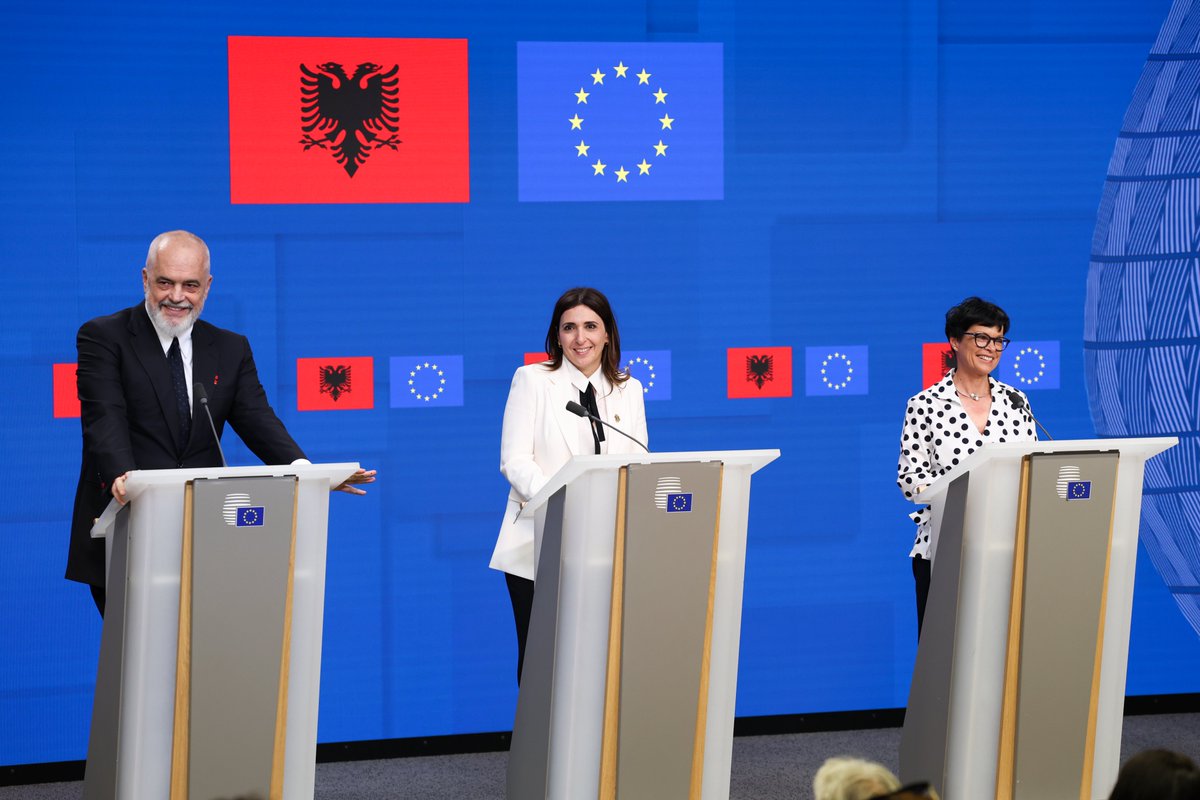
A big step forward for Albania on its path to EU membership!
With Albanian Prime Minister @ediramaal and Cypriot Deputy Minister for European Affairs @marilena_raouna in Brussels today, Albania reached the interim benchmarks, and we set the closing benchmarks for fundamentals such as an independent judiciary and anti-corruption measures.
This is a major milestone as it allows #Albania to start closing negotiating chapters.
Now begins the most demanding phase of the negotiations, preparing to join the Union, and further build the trust with Member States.
Congratulations to Montenegro on 20 years of independence! 🥳
In a region with a complex history, mutual respect for neighboring countries’ choices and measured rhetoric matter for preserving good neighbourly relations.
Built for journalists, researchers, observers, and citizens following political developments in Serbia 🇷🇸
Part civic tech, part election betting simulator.
And good luck to everyone trying to decide whether it’s safe to book summer holidays yet.(🧵/end)
'So… when exactly could elections in Serbia take place?' At this point, Serbian political analysis resembles weather forecasting mixed with sports betting.
So our @CRTArs colleagues embraced the chaos and built this:
https://t.co/MBZRJ6WsBq
(🧵/1)
The 🛠️lets users explore different election📆scenarios and understand the legal deadlines tied to them, including when elections would need to be called, and when resignations would be required. An accessible way to make 🇷🇸’s complex electoral procedures easier to follow. (🧵/2)