1/n
Out today in @Nature: our Alzheimer’s disease GWAS of ~2.8M people (~184k cases). We find 48 new loci, ~3x higher SNP-heritability, enrichment in genes up-regulated in microglia and down-regulated in neurons, and we release public summary statistics. https://t.co/XKNxI8f0XF
RGC contributed association summary data to a new @Nature study led by @VUamsterdam. The study found 48 new genetic regions associated with Alzheimer’s disease, with risk concentrated in microglia and neurons.
Discovery of 48 new, common genomic loci (a ~60% jump) associated with Alzheimer's disease. A high proportion of the new loci are tagged to brain immune cell (microglia) function @Nature
https://t.co/yd3D6E4DbK
I just want to add some of my favourite parts from the paper. We used publicly available scRNA-seq data to identify potential cell specific mechanisms for the loci we identified. Here are some examples in cell types other than microglia: 1/8
1/n
Out today in @Nature: our Alzheimer’s disease GWAS of ~2.8M people (~184k cases). We find 48 new loci, ~3x higher SNP-heritability, enrichment in genes up-regulated in microglia and down-regulated in neurons, and we release public summary statistics. https://t.co/XKNxI8f0XF
@MKarlstetterPhD Thanks! No, we didn’t. We tested genes differentially expressed in AD cases vs. controls (enriched for genes upregulated in microglia) and, separately, microglia-specific genes in controls. Would be interesting to test genes that shift expression with age
1/n
Out today in @Nature: our Alzheimer’s disease GWAS of ~2.8M people (~184k cases). We find 48 new loci, ~3x higher SNP-heritability, enrichment in genes up-regulated in microglia and down-regulated in neurons, and we release public summary statistics. https://t.co/XKNxI8f0XF
7/n
Special thanks to @Dubhghlaso (shared first author), my PIs @DPosthu and Ole Andreassen, and the whole Alzheimer’s Disease Working Group of the Psychiatric Genomics Consortium (PGC-ALZ) @PGCgenetics
Excited to share our new @NatureHumBehav paper reporting within-family heritability estimates (the gold standard design unconfounded with population stratification, shared environmental effects and assortative mating) from 500,000 siblings pairs of diverse ancestries.
If you’ve ever run a GWAS, chances are you've used COJO (Conditional and Joint analysis). Well, we've extended and improved (up to 100× faster 🚀) this essential tool in the GWAS toolkit to enable joint analyses across multiple ancestry groups.
Paper:
https://t.co/eXpiCYBSix
1/
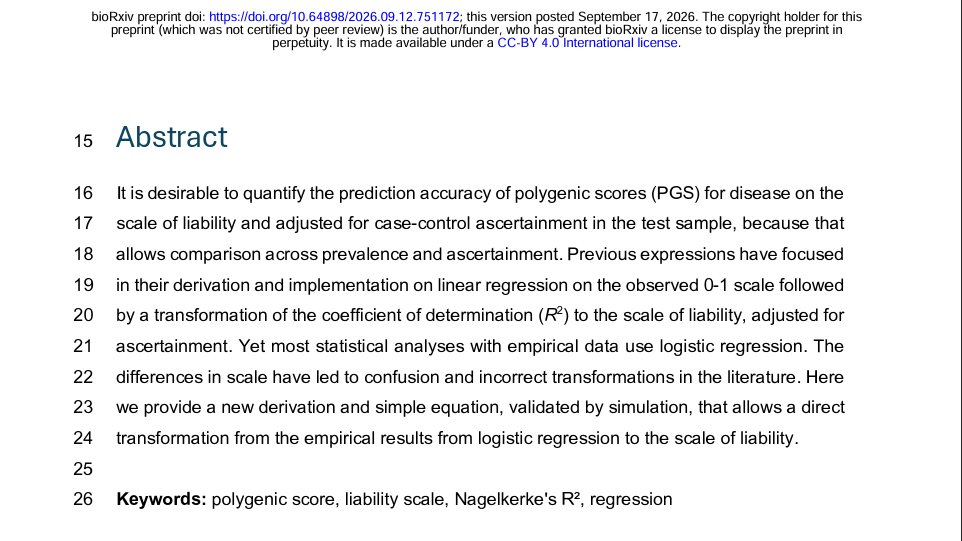
New preprint 🧵
Lee and colleagues (Genet Epidemiol, 2012) introduced a canonical formula to transform linear-regression variance explained (R²) to the liability scale.
6/
We provide an R function to implement the conversion. It applies directly to previously published Nagelkerke R² estimates, placing them on a comparable scale without reanalyzing individual-level data.