Taking a profit is often a "damned if you do, damned if you don't" dilemma.
While taking a profit is always better than taking a loss, there are times when taking a profit can create anxiety and outright regret.
Let's say you buy a stock at 50 with a mental target of 100 and maybe the possibility of 150.
Next let's say the stock goes to 100 but you do not take profits.
Next let's say that your trailing stop (if you use these) takes you out of the trade at 80.
Do you then regret not taking profits at 100? Of course you do if you are even part human being.
But what if you would have taken profits at 100 but then the stock kept running? Chances are you would have also regretted the decision to take profits at 100.
You see, taking profits is a damned-if-you-do-damned-if-you-don't business.
I hate regret. I decided many decades ago in my 50 year career that regret is something a trader needs to avoid. Living in a cycle of regret is not healthy for trading will sooner or later come back to bite you.
So I made a decision to create rules and stick by them. Rules created process for me so that my emotions were not led around by my last or current trade.
I take profits at targets when I have a light position on. If I take a heavier position I will then take profits at the initial target on a portion of my trade and hold out for a 2X profit on the other portion.
Do I miss the occasional rocket-ship market by taking profits? Of course. There is no perfect trading plan.
There is an alternative way that from time to time I will employ in a trade. That is using a simple moving average on a partial position so that I adopt a trend following approach on some of the risk I take.
In a trade following approach inevitably the top cannot be picked so some money is given back at the trend change or major correction. But again, there is no perfect model.
My recommendation to new traders is to commit yourself to the path of least regret, whatever that might be.
Now that we are near price discovery, a few things to consider:
You are going to see some insane price targets for the end of the cycle.
Most of this is just bullish hopium and euphoria—be careful not to get caught up in it.
There is no way someone can predict where and when the cycle will end with a high degree of accuracy.
The majority of people are purely guessing; some will use technical analysis (TA) and other strategies to make more "educated" guesses.
However, these are guesses nonetheless.
To avoid falling prey to the obscene euphoria we're likely to start seeing, it's best to create a solid plan of action.
How will you exit the market in order to maximize your gains and minimize the amount you give back?
Below, I'll explain my thought process as it relates to my spot holdings, specifically Bitcoin.
Once the top is in, prices will begin to distribute.
This can last anywhere from a few weeks to a couple of months.
During this time, we usually see the last hurrah for altcoins.
After distribution finishes, prices typically fall off quickly, often dropping 50% or more before slowly declining for the remainder of the bear market as volatility dries up.
What this means is if you mistime the top, you can see 50% or more of your gains disappear quickly while you wait, hoping for prices to continue higher.
So how do you avoid this?
I'm going to share three rules that I used over the last two cycles to help me sell near the top and keep the majority of my bull market gains.
1 - Market structure.
Once daily market structure was broken in both the 2017 and 2021 cycles, the top was in.
In 2017, there were two clear levels you could have used as your market structure break.
Once market structure (MS) was broken, you exit on the next bounce.
For what it's worth (Fwiw), this also worked at the $14k top in 2019.
In 2021, the same applied for both the April/May and November tops.
This cycle has been a bit trickier, as the last 6+ months of consolidation have seen multiple daily market structure breaks.
So, instead of relying purely on daily market structure, I will also use the 3-day (3D) market structure for confirmation.
The 3D chart will confirm more slowly, but once that breaks, I'll be confident the top is in—barring some kind of aggressive reclaim
2 - Portfolio Targets
This one is pretty straightforward. I have a few portfolio-level targets in mind, both conservative and more ambitious ones.
Once those levels start getting hit, I begin cashing out.
3 - Price Targets
This is the most difficult one because, as I said earlier, it's a guess.
I've always erred on the more conservative side. In 2017, I started cashing out above $10k, and in 2021, I started selling between $40k and $50k.
Did I nail the top? No, but I was close, and when prices were trading 50% lower not long after, I was very happy with my sells.
Keep in mind, I was fortunate enough to buy near the bear market lows, so selling anywhere near the top resulted in an amazing return.
What happens if your price target isn't reached? Refer back to rule number 1. If market structure starts failing before your targets are hit, perhaps your targets were too aggressive.
Summary
The beauty of the above rules is that they all work in unison. Just because you've exited the spot market and locked in your gains doesn't mean you can't still trade.
If for some reason we nuke and break market structure, but then aggressively reclaim the level, you can always get back involved.
I'd prefer to lock in gains and potentially buy back higher rather than keep holding and risk giving back a lot in a 50% drop.
I didn't sell at the exact top, and yes, when prices kept climbing after I sold, I did feel FOMO. But that quickly went away when prices dropped 50%, well below where I exited.
You just want to be close.
This is all my opinion, of course, and it's what worked for me over the last two cycles.
I am also admittedly much more conservative than many of you here. This isn't my first cycle, and I don't need to 100x to "make it."
For what it's worth, my price targets for Bitcoin are $100k/$110k on the low end and $150k on the high end.
I'll likely be selling and locking in gains well before the exact top is put in, and that's okay with me.
This is an extremely long post, but I went over a lot of what is written here in my YouTube video last night.
GLHF.
https://t.co/h8GmDNfrqu
Bull cycle guide
This thread is going to contain numerous tips to help you maximise gains when the market is trending to the upside.
Before I touch on strategies to take profit. It's important to manage your risk appetite first. If you are participating with funds required to pay for rent or your weekly food shop. This will drastically impact your decision-making, as they will be driven by your emotions.
When you have found an amount that you are comfortable investing in the market. It's also important to spread your risk. Putting all of your eggs into one basket will increase the likelihood of you cutting winners early or holding on to losers. It is far easier to let winners run when the position takes up a smaller percentage of your portfolio.
Another common mistake I see is traders fully closing a position early to try and re-enter again with full size. This is counterproductive for the majority as you will find yourself holding a smaller position in comparison to what you started with.
I am forever seeing people say - damn, I sold way too early. The price is now up 10x! I wish I held. It's too late to buy back in - price proceeds to do another 10x. I think you get the gist.
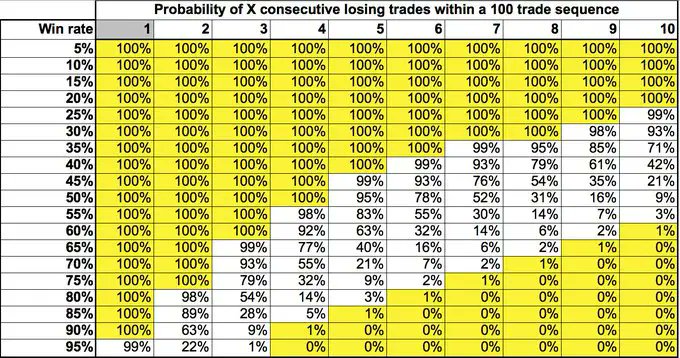
This is common when you oversize positions due to fear of losing. Be realistic with how often it is normal to lose a trade.
How do I mitigate this better?
Skim your position size on the way up. You also have the option to buy back a portion of what you sold during retraces in an uptrend. Paying yourself gradually will allow you to hold winners for longer.
At what point do I take profit or buy back?
If a coin is yet to go through a cycle and it has been down only. They are easier to navigate during the earlier stages of a trend reversal. It will give clear price targets - supply zones. Also good areas of confluence to buy back - previous supply now demand. Volume profile is also very useful to identify reclaims of importance alongside moving averages.
When a coin heads into price discovery, this is a little more complicated.
What tools do I use to identify that price is extended?
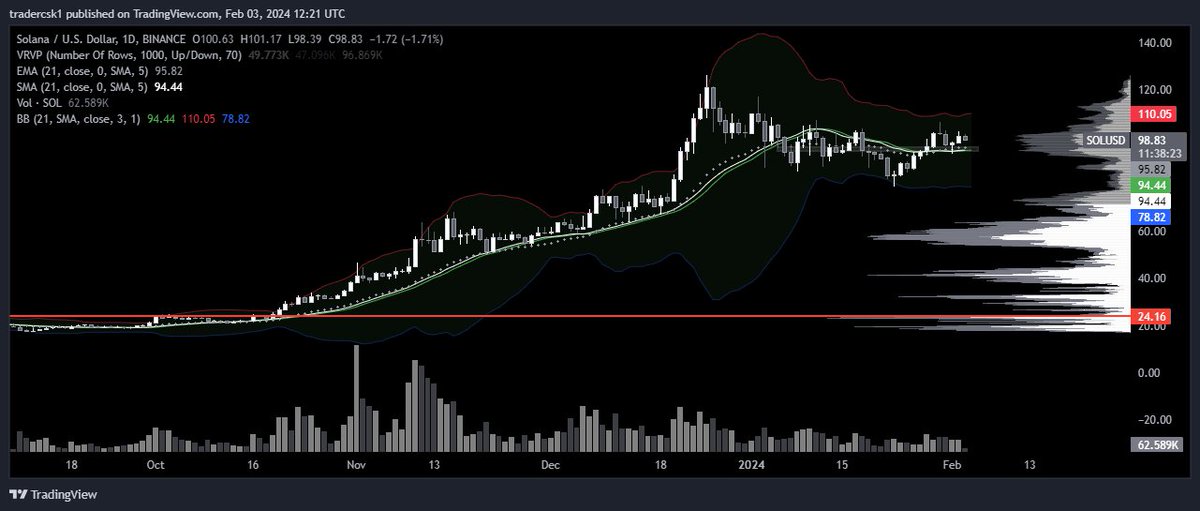
Bollinger bands on high time frames.
Study older coins and customise your settings. Use this as a guide to show you when the price may be overextended.
Fibonacci indicator.
This will give you rough target points, which may coincide with the top of your bollinger band for an extra layer of confluence.
Marketcap.
Depending on the coin. It will have psychological levels where people will naturally take profit.
For example, 1M cap entry. 10M cap take profit/exit.
Price.
Round numbers - e.g 10 cents, $1, $50, etc, is typically where people will take profit.
Be realistic with your targets. If you're holding something at a price of 0.00005 cents per coin with a 1B marketcap. Ignore anyone that tells you it's going to $1.
Circulating supply marketcap vs fully diluted valuation.
FDV is less of a problem during a bull market. Try not to get caught up in those numbers as it may result in you selling early. This is more of a problem when the music stops and the trend changes. You do not want to be left holding the bag.
How do I know when the trend changes? When should I fully exit my position?
I use moving averages to determine when the price is still in a strong trend on the daily time frame. If it falls below a key moving average. That signals to me that the trend is over, and I need to fully exit the remainder of that position.
Realizing gains.
When you are taking profit. It is important to remove a portion entirely out of the market. If you don't do this, it is completely pointless.
It is extremely common for participants to make a lot of money and then round trip their entire stack back to where they started.
Treat yourself and your family. Enjoy it and don't lose track of value. It's easy for this to happen when you're looking at numbers on a screen. If it can change your life and your loved ones. Don't give that back to the market.
Remember to stay grounded.
If you found this thread helpful. Like, share, bookmark, all of that good stuff.
Thanks for reading.
Only 5 HOURS LEFT!
Our Elliott Wave Mastery eBook drops FREE tonight!
Learn to read waves, predict market moves & trade smart — at zero cost. Who’s grabbing it? Drop a “YES” if you’re ready!
🔁 Retweet to share with your trading crew!
❤️ Like if you love free trading gems!
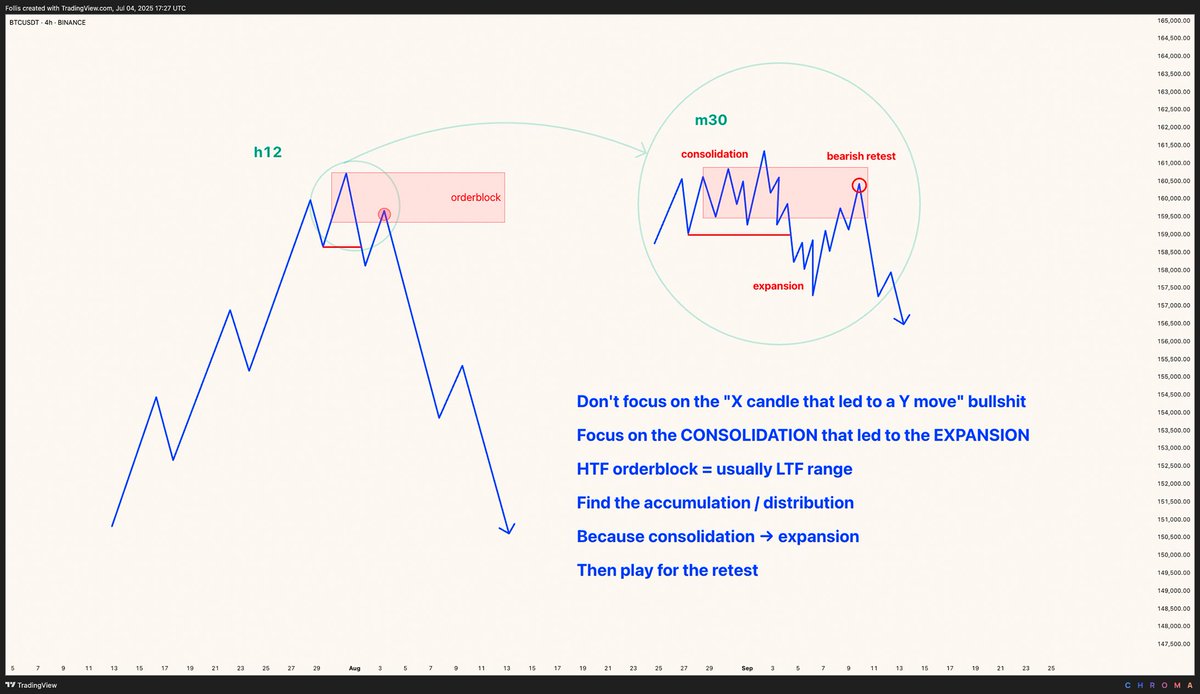
Something I see traders get wrong time and time again is supply & demand
Too many get caught up with the "X candle that led to a Y move that broke Z structure" stuff
Instead, you should be focussed on the following question:
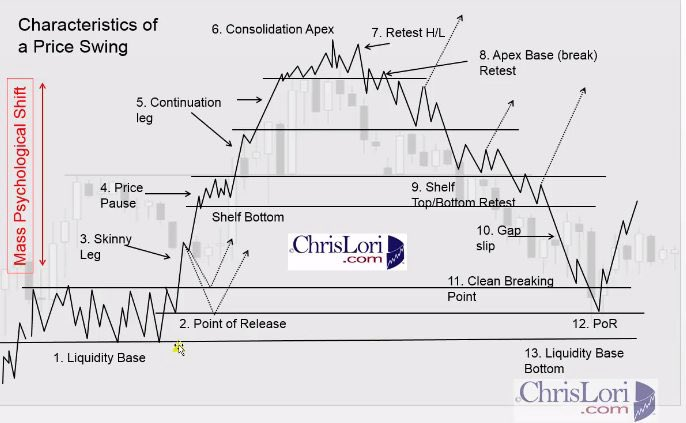
What was the CONSOLIDATION that led to the EXPANSION?
HTF orderblock candles are usually LTF consolidation ranges
This chart illustrates what I mean by this
So when you are looking for an supply/demand zone or orderblock to be retested
What you are actually looking for is a retest of that consolidation range
Which is exactly how we are taught to trade range breakouts — you wait for the retest, then play the confirmation
Consolidation → expansion
The big money in booms is always made first by the public on paper and it remains on paper 📜🗞️ but a speculator makes money in bear or bull ones.
$NVS $CTAS
$HQY $SBET
$STX $TFPM
$META $AVGO
$PWR $FTDR
$CAKE $CRBL
$NDAQ $BPOP
$GEV.
This is a chart pattern I term as "J" hooks. J-Hooks almost immediately lead to vertical moves. Some of my best trades in my 50 year career have come from J Hooks
If I'm EVER having the internal debate about if I should take profit on a position or not, I ALWAYS take profit.
Watching price retrace AFTER I've had that internal dialog and not taking profit is absolutely soul crushing.
It feels better to take profit and see it continue pumping while understanding that I can enter during the next consolidation period.
Rather than, not taking profit at all and watching price retrace or even fully go back to my entry.
This is one of those topics that no amount of educational content will hit home quite like going through it several times and simply not wanting to feel it anymore.