@Sentdex@__K8r@ApplyWiseAi You want oss to succeed, so you cope about frontier model improvement being negligible and it's all harness. This is literally the definition of cope. Anyways, up to you what you want to call it
@Sentdex@__K8r@ApplyWiseAi I'm not sure how better to put it besides what I said above. I think it's fine / desirable to want oss to succeed but saying frontier model improvement has been negligible and it's just harness improvement is coping.
@Sentdex@__K8r@ApplyWiseAi You're coping that model perf improvement is negligible. Both benchmarks and effectiveness in "actual" work has been steadily improving
Super excited to announce seven new world-class MAI models today. They represent what we consider a new era in AI designed to keep you in control and on the frontier.
First is our text foundation model, MAI-Thinking-1, exceptionally strong on reasoning and SWE tasks.
- It’s a 35B active parameter MoE with a 256K context window. Independent human raters on Surge prefer it for overall quality in blind side-by-sides versus Sonnet 4.6, and it’s achieved 97% on AIME 2025, the key measure of its general-purpose reasoning abilities.
- It's at 53% on SWE Bench Pro, placing it right alongside Opus 4.6 on one of the toughest coding benchmarks.
- And since we co-designed our models with our own silicon, MAI-Thinking-1 is optimized on our MAIA 200 chip. Benchmarking head-to-head against the GB200, we see 30% better performance per dollar as well as a 1.4x performance-per-watt gain when running our MAI models on the MAIA 200 end-to-end.
Next is MAI-Image-2.5 and its Flash variant. Two super strong models now at #2 on the leaderboards, surpassing the score of Nano Banana 2 on image editing.
Last for now is MAI-Code-1-Flash, our new inference efficient coding model, especially tuned for VS Code and GitHub Copilot CLI.
- Code-1-Flash achieves 51% on SWE Bench Pro, despite having just 5B parameters, putting it closer to Haiku in size but cheaper in cost.
All of this is the foundation for Microsoft Frontier Tuning. It lets you customize our models to create custom, company-specific agents that only you control. You can make our model, your model. Your data. Your agents. Your moat.
Early adopters are already seeing a difference. When we tuned our models for McKinsey’s tasks, MAI delivered the highest win rate, outperforming GPT-5.5 on quality, while being 10x lower on cost.
Also really excited to be collaborating with the amazing team at Mayo Clinic to jointly train a new frontier AI model for healthcare.
Our announcements today mark another milestone on the road to humanist superintelligence. You can learn more and about our other new models in our latest blog: https://t.co/v65eop5Ixq
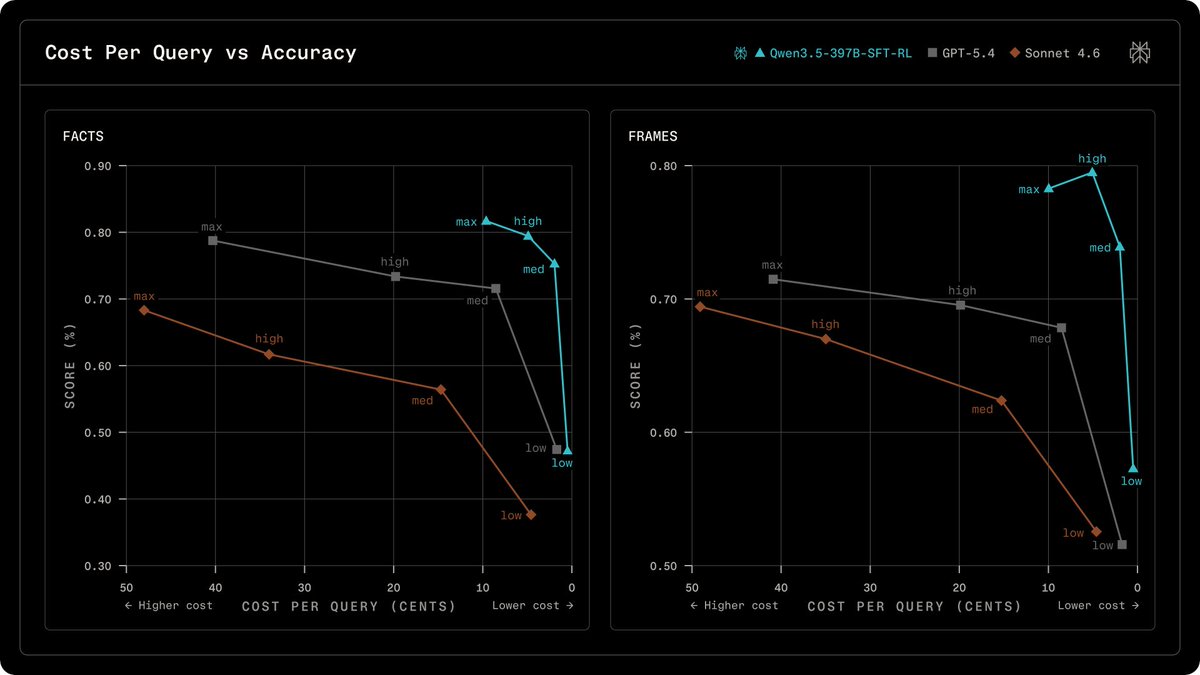
We've published new research on how we post-train models for accurate search-augmented answers.
Our SFT + RL pipeline improves search, citation quality, instruction following, and efficiency.
With Qwen models, we match or beat GPT models on factuality at a lower cost.
@official_j3rck Does this actually matter since rope is relative? I feel like you will still get identical results whether you use the "correct" position ids or range(0, max_tokens)
@SukaruAnow@Jahnbeetwif@FangYi11101@flxia_ Not really, right now he's gettin the distribution over the two dice. Another way to see it, suppose he rolled just 1 dice 10k times and recorded that, you'd expect to see a uniform distribution, not a normal, since all he's doing is sampling from underlying distribution.
@seconds_0 why does he need to publicly write code to be correct about model behavior or research in general? not saying i agree with his take, just a weird standard to have
@ctjlewis I mean, this is a real thing that he tried and it worked, no? Unless you think he's lying / exaggerating
Anecdotally my experience is similar -- went from ~100% handcoded in Nov to ~5-10% in Dec. I'm still heavily in the loop and manually approve almost everything tho
@HaareBlond@Sentdex Sure but you can say RL a particular policy, say do a backflip, but the robot can't do anything else. This is what I mean by fixed movements