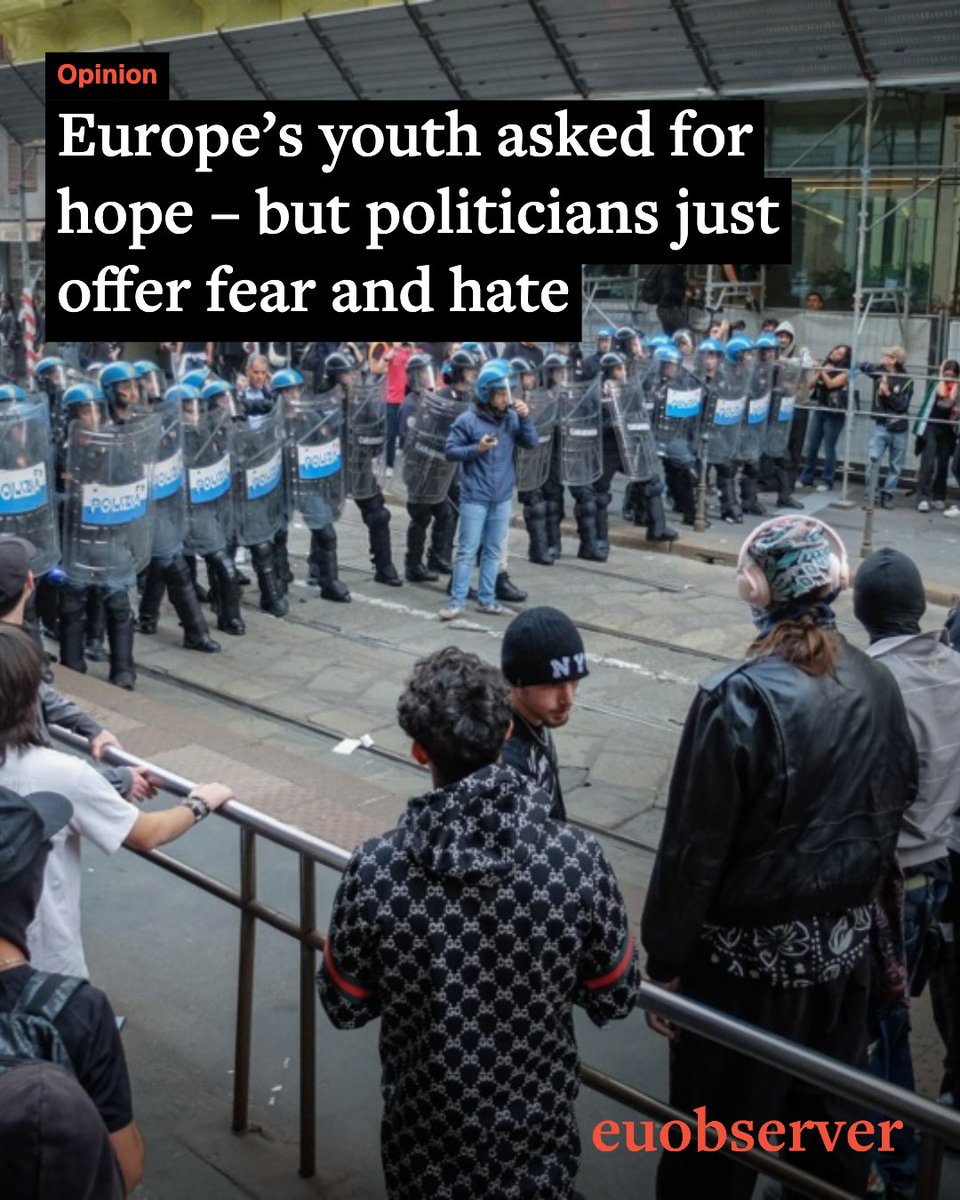
Europe's young people are demanding a future. But too often, politics is offering them someone to blame instead. 🇪🇺
Across Europe, young people are protesting unaffordable housing, cuts to education and growing economic insecurity.
Yet as these frustrations deepen, political debates are increasingly dominated by migration, national identity and security — issues often framed through fear rather than solutions.
In our latest opinion, Shada Islam argues that this is more than a failure to listen. It's a political choice about which concerns get attention, and whose voices are left out.
🔗 Read the full opinion at https://t.co/HDMDCXopTf 👉https://t.co/HRj02Jr7kF
Human cost of Putin’s war emerging in ‘death fields’ of Russian soldiers in Dobropillia (Ukraine Battlefield update, day 1,700) https://t.co/It9yaoxXLv
[Interview] ‘I hear MEPs says Muslims are a threat, with no consequences. I say Free Palestine and I’ll be arrested’. MEP Benedetta Scuderi warns protest repression is being normalised in Europe https://t.co/k4kceVPb9s
EU governments want to cut foreign aid by 17%. MEPs want to increase it by €25 billion instead. 🇪🇺
Europe's next budget is becoming a political battleground.
While the Irish EU presidency has proposed €38bn in cuts to the bloc's foreign spending, MEPs are pushing back — calling for more funding for humanitarian aid, Gaza's reconstruction and countries seeking EU membership.
In our latest article, Benjamin Fox looks at the growing clash between EU governments and Parliament and what it means for Europe's future priorities.
🔗 Read more at https://t.co/HDMDCXopTf 👉 https://t.co/YKCSrANlvZ
Spain's left had one last chance to unite before November's election. It didn't happen. 🇪🇸
With the snap election on 29 November approaching, parties to the left of Pedro Sánchez's Socialists have failed to agree on a joint electoral platform.
Old rivalries, political disagreements and what one politician described as a “war of egos” have left the left more fragmented than ever.
Meanwhile, the centre-right People's Party has left the door open to governing with the far-right Vox.
In our latest opinion, our editor-in-chief Elena, looks at why Spain's left failed to come together — and what this division means for voters looking for a political alternative.
🔗 Read the full opinion at https://t.co/HDMDCXopTf 👉 https://t.co/mux5M2CsFQ
Europe says it won't buy Arctic oil and gas. So why has it dropped its call for a drilling ban? ❄️
The European Commission has unveiled its new Arctic strategy, promising to keep fossil fuels in the ground — but quietly removing its earlier push for an international moratorium on drilling.
The shift follows months of lobbying from Norway, which argues that Arctic resources are important for Europe's energy security.
Brussels insists it doesn't need them. So why soften the strategy if Europe's position hasn't changed?
In our latest article, Wester van Gaal looks at the politics behind the decision — and what it means for the future of one of the world's most vulnerable regions.
Read more at https://t.co/HDMDCXopTf 👉 https://t.co/o1bW3eWimW
‘I’m 42 and I’ve spent my entire adult life held captive by Bibi’ – can Israel finally break free of Netanyahu, as Hungary did of Orbán? https://t.co/ChzoDXVkjF
Ukrainians evacuate soldier using heavy air drone after he spent 500 days at the front, in another first-ever in the war, (Ukraine Battlefield update, day 1,699) https://t.co/pN5LeyrzxH
🚗🇪🇺 What should it actually take for a car to be called “Made in Europe”? France and Germany have a new answer.
At last week's European Council meeting, Emmanuel Macron and Friedrich Merz struck a deal that could reshape Europe's car industry.
Under their proposal, cars would need to be assembled in Europe, with at least 70% of their component value created here from 2028, excluding batteries, to qualify for certain public subsidies.
But there's a trade-off: France gets stricter European production rules, while Germany gets more flexibility on car emissions.
The two countries also want to separate car rules from the EU's wider industrial law.
For European workers, manufacturers and car buyers, these decisions could shape where the next generation of vehicles is made — and which cars receive public support.
Read the full article on our website 👉 https://t.co/vJ2Rp4QA4D