Congrats to Alberto Muñoz-Ortiz, who successfully defended his PhD thesis last Friday!! 🎉And thank you to the wonderful committee for making this day even more special: Miryam de Lhoneux (@mdlhx), Marcos Garcia (@m_garthia), and @miguel_a_alonso.
Today, @anaezquerro_ will be presenting our paper 'Hierarchical Bracketing Encodings for Dependency Parsing as Tagging' at #ACL2025NLP 🇦🇹
Room 1.86 (Session from 14:00 to 15:30).
Paper: https://t.co/qbW9zAIwj1
Happy to share that our paper 'Document-level event extraction from Italian crime news using minimal data' has been published: https://t.co/1572yYo6g2 #nlp#nlproc
Highlights:
🧵Corpora:
- Emotion Recognition
- Humor Detection
- Offensive Language Identification
💻Base Models for Fine-Tuning (trained on Guarani Wiki):
- From scratch: BERT-based tiny, small, base and large models
- Continuously pre-trained models: m-BERT and BETO
🚀 Multidimensional Affective Analysis for Guarani/Jopara! 🌎
This project explored affective computing for low-resource languages, focusing on emotion recognition, humor detection, and offensive language identification in Guarani and Jopara (a code-switching mix with Spanish).
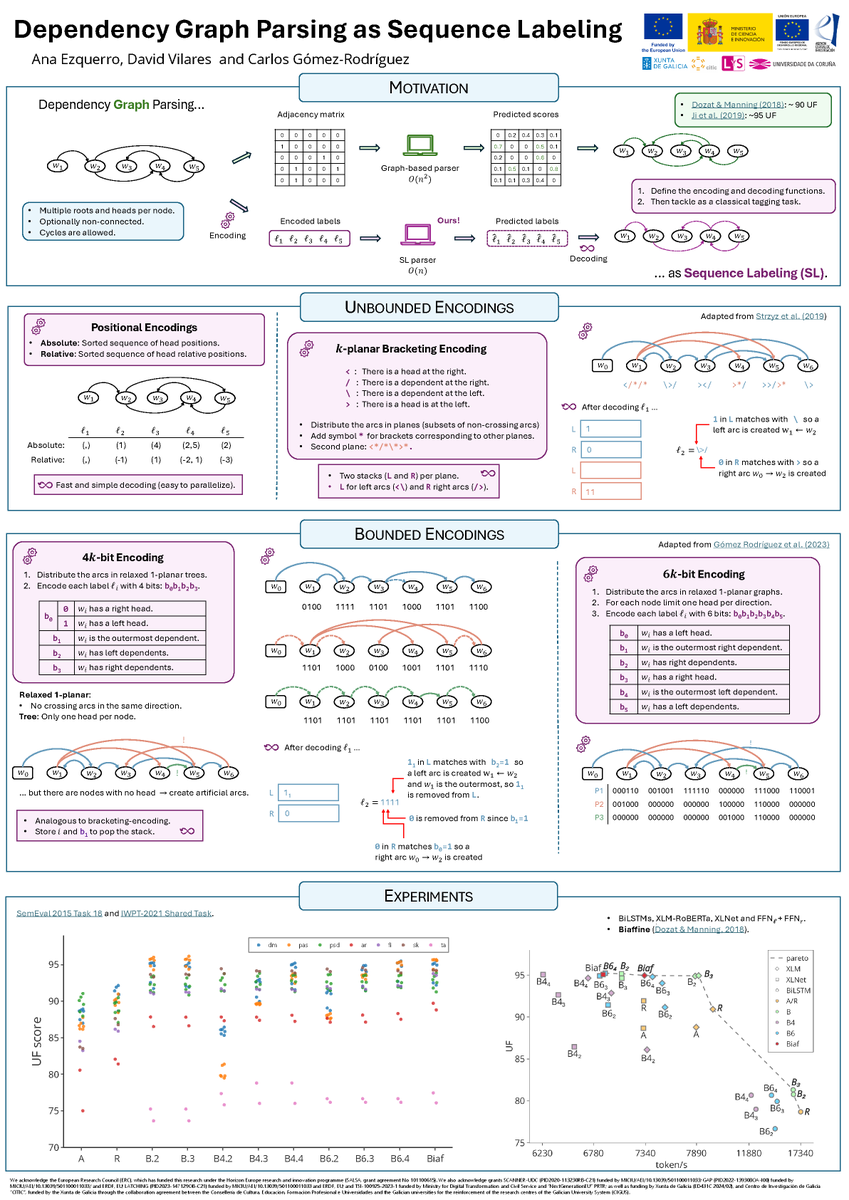
Today at 14:00, we'll be presenting "Dependency Graph Parsing as Sequence Labeling," by @anaezquerro_, @eusondavid, and @carlosgr_nlp at #EMNLP2024! Join us at the poster session in Riverfront Hall.
🔗 Paper: https://t.co/6SImZMmkmY
📰Xa dispoñible no #RUC e #Zenodo o traballo do grupo GI-LYS e da @FIC_UDC: "From Partial to Strictly Incremental Constituent Parsing"
https://t.co/Mwf8Fj7vqj
https://t.co/Aa2BmKqIBG
https://t.co/RZ4zhKkrZ2
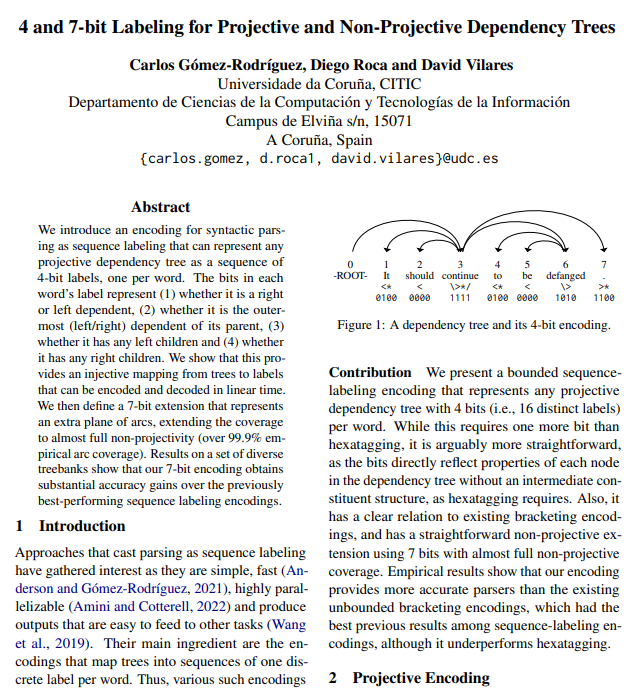
📰Xa dispoñible no #RUC e #Zenodo o traballo do grupo @lysresearch e da @FIC_UDC: "4 and 7-bit Labeling for Projective and Non-Projective Dependency Trees"
https://t.co/ofTbin4jox
https://t.co/gKpYEY9gKo
https://t.co/PnRvMd4RPJ
@ragerri@JulioGonzalo1@carlosgr_nlp@eagirre@artetxem Exacto. Yo les he escrito ya tambien, y ojalá que lo haga mucha gente más. Esperemos que entren en razón y se consideren como aportaciones ordinarias. No entiendo este movimiento. Lo contrario es un paso atrás en la buena dirección que por fin se había tomado en los últimos años.
To me, at least in theory, reasons to reject should be something stronger than weaknesses, but in practice, when it comes to reviewing, I see many choose to copy&paste from one field to the other, and many times both fields contain overlapping information.
Finding that many reviewers for #eacl2023, like myself often when reviewing, feel that "strengths/weaknesses" and "reason to accept/reasons to reject" are roughly equivalent. Any views on how these two are important and different?
If you're interested in making NLP/AI equally useful for all of us, and perhaps more responsible, here's a chance to join CoAStaL/UCPH [https://t.co/DiI6xmcmqa] as a PhD student: https://t.co/TCGV6KoI0T