Debunking Hyperliquid FUD (Part 1: HLP, liquidations, and platform guarantees)
It's sad to see coordinated misinformation campaigns targeting Hyperliquid, which have led to widespread misunderstanding of what we are all working so hard to build.
In response, this series of posts provides detailed, factual explanations of how Hyperliquid works. As a community, we must actively fight FUD by spreading the truth. The tone with which we do this also matters: the best way to grow as a protocol and ultimately house all finance is to remain humble and welcome more users into the ecosystem.
--
The first post focuses on HLP and liquidations on Hyperliquid.
High level summary
The FUD is that the Hyperliquid protocol is subject to large losses stemming from manipulation. On the contrary, Hyperliquid's margining design mathematically guarantees platform solvency. Note that HLP’s losses are isolated to the vault itself, and Hyperliquid does not depend on HLP’s operation to exist. This was true even before the JELLY incident. After the JELLY incident, there is an additional change to protect HLP from losses during backstop liquidations. The fundamental changes are to HLP, not the platform itself.
HLP background
HLP is a permissionless protocol vault pioneered by Hyperliquid. HLP does not collect fees from depositors, and historically has returned 60M USDC in pnl to its depositors. On CEXs, this profit typically goes to the internal market making desks instead of users.
HLP plays two roles: market making and backstop liquidations. In terms of market making, HLP runs a passive strategy that accounts for less than 2% of Hyperliquid's total volume. The vast majority of volume on Hyperliquid is between two non-HLP users.
Liquidations
On Hyperliquid, liquidations are first sent to the book as a market order. This allows any user to participate in providing liquidity to liquidations, which is profitable flow on average. On other exchanges, this flow is internalized by the exchange as a revenue source.
HLP only performs backstop liquidations, which involves taking over positions that are unable to be market liquidated. When account values go negative, the last resort for platform solvency is auto-deleveraging (ADL). ADL closes underwater positions against the most profitable and highly leveraged positions on the other side, ensuring the protocol's solvency. ADL is extremely rare but importantly targets the attacker's position on both sides during manipulation attempts as described below.
JELLY incident
An attacker recently attempted to exploit HLP by opening a large long and short against themself. Open interest caps allowed a position worth 4M USDC at the time of trade, but the logical issue was that HLP collateralized the liquidation with its full balance. It is false that the platform itself had solvency risks, but HLP was indeed overexposed to the manipulation.
Changes made
Now the liquidator component vault of HLP has capped collateral, limiting its potential loss by backstop liquidations. A historical analysis was conducted based on this new system. Apart from the JELLY incident, this change would not have caused additional ADLs in the past, even during extreme volatility. However, it would have minimized HLP’s losses during the JELLY incident to low six figures, which is far less than the attacker spent on market manipulation. In particular, ADL would have closed the attacker’s momentarily profitable long position, leaving other JELLY positions untouched.
Validators now actively discuss delistings in an open governance forum on Discord. Several interesting dashboards have been created by users and validators: https://t.co/szhzxLnfr5, https://t.co/nvOxx9UfEV.
Market cap of the underlying spot assets will likely be an important input into delisting considerations. While delistings are important to ensure that users on the platform do not suffer from potential price manipulation, they are not required for platform solvency.
New state of margining system and HLP
Hyperliquid still functions as before, handling under-collateralized positions in the order of 1) market liquidations 2) backstop liquidations 3) ADL. Backstop liquidations on HLP now have additional protections to cap the total losses, making mark price manipulation attacks more expensive than the limited available gain from HLP. HLP's role continues to shrink as Hyperliquid grows, and at this point is nonessential to the protocol's operation. HLP still exists as a source of protocol yield through backstop liquidations and providing consistent background liquidity.
The Hyperliquid blockchain has been upgraded to feature fully onchain validator voting for asset delisting. When a quorum of stake has voted for a delisting, the action automatically triggers onchain. This permissionless stake-based vote weighting primitive is built natively into HyperCore and technically requires no offchain coordination.
As a demonstration of the primitive, the Hyper Foundation validators 2-5 will vote to delist MYRO perps around 13:00 UTC on March 29. Hyper Foundation validator 1 will abstain from voting until delegations to initial Delegation Program participants are complete.
Like on other chains, most validators will likely make their intended votes clear offchain beforehand to provide users clarity and predictability. The Hyper Foundation does not act or speak on behalf of other validators. There may be interfaces built or provided in the future to summarize validator voting in a more user-friendly way.
Yesterday is a good reminder to stay humble, hungry, and focused on what matters: building a better financial system owned by the people. Hyperliquid is not perfect, but it will continue to iterate and grow through the collective efforts of builders, traders, and supporters.
Users with JELLY long positions at the time of settlement will be refunded by the Foundation as if their position settled at the closing price of 0.037555. This results in all JELLY traders being settled at a price advantageous to them, except flagged addresses.
To recap what happened:
A trader self-traded a 4M USDC JELLY position at 0.0095.
The price of JELLY then rose more than 4x, with HLP backstop liquidating the 4M position.
The short position led to a loss in HLP’s account value.
The OI cap formula is a dynamic function of global liquidity and OI on other venues including major CEXs. A 4M USDC position fell within those limits, but additional open interest was prevented from being opened beyond the automatically triggered cap.
However, the key issue was that once HLP took over the position, it shared collateral with the other component vaults in the strategy and therefore did not trigger ADL.
Risk management on Hyperliquid is being strengthened in various ways, including:
+ HLP: The Liquidator vault will have a tight cap representing a small percentage of total HLP account value, rebalanced less frequently, and more sophisticated logic around taking backstop liquidations. ADL will be triggered if the Liquidator loses above a certain threshold, instead of moving collateral automatically from the other component vaults. Note that ADL is not expected to trigger during organic market activity.
+ OI caps: Open interest caps will be refined to be dynamic relative to market cap.
+ Delistings: Validators will vote onchain to delist assets that fall beneath thresholds.
Thank you for your continued feedback, support, and commitment.
Hyperliquid
ETH deposits, withdrawals, and spot trading are now live on Hyperliquid.
Deposit ETH on https://t.co/w3p1uACBAJ or https://t.co/LamxFmSrHV
Trade spot ETH at https://t.co/XcvOVUSZ7A
After evidence of suspicious market activity, the validator set convened and voted to delist JELLY perps.
All users apart from flagged addresses will be made whole from the Hyper Foundation. This will be done automatically in the coming days based on onchain data. There is no need to open a ticket. Methodology will be shared in detail in a later announcement.
As with other chains, validators often need to convene to take decisive action as a group to ensure the integrity of the network. It is a priority to enhance robustness and transparency to the voting system.
Note that HLP’s 24 hour pnl as of writing is approximately 700k USDC. Technical improvements will be made, and the network will grow stronger as a result of lessons learned. More details will be shared shortly.
HyperCore and HyperEVM linking is live on mainnet. HyperCore spot assets are now available as building blocks for applications on HyperEVM. Furthermore, HyperEVM builders now have a permissionless path to listing on the same liquid and performant order books that power billions of volume every day on HyperCore.
The full defi lifecycle includes building a project, launching a token, and trading that token. Every step of the journey can be done permissionlessly within Hyperliquid. Defi features composability, self-custody, and no gate keepers. CEXs feature frictionless UX and deep liquidity. Hyperliquid combines both into a seamless and onchain system to house all of finance.
See the Docs for details: https://t.co/aIG1amtGyt. It is strongly recommended to test everything on testnet before linking on mainnet, as linking is immutable.
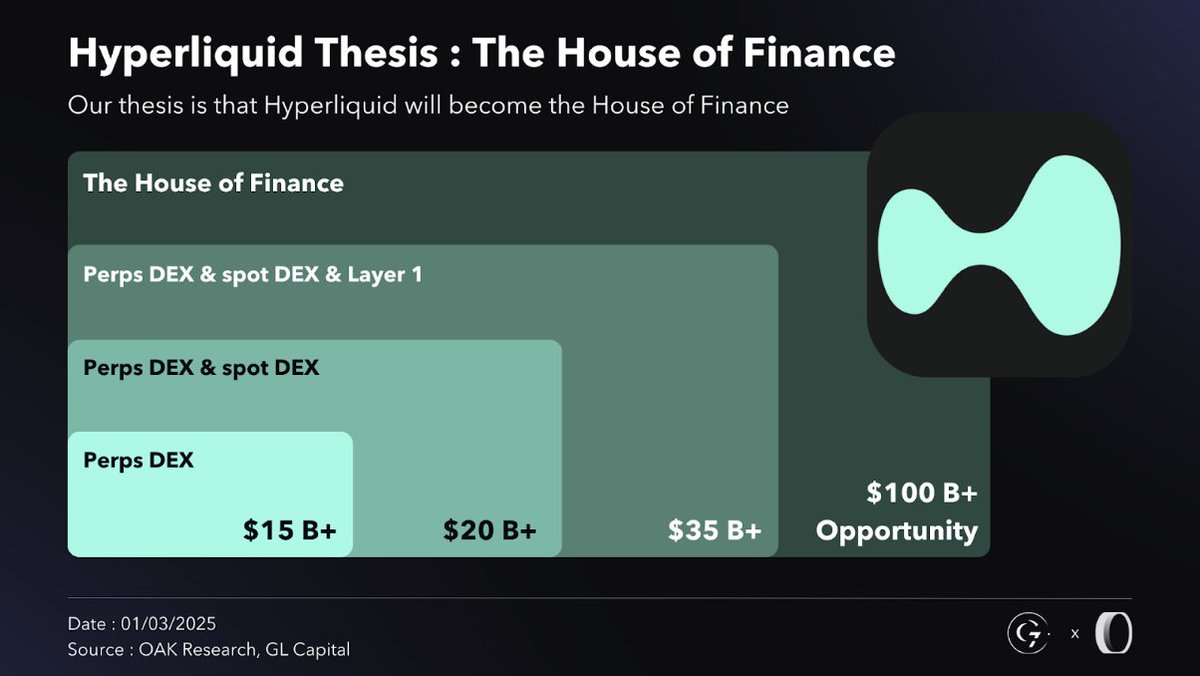
Hyperliquid Proposed Valuation || @HyperliquidX
Hyperliquid is in a league of its own, with no real comparables in crypto.
As the fastest-growing company in the industry, $HYPE presents a compelling R/R, backed by strong fundamentals and massive growth potential.
What sets Hyperliquid apart is its intrinsic value:
🔹 High revenue-generating business
🔹Reinvesting 100% buying back $HYPE
This valuation suggests significant upside: $100B+ opportunity if it successfully delivers on its vision of becoming "The House of Finance".
The maximum downside seems limited: -55% based on bear case scenario.
Let's break down this compelling R/R through a sum-of-the-parts valuation.
Introducing Staking Tiers
Staking tiers will be determined by the amount of HYPE staked. The initial benefit of staking tiers is reduced trading fees. These updates are expected to go live on or after April 30 to give users time to adjust.
As part of this update, the overall fee system will be reworked. The new fee system will have the following properties:
1. Even without staking discounts, perps and spot fees are lower than CEXs for most users.
2. Fee sensitive users can stake HYPE to benefit from even lower fees than the existing system.
3. Protocol revenue is projected to increase.
4. HYPE will have more utility for users.
What else is changing:
+ Separate fee schedules for perps vs spot
+ Spot volume counts double toward your fee tier
What is not changing:
+ Maker rebates based on % of total maker volume
+ Perps and spot volume combined to determine your fee tier
For more details, see the Docs: https://t.co/YGA0EK0ZqO.
Hyperliquid has redefined trading.
When a whale shorts $450M+ BTC and wants a public audience, it's only possible on Hyperliquid.
When headlines say "Bitcoin Market on Edge," they are equating "Hyperliquid" with the "market."
Anyone can photoshop a PNL screenshot. No one can question a Hyperliquid position, just like no one can question a Bitcoin balance.
The decentralized future is here.
There's been a lot of discussion on Hyperliquid's margin design. I’ll address some flaws in the common arguments and explain Hyperliquid's first-principles based approach to improving the system. To my knowledge, this is the first such design in margining systems.
Perhaps other teams will find it useful for their own logic. Like good theories in physics, the best margining design is simple, canonical, explainable, and works in a wide variety of pathological scenarios.
1. The conclusion of some people has been that there needs to be a centralized force that detects and limits malicious behavior. This completely violates the purpose of defi and everything Hyperliquid stands for. This forces users back to a web2 world where the platform has the final say. True decentralized finance is worth it, even if it is 10x harder to build. Just a few years ago, no one believed DEX/CEX volumes would reach its ratio today. Hyperliquid is leading the charge here and has no intention to stop.
2. Some assume that copying approaches from CEXs will work in defi. The most common suggestion I've seen is per-address margin requirement fraction scaling with position size, as CEXs only offer higher leverage for smaller positions. However, this doesn't work to prevent manipulation attempts on a DEX because a sophisticated attacker can easily open positions on many accounts. Nonetheless, this will help somewhat reduce the impact of "organic whale" positions and is on the list of features to implement.
3. Another suggestion is to implement some features that severely limit usability of the platform in exchange for safety. For example, if unrealized pnl is not withdrawable, many attacks are not possible. Indeed, Hyperliquid pioneered isolated-only perps for illiquid assets which feature this safety mechanism. However, this change would have a crippling effect on funding arbitrage strategies, where unrealized pnl from Hyperliquid needs to be withdrawn to offset the loss on other venues. Real user needs are a top priority in system design.
4. There were also suggestions to innovate on design by having margin settings based on global parameters. However, liquidation prices need to be deterministic functions of price and position size. If global parameters such as open interest were added as inputs to margin requirements, users would lose confidence in the ability to use leverage at all.
So what's the answer? We all want defi, but a permissionless system must be robust to manipulation at all scales.
The answer lies in understanding the true problem with large positions: they are difficult to mark. The first order approximation of mark price times size breaks down when market impact approaches maintenance margin. It's impossible to accurately simulate market impact because book liquidity is a path-dependent function of time and actions of other participants. Without simulating market impact, it can be possible for liquidation to be a low-slippage way to exit at a price that is unfavorable to the liquidator.
Therefore, Hyperliquid's margining system update has the following desirable property: any liquidated position is either a loss relative to entry price, or at least a (20% - 2 * maintenance_margin_ratio / 3) = 18.3% loss relative to the last margin transfer out (using an example of 20x leverage). An organic 20x user who makes 100% return on equity after a 5% move will still be able to withdraw the majority of the pnl without closing the position. However, by introducing separate margin requirements between transfers and opening new positions, profitable manipulation attempts require moving the mark price almost 20%. This kind of attack is infeasible from a capital perspective.
Finally, I'd like to point out that the mark price problem also solves itself as market makers continue scaling up on Hyperliquid. It's quite possible that the trader yesterday could have lost money in aggregate. $1.8M pnl longing on Hyperliquid could have been more than offset when pushing the price on other venues, or using other accounts on Hyperliquid. HLP took over an undesirable position, losing $4M. The only market participants who definitely made money in aggregate are the market makers. With millions of dollars of pnl to be made in the span of minutes, it's becoming clear to sophisticated participants that Hyperliquid is one of the venues with the best flow. As liquidity improves, it will become more and more expensive to dislodge prices. So while the margining system improvements will go a long way, the allure of easy pnl attracting market makers will provide an independent source of robustness over time.
The future is decentralized.
Hyperliquid.
To be clear, users can still trade with the same leverage, up to 40x. This change only affects removing unrealized pnl on open positions (e.g., withdrawing).
To date, Hyperliquid has processed over $1 trillion in trading volume and become the first DEX to rival CEX scale. As volume and open interest continue to grow, there are increasingly large tests for the margining system. Yesterday’s event highlighted an opportunity to strengthen the margining framework to address extreme conditions more robustly. Immediate review was undertaken to analyze the scenario in detail and investigate ways to mitigate similar situations. Risk management is, and has always been, a top priority. It is a constant focus, even if not publicly highlighted each day.
To that effect, there will be a change to require 20% margin ratio on margin transfers in a network upgrade after March 15 0:00 UTC. "Margin transfer" refers to funds leaving cross wallet and isolated margin positions. Examples include withdrawals, perp to spot transfers, and adding or removing isolated margin. This change does not affect the opening of new cross margin positions and only affects new isolated margin positions if cross margin usage would exceed 5x after the isolated position is opened. This update is intended to maintain healthier margin requirements and reduce the systemic impact of large positions with hypothetical market impact upon closing.
As always, Hyperliquid remains committed to providing a performant, transparent, and resilient trading environment and delivering the best possible experience for users.
Regarding what happened with Hyperliquid and HLP vault (AKA the explaination I would wanted to have 30min ago):
They already explained it pretty well, but to add some context about how HLP works and what the UI shows, here's an easy explaination.
1) Hyperliquidity Provider (HLP)(https://t.co/ocZVmR5DJ3) is the combination of 3 vaults: HLP Liquidator, HLP Strategy A, HLP Strategy B. In the UI the HLP shows the net amount of the positions of those 3 sub-vaults.
E.g.: If Strat.A has $100M ETH long, Strat.B has $200M ETH long and Liquidator has $300m ETH short, the UI will of HLP will show a position of $0.
2) HLP Strategy A (https://t.co/UWKU8yzrq5)
Its main position is a 20x ETH short of $145M.
3) HLP Strategy B (https://t.co/yw1Lt6UZlu)
Its main position is another 20x ETH short of $145M.
4) HLP Liquidator (https://t.co/ugq7ebEoTt)
Its only position is a 20x ETH long of $290M.
This is the vault that liquidated the position of the whale.
5) Execution
AFAIK (not 100% sure of this because it's too technical and I'm retarded) the flow happened this way: whale got liquidated with HLP Liquidator buys and then Strat.A and Strat.B hedged that position but since they couldn't find the exact same entry price, the HLP is down ~$4M.
TLDR: we're good, take it as a stress test that "only" cost $4M to the HLP (1mo profits).
Regarding commentary and questions on the 0xf3f4 user's ETH long:
To be clear: There was no protocol exploit or hack.
This user had unrealized PNL, withdrew, which lowered their margin, and was liquidated. They ended with ~$1.8M in PNL. HLP lost ~$4M over the past 24h. HLP's all-time PNL remains at ~$60M. As a reminder, HLP is not a risk-free strategy.
Max leverage will be updated for BTC and ETH to 40x and 25x respectively to increase maintenance margin requirements for larger positions. This will provide a better buffer for backstop liquidations of larger positions.