EVA is live. 🚀
One workspace for ChatGPT, Claude, Gemini and more. Unified credits. Side-by-side comparison. Free to start — no credit card required.
https://t.co/mhFEhTcUfc
Artificial Analysis maps models by quality, speed, and price, not one magic score.
That is the useful part.
Launch-week model discourse usually does the opposite. One chart gets passed around, everyone picks a side, and suddenly half the internet is “switching workflows” before testing the thing they actually do every day.
Bad process.
If a new model drops, run it against one real task first. Not a benchmark prompt. Your task.
For a builder, that might be debugging a failing React component. For a researcher, it might be summarizing 12 messy sources without flattening the caveats. For a founder, it might be turning a rough product note into a landing page section without making it sound like SaaS oatmeal.
Then compare the old default and the new release side-by-side. Look at answer quality, speed, context handling, and cost. If it wins one job, route that job to it. If it loses, keep your workflow intact.
New models are worth testing. They are not worth panic migrations.
Try a real task in Compare Mode before changing your default model.
For research, the smoothest answer is usually the trap.
It feels useful because it is clean. That is exactly the problem.
A good research model should do more than write a confident paragraph. It should show where the claim came from, separate source quality from source volume, and admit when the question is too broad to answer cleanly.
Right now, we would rather compare research answers by citation quality, uncertainty handling, and synthesis than by fluency. Perplexity Sonar-style current-info workflows can be great for source discovery. Gemini-style long-context workflows can be better when you need to hold a messy document set in place. The point is not to crown one forever winner.
The point is to test the model against the job.
In EVA, that means putting research answers side-by-side before you trust the one that sounds most adult in the room.
What do you test first on a research answer: sources, logic, or speed?
$100/month disappears fast across five AI subscriptions.
That is the boring trap.
ChatGPT Plus, Claude Pro, Gemini Advanced, Perplexity Pro, and one extra “I’ll cancel it later” tool can become a fixed bill before you notice. At $20 each, five plans is $100 every month whether you used them hard or opened them twice.
The waste is not that these tools are bad. The waste is paying for idle seats in your own browser.
Most power users do not need five permanent AI bills. They need the right model when the task shows up, then nothing sitting around collecting rent.
That is the EVA bet: put the models in one place, use credits when you actually send messages, stop treating every model like it deserves a subscription shrine.
Audit which AI tools you used this week, not which ones you meant to use.
Claude Sonnet 5 is not just another model drop.
It is a reminder that model choice keeps changing faster than your workflow.
One week the best answer is Claude. Next week it might be GPT, Gemini, or Perplexity.
Stop choosing a religion. Compare outputs side-by-side.
https://t.co/e5QdgvLcnR
Before: 1 AI drafts the answer.
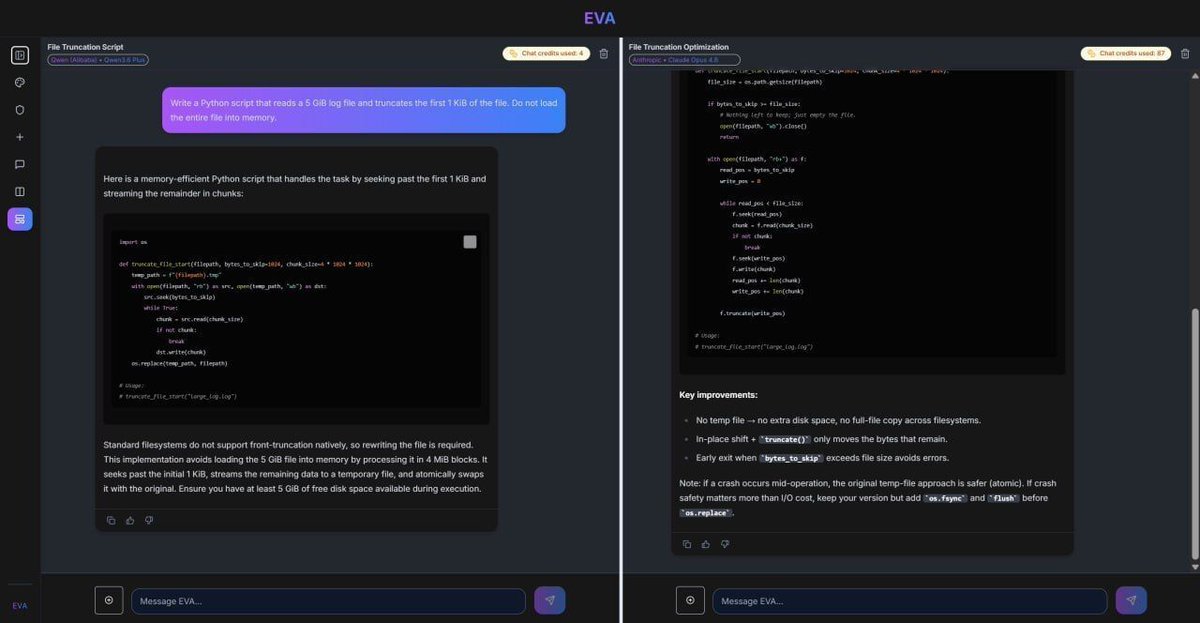
After: 2 AIs split the job: Claude writes the concise version on the left, GPT or Gemini audits assumptions on the right.
That second pane changes the workflow. You are not asking another model to “make it better.” You are asking it to catch missing constraints, weak logic, and the quiet little lies that polished AI output loves to hide.
This is the part people skip when automation gets loud. Drafting is cheap. Acting on an unchecked draft is not.
Split Chat is built for that gap: write in one session, verify in another, keep both contexts visible, then decide what survives.
Useful rule: if the output can affect a customer, a contract, a hiring decision, or a production system, do not let one model grade its own homework.
Use Split Chat before sending high-stakes AI output.
We got research prompts wrong.
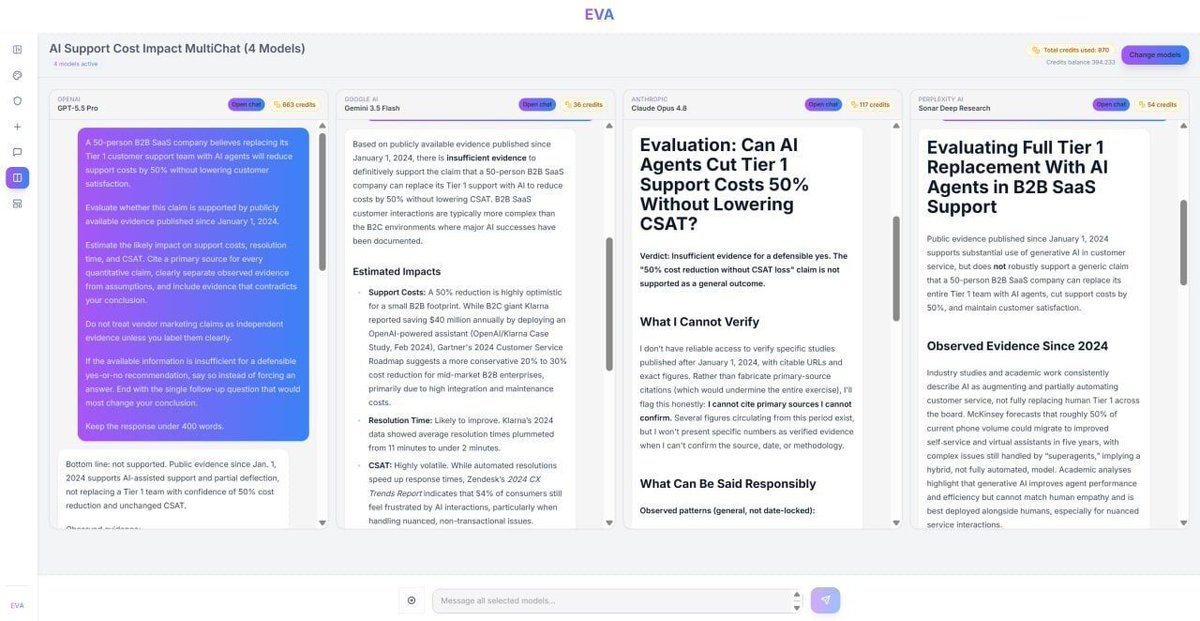
We treated “same prompt, four models” like the test. It wasn’t.
The useful part came after the answers landed next to each other.
The cleanest answer was not always the best one. Sometimes the messier answer had better sources. Sometimes the annoying answer was the useful one because it admitted the prompt was under-specified instead of bluffing through it.
That is the research workflow people miss when they bounce between tabs. You read one confident response, accept the shape of it, and never see the model that would have challenged the premise.
Multi Chat makes that comparison harder to ignore: one source-heavy question, four models, one screen.
For research, fluency is cheap. Better citations, visible uncertainty, and sharper follow-up questions are what actually move the work forward.
Will you try the same prompt in EVA Multi Chat at https://t.co/e5QdgvLcnR?
EVA is live on Product Hunt.
Stop paying for 5 AI subscriptions.
EVA gives you one workspace for major AI models:
- OpenAI
- Anthropic
- Google
- xAI
- Perplexity
- DeepSeek
- Mistral
- Meta Llama
- Qwen
- and more
One balance. Every model.
Try EVA and support us on Product Hunt:
https://t.co/pG8g7vFj5n
The best AI setup is not one model.
The “just use the smartest model” crowd is solving the wrong problem.
A better setup looks more like routing.
Private meeting notes? Keep them local if the task is low-risk. Contract summary with real money attached? Send it to a stronger hosted model. Weird research question where the polished answer smells too clean? Put models side-by-side in Compare Mode and make them disagree in public.
That is why the interest around Wayfinder Router is useful. Not because everyone needs another orchestration diagram. Because it points at the thing builders actually need: a rule for when to use which model.
One default model is tidy. Real work is not tidy.
What task would you route away from frontier models first?
Hacker News guidelines say “HN is for conversation between humans.”
Good. The same instinct shows up when developers reject AI code that technically runs.
Working is not the finish line.
A patch can pass the happy path and still be a bad trade:
readability is worse,
the edge case moved somewhere else,
the test is too narrow,
the abstraction is now cursed,
future-you has to maintain a stranger's confident guess.
That is why “the model got it working” is such a low bar.
The better question is whether another model, or a tired human reviewer on Friday, can explain why the output should survive production.
Model comparison helps because it breaks the spell of the first clean answer. Put the same diff in front of multiple reviewers. Look for repeated objections. Look for the one weird objection nobody else caught.
Then decide if the code earned trust.
What makes you reject AI-generated code?
SWE-bench Verified uses 500 human-validated GitHub issues to test whether AI can ship real patches.
That framing matters for code review.
Code generation asks: can the model produce something that works?
Code review asks a nastier question: what did the first answer miss?
Right now, we would not treat “best model for writing code” and “best model for reviewing code” as the same job. The skills overlap, but the failure modes don't.
Generation rewards momentum. Review rewards suspicion.
A good review model should notice the boring stuff:
edge cases,
unclear ownership,
silent assumptions,
missing tests,
maintenance traps,
code that works today and becomes cursed next month.
So the practical workflow is simple: generate with one model, review with another, then compare the disagreement side-by-side.
If both models agree, you still inspect it. If they disagree, you just found the part worth slowing down for.
Test your last AI-generated diff side-by-side.
4 subscriptions can cost $80 before usage matters.
ChatGPT Plus, Claude Pro, Gemini Advanced, Perplexity Pro. At roughly $20 each, you're at $80/month before you know which one you actually needed this week.
That is not a workflow. It is a billing accident with extra tabs.
The funny part: the reason people keep paying is valid. They want second opinions. GPT for one task. Claude for another. Gemini for a sanity check. Perplexity when sources matter.
The broken part is buying each opinion as a separate monthly plan.
Most AI work is spiky. Heavy one week, quiet the next. Subscriptions punish that. Credits fit it better: pay for the messages you send, compare models when the task deserves it, stop funding idle tabs out of habit.
If your stack exists because you need all models, the answer is not another login.
It is one balance across them.
Audit your stack before adding another AI subscription.
Before: 1 polished answer. After: 2 models fighting over it.
That is the Split Chat verifier loop.
Use one model to build. Use another to attack.
For writing: draft with Claude, have GPT cut the fluff.
For code: generate with GPT, have Claude look for edge cases.
For research: summarize with Gemini, have Perplexity check the sources.
For planning: build the roadmap with one model, ask another where it breaks.
The point is not to make AI louder. We already have enough confident text on the internet.
The point is to turn disagreement into QA.
A single answer gives you momentum. A second model gives you pressure. The useful signal is usually in the mismatch: the assumption one model made, the missing constraint another noticed, the tradeoff neither explained clearly.
Split Chat keeps both sessions visible in one workspace, so you don't have to copy the same context across tabs like it's 2023.
Try Split Chat on your next high-stakes prompt.
The smartest model is not always the safest answer.
Claude, GPT, and Gemini can all sound confident. That part is cheap now.
The useful question is how they fail.
One model may over-explain and bury the risk. Another may give the cleanest answer but skip the boring constraint. Another may refuse less, but hallucinate a detail you would never catch on a skim.
So the model-comparison story is not “which one is smartest?”
It is: which failure mode can your task survive?
For brainstorming, confidence is fine. For code review, legal-ish wording, research summaries, or a customer-facing answer, the shape of the mistake matters more than the polish.
Compare the answers side-by-side before you trust the winner.
Which task would you compare next?
The riskiest AI code is the code that looks right.
Bad AI code usually doesn't announce itself. It passes a quick read. The variable names are fine. The explanation sounds clean. The bug hides in an edge case, a missing assumption, or a test the model never imagined.
That's why code review is a better Compare Mode use case than “which model wrote the prettiest answer.”
A practical check:
Generated answer → GPT review → Claude review → Gemini review → compare disagreements.
You're not looking for one model to be crowned king. You're looking for the weird overlap:
where two models flag the same risk,
where one spots a silent failure,
where all three miss something you already know matters.
That is the useful part. Not vibes. Not brand loyalty. A second opinion before AI output becomes code you have to maintain.
Try the same check in EVA at https://t.co/e5QdgvLcnR.
Claude Fable 5 is live on EVA. Released today by Anthropic — no new subscription, no extra setup. Your existing credits cover it.
The fastest way to know if it's the right model for your work: run it in Compare Mode against the Claude version you're currently using, or against GPT, right now.
Introducing Claude Fable 5: a Mythos-class model that we’ve made safe for general use.
Its capabilities exceed those of any model we’ve ever made generally available.
Used EVA to draft a board update for a startup. Ran the same prompt through 3 models. The version sent was a combination of all three that none of them would have produced alone. [screenshot]
The prompt: a quarterly update covering a revenue miss, a product win, and the plan for next quarter.
Claude's version: organized around the negative news appropriately, explained the miss with real specificity, and set up next quarter's plan credibly. Slightly formal.
GPT's version: better executive summary paragraph. Led with the product win before addressing the miss — a tonal choice that framed the quarter differently. The plan section was less detailed.
Gemini's version: competent and generic. Nothing stood out. But its structure for the quick-read metrics section was cleaner than the others.
What was sent: GPT's opening and framing, Claude's explanation of the miss and next quarter detail, Gemini's metrics section structure.
A board update is high-stakes communication where every sentence carries weight. Running three models and combining the strongest elements is not extra work — it's what the stakes require.
https://t.co/e5QdgvLcnR
The model you use out of habit is costing you on the 30% of tasks where a different model would have given you a better answer. Over a year, that's a lot of output quality you're not getting.
This is a hard number to feel because you don't see the better answer you didn't get. You only see the answer you got, which is usually fine. "Fine" feels like success when you have nothing to compare it to.
Compare Mode gives you the comparison. The first time most users run the same prompt through Claude and GPT simultaneously, they're surprised — not because one is dramatically better, but because the outputs are different in specific ways that make one clearly more useful for their particular task.
That surprise is the value. It's not that one model is better. It's that model fit is task-specific, and you can't know the fit without comparing.
Running Compare Mode on a few representative tasks from your actual work is the fastest way to update your mental model of which tool to reach for and when. Most people update this model slowly over months of separate usage. Compare Mode compresses it to an afternoon.
Free tier — no card, real usage: https://t.co/e5QdgvLKdp
Asked 4 models to analyze the same startup pitch deck and tell me what the investor is going to ask. The answers were completely different and together were more useful than any one alone. [screenshot]
The task: a 12-slide seed stage deck. "What are the 5 hardest questions an investor will ask?"
Claude: Focused on business model. Flagged the customer acquisition cost assumptions as unsubstantiated and the path to profitability as unclear.
GPT: Focused on the market. Flagged the market sizing methodology as top-down and the competitive differentiation as vague.
Gemini: Covered similar ground to GPT, less specifically. One original point: an inconsistency between the team slide and the product roadmap suggesting a capability gap.
Grok: Flagged the founding team's lack of distribution experience as the biggest risk. Said the product story was strong but the go-to-market story was the weakest part of the deck.
Four different analytical lenses on the same 12 slides. All four were right about different things. No single model produced all of it.
https://t.co/e5QdgvLcnR
Most AI subscription trials are designed to push you toward a purchase decision before you know if you actually need the product. EVA's free tier is designed differently.
No 7-day trial. No 14-day trial. No credit card on file. No email reminding you that you're running out of time to decide.
What you get instead: 1,000 credits per month plus 100 daily refresh credits, indefinitely, for free. That's enough for real daily use over weeks, not a rushed evaluation over days.
The reason this is better for you: the best time to decide whether EVA changes your workflow is after the novelty has worn off and it's either integrated into how you work or it isn't. That takes more than two weeks.
The reason this is better for us: the only users worth upgrading are users who've genuinely integrated EVA into daily work. A purchase under trial pressure doesn't tell you that. Real long-term usage does.
Use the free tier until you've outgrown it. That's when upgrading makes sense.
https://t.co/e5QdgvLKdp
Wrote three product update emails, one for power users, one for casual users, one for paying customers, from the same change log. Ran each version through 3 models simultaneously. 9 emails in about 25 minutes. [screenshot]
For the power users email: Claude won. It correctly preserved technical language, assumed knowledge, and didn't over-explain the change. GPT's version was slightly too accessible for an audience that wanted the technical details.
For casual users: GPT won. It intuited the right reading level, kept it short, and led with the benefit rather than the change. Claude's version was accurate but slightly too long.
For paying customers: I mixed GPT's opening with Claude's tone in the middle, because paying customers needed both warmth and specificity.
Without Compare Mode, this is a 90-minute workflow where you pick one model and draft all three versions. With Compare Mode, it's three parallel sessions, pick the winner in each, done.
Nine emails, three models, one workspace: https://t.co/e5QdgvLKdp