Today was the most difficult day in the history of Digital Credit.
$STRC traded as low as $82.50 before recovering sharply. $SATA traded from par down to the low 90s before also rebounding. It was a difficult day for many investors.
What happened today was a leverage liquidation event, not a deterioration in underlying credit quality.
There is an old saying in income markets that the road to hell is paved with carry.
When investors discover an asset that offers attractive yields, relatively low volatility, and strong underlying credit characteristics, many eventually decide that owning it is not enough. They borrow against it. They lever it. They attempt to enhance the carry.
That works until it doesn't.
When markets move against leveraged holders, forced selling can create a cascade. Prices fall, margin calls increase, more selling occurs, and the cycle feeds on itself. The selling becomes disconnected from fundamentals and becomes driven by balance sheet constraints.
We have seen this many times before in traditional finance. Some of the largest hedge fund failures in history involved highly leveraged positions in U.S. Treasuries. Not because Treasuries suddenly became poor credits, but because investors became overextended while trying to earn additional yield on assets that appeared safe and stable.
That is the dynamic that played out today in Digital Credit.
Importantly, the creditworthiness of the issuers remains strong.
At @Strive, our dividend reserves remain intact. Our company is not under stress. We remain well positioned to meet our obligations and continue executing our strategy. The underlying credit profile remains substantially unchanged from where it was before today's volatility.
One of the lessons markets teach repeatedly is that leverage flushes are not necessarily evidence of weak collateral. In many cases, they occur precisely because the underlying collateral is viewed as stable enough to encourage excessive leverage in the first place.
In that sense, today's events were difficult for some investors, but they were also instructive.
Digital Credit is still in its infancy. It is better for the market to experience and learn from these dynamics now, while the market remains relatively small, than years from now when the market is many times larger. Investors, issuers, and market participants all benefit from understanding the risks associated with leverage and liquidity before the asset class reaches full scale.
No one knows with certainty whether today's lows will ultimately prove to be the bottom.
What is clear is that there was substantial demand at those prices. Both $STRC and $SATA experienced significant buying interest off their intraday lows, resulting in sharp recoveries. That price action reflects meaningful demand entering the market at lower levels and is an encouraging sign for the health of the asset class.
A liquidation event and a credit event are not the same thing.
The price action today did not change my conviction in the long-term opportunity for Digital Credit. If anything, it reinforced my belief that we are building an entirely new category of financial instrument that will experience many of the same growing pains that other large fixed income markets experienced before reaching maturity.
The volatility was uncomfortable for many participants.
The lesson will prove valuable.
Stay calm. Focus on fundamentals. Markets have a way of working through excesses, and when they do, stronger foundations are often left behind.
Only ~5% of SpaceX stock is floating right now
~95% $SPCX is still locked
Most don’t realize bearish pressure often comes later, when insiders finally get liquidity
Unlock schedule below ⬇️
NVIDIA IS BUYING ITS OWN CHIPS AND CALLING IT REVENUE
And your retirement account is secretly holding the bag.
This scheme is literally straight out of the Enron playbook...
In January 2026, a special purpose vehicle called Valor Compute Infrastructure was created with one purpose:
Buy Nvidia's chips so Nvidia could book the sale as revenue.
Valor raised $5.4 billion and purchased over 100,000 of Nvidia's GB200 GPUs.
But $1.9 billion of that money came FROM Nvidia itself.
Nvidia invested $1.9 billion into the shell company, then sold that same shell company $5.4 billion worth of its own chips and booked every dollar as revenue.
It's the Girl Scout whose dad bought all the cookies and then she wins the sales contest because Dad was the customer. Except this Girl Scout is a trillion-dollar company and the cookie sale is $5.4 billion.
But it gets MUCH worse:
The remaining $3.5 billion in financing came from Apollo Global Management. Apollo structured the debt, packaged it into securities, and then sold those securities to Athene.
And guess who Athene is? Apollo's OWN insurance subsidiary. The one that sells fixed annuities to American retirees as safe, conservative retirement products.
Follow the chain:
Nvidia funds a shell company with $1.9 billion. The shell company buys $5.4 billion in Nvidia chips. Apollo finances the remaining $3.5 billion. Apollo sells the debt to its own insurance arm. That insurance arm packages it into annuity products and sells them to retirees who think they're buying something safe.
The retirees have no idea that their retirement savings are now backed by 100,000 computer chips sitting in some data center that will be worth pennies on the dollar in three years.
Now look at what's happening inside Athene:
$74.2 billion in US reserves but $217 billion in assets have been shifted to a Bermuda-based captive insurer, outside normal US regulatory oversight.
$103 billion of that portfolio (roughly 35%) is classified as Level 3 assets. That means there is no observable market price.
These assets are valued by internal models, not by actual markets.
And sitting on top of all those unpriced assets? 16.6x leverage.
If you're getting flashbacks to 2008, you should be.
Back then it was mortgages bundled into securities that nobody understood, sold to investors who had no idea what they were holding, rated as safe by agencies that never looked under the hood.
Today it's GPU-backed securities. Computer chips bundled into structured credit instruments, routed through an offshore insurance subsidiary, and sold to you as a retirement product.
The collateral is 100,000 GPUs leased to a single customer through an xAI subsidiary. If xAI stops making lease payments for any reason - financial distress, a pivot in strategy, anything - the entire structure unravels.
And Nvidia releases new architectures every year, so each generation delivers dramatically more compute per watt. A 5 year lease on technology that's obsolete in 2 years creates a mismatch that should terrify every annuity holder in America.
Every single step in this chain is technically legal. The SPV is legal, the lease is legal, Nvidia's equity stake is legal, the securitization is legal, and the Bermuda transfer is legal.
But legality and legitimacy are not the same thing.
I've seen every trick Wall Street has ever pulled in my 45 years of doing this.
And what I'm looking at right now is a pipeline that takes AI infrastructure risk, launders it through 8 layers of financial engineering, and deposits it in the retirement accounts of Americans who never agreed to fund Elon Musk's data centers.
In 2008 it was mortgage-backed securities.
In 2026 it's GPU-backed securities.
Different asset. Same greed. With the same ending.
Together with RDW, we have officially completed the final vehicle testing phase for Full Self-Driving (Supervised) and have submitted all documentation required for the UN R-171 approval + Article 39 exemptions. The RDW team is now reviewing the documentation and test results package internally. They have communicated the expected approval for Netherlands date of 4/10, shifting from 3/20 previously and we look forward to successful completion of this cooperation.
Following the Netherlands’ approval, European countries will be able to recognize this approval nationally. We are anticipating a possible EU-wide approval during the summer.
Over the past 18 months, this approval has involved a series of intense documentation, development, testing, research & audits. Including but certainly not limited to:
– 1,600,000+ km of FSD (Supervised) testing on EU roads
– 13,000+ customer sales ride-alongs
– 4,500+ track test scenario executions
– Thousands of pages of written documentation for 400+ compliance requirements
– Dozens of research studies into safety performance/results
We're extremely proud of the work conducted with the RDW team up until this point.
We very much look forward to the approval in April, and sharing FSD (Supervised) with our patient EU customers!
In our brand new sit-down, I handed @saylor every anti-Bitcoin argument the internet has and he responded to ALL of them.
I dare any Bitcoin critic to watch this interview and not reconsider at least one of their arguments.
TIMESTAMPS:
00:00 Michael Saylor address Bitcoin bear market and negative sentiment
8:37 Big Tech was once doubted but ultimately won
10:22 Why Bitcoin didn’t hit higher price predictions
16:57 Long-term return expectations
23:12 Why retail didn't participate in last bull market
33:55 How is $STRC performing?
56:49 Handling the critics and volatility cycles
1:13:54 Is quantum computing a threat to Bitcoin?
1:33:47 What's the strongest argument against Bitcoin?
1:35:53 Does Strategy's Bitcoin cost basis matter?
1:43:30 Bitcoin mentioned in the Epstein files
🚨 BREAKING: Elon Musk says within the next 5–6 years, there will be no conventional mobile phones, no apps or operating systems, and most of the content people consume will be generated by AI.
In my discussion yesterday at @Money2020 with @ScottMelker, I explained why Digital Credit instruments like $STRK, $STRF, $STRD, $STRC are 2–4x more efficient than Traditional Credit — and how Strategy has become the world’s most scalable, tax-efficient generator of fixed income.
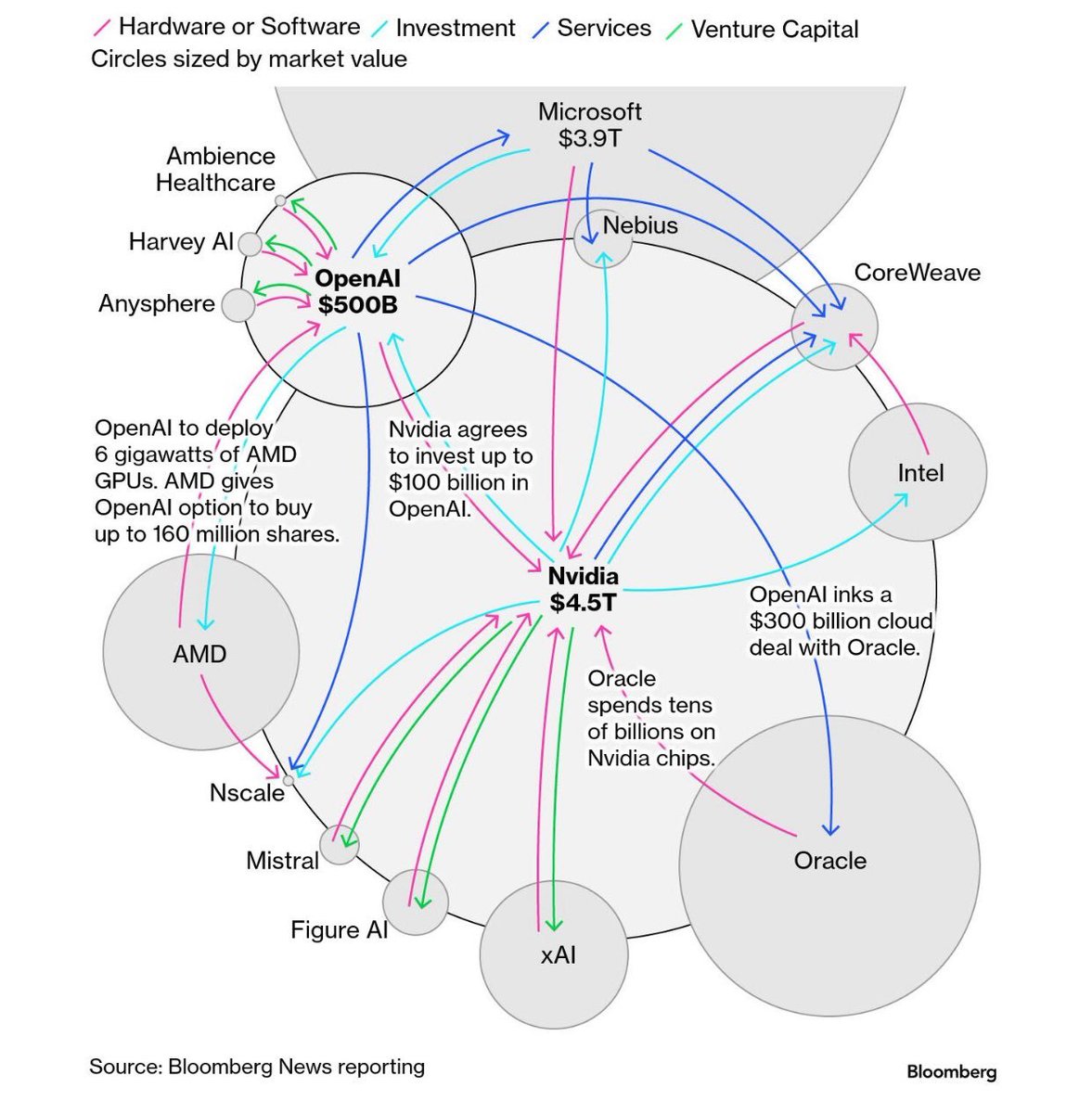
OpenAI has literally engrained itself in most of the world's largest technology companies.
And, almost all of the money that companies are investing in OpenAI is being used BY OpenAI to purchase products and compute from the investor.
What is happening here?
$MSTR is equity in Bitcoin's central bank: @Strategy
Why is that? It's something many are struggling to understand 🧵
Central banking is the practice of managing the monetary policy and economic stability of a particular economic bloc. Central banks issue base money, set interest rates, control money supply, and backstop systemic liquidity. Central banks hold asset reserves which back the base money it issues.
Strategy does all of these things through $STRC and $BTC. Strategy is therefore a central bank.
Here's the lineup:
Bitcoin is the central bank reserve asset that backs the issued base money, $STRC. US debt is the central bank reserve asset that backs the dollar.
STRC dividends are the interest rates set by the Bitcoin central bank. Fed Funds Rate is the interest rate set by the Fed.
STRC dividends / monetary policy are announced once a month. FOMC meetings are once a month, and the discussion is around interest rates and monetary policy.
The purpose of STRC monetary policy is to peg the base money value to $100. The purpose of FOMC interest rate adjustments is to control the dollar's price in terms of goods and labor. You might notice that this is the dual mandate: inflation (goods) and unemployment (labor).
The money supply of STRC only goes up as Strategy issues more to buy its reserve asset: bitcoin. The money supply of the dollar only goes up as the Fed issues more to buy its reserve asset: US debt.
Strategy is the bitcoin buyer of last resort. It will use all tools at its disposal to buy bitcoin because the shareholders demand BTC Yield. The Fed is the lender of last resort (via the discount window) and the ultimate source of financial crises bailout (2009, 2023, etc).
If bitcoin collapses, Strategy and STRC are done. If the US debt market collapses, the Fed and the dollar are done.
Proof of work secures Strategy's reserve asset by ensuring decentralization. Proof of War secures the Fed's reserve asset by ensuring the petrodollar system.
Strategy's common equity $MSTR accrues earnings to shareholders (we call this BTC $ Gain). The Fed's net profits are distributed to the US Treasury.
Strategy's business is being copied by companies in various regions (most notably Metaplanet). Since the 1910 Jekyll Island meeting, numerous central banks have sprung up worldwide with their own fiat currencies.
Strategy has a lot of critics who think the central bank should do X instead of Y. The Fed... well you can take a look at the Macro Twitter experts.
I hope this helps clarify why Strategy is a de facto central bank.
Thank you for your attention to this matter.