What am I working on?
I am letting the answer arise. It may look like a hackerspace, a maker monastery or temple, a salon, a fourth space like The Commons (@theSFcommons), a founder house, a scenius incubator, a praxis lab, an artist in residency community, or several other configurations of liquid networks.
As long as it helps individuals reach their potential (Maslow’s self-actualization or beyond) through mutual support.
Steve Jobs on Rules:
“The system is that there is no system. That doesn't mean we don't have process. Apple is a very disciplined company, and we have great processes. But that's not what it's about. Process makes you more efficient.
But innovation comes from people meeting up in the hallways or calling each other at 10:30 at night with a new idea, or because they realized something that shoots holes in how we've been thinking about a problem.
It's ad hoc meetings of six people called by someone who thinks he has figured out the coolest new thing ever and who wants to know what other people think of his idea.
And it comes from saying no to 1,000 things to make sure we don't get on the wrong track or try to do too much.”
Today, we celebrate 50 years of Apple. In the early days, there was no funding and no safety net, just two founders in a garage with a shared belief in what technology could become.
#Appleat50#Apple
Happy 50th anniversary, Apple. 🍏
Today, I’m taking a pilgrimage to celebrate the 50th anniversary of the founding of Apple Computer Company, later Apple Inc.
I am visiting a dozen or so historical places specific to the origins of Apple. I’ve been to some many, many times and for others it’ll be my first peek.
So far, I’ve been to the quite ordinary ranch house, Steve Jobs’ childhood home, that served as Apple HQ for a year before they incorporated. And also to Marion Derby’s house and former Haiku Zendo.
There’s not much to SEE actually. These are not grand landmarks. They’re quiet, nearly invisible, sort of mundane. You’d miss them if you weren’t specifically seeking them.
And that’s part of the magic.
It’s less like visiting monuments. . . and more like tuning into a frequency that once lived there—and maybe still does.
Most people visit these places and see: “Apple started here.”
But if you were to move the way a pilgrimage moves you, you might feel: “Something ALWAYS starts like this.”
#apple50 #founders #stevejobs #stevewozniak #pilgrimage #siliconvalley
I‘d love the money because I have committed to my dream, and have started writing kid’s book featuring different historical people but with a different slant. Often people like the Wright Brothers, for instance, painted with “extraordinary genius” brush, so kids get the subtle message that maybe it’s not possible for them. Part of my message is “You don't have to know if your idea is realistic. You just have to begin exploring.” Also, very good to see you writing for children, too. My dream is bigger, but I am starting with the books.
Today’s post is on the commitment required by Steve Wozniak and Steve Jobs to begin Apple. Woz built a computer to have a computer. He shared copies of his schematics freely with fellow hackers. They could have just let it be a nice hackathon project, and let it drop. Both of them had full time jobs. So why? The why is a deeper topic, so I’ll probably touch and expand on it the rest of the month leading up to the #Apple50 anniversary. Read at:
https://t.co/REIV1WxYnF
#apple50 #founders #builders #startup #originstory #stevejobs #stevewozniak
Steve Jobs: “My model of business is The Beatles”
“[The Beatles] were four very talented guys who kept each other’s negative tendencies in check. They balanced each other, and the total was greater than the sum of the parts. And that’s how I see business. Great things in business are never done by one person. They’re done by a team of people.”
Steve continues:
“The Beatles — when they were together — they did truly brilliant, innovative work. And when they split up, they did good work, but it was never the same. And I see business that way too. It’s really always a team.”
Today’s post: Steve Wozniak starts working on his Eureka moment computer he envisioned after a demo of the Altair 8800 at the gathering of hackers and hippies (often both/and) known as The Homebrew Computer Club. Read and view the post:
https://t.co/AF8HCO3gCF
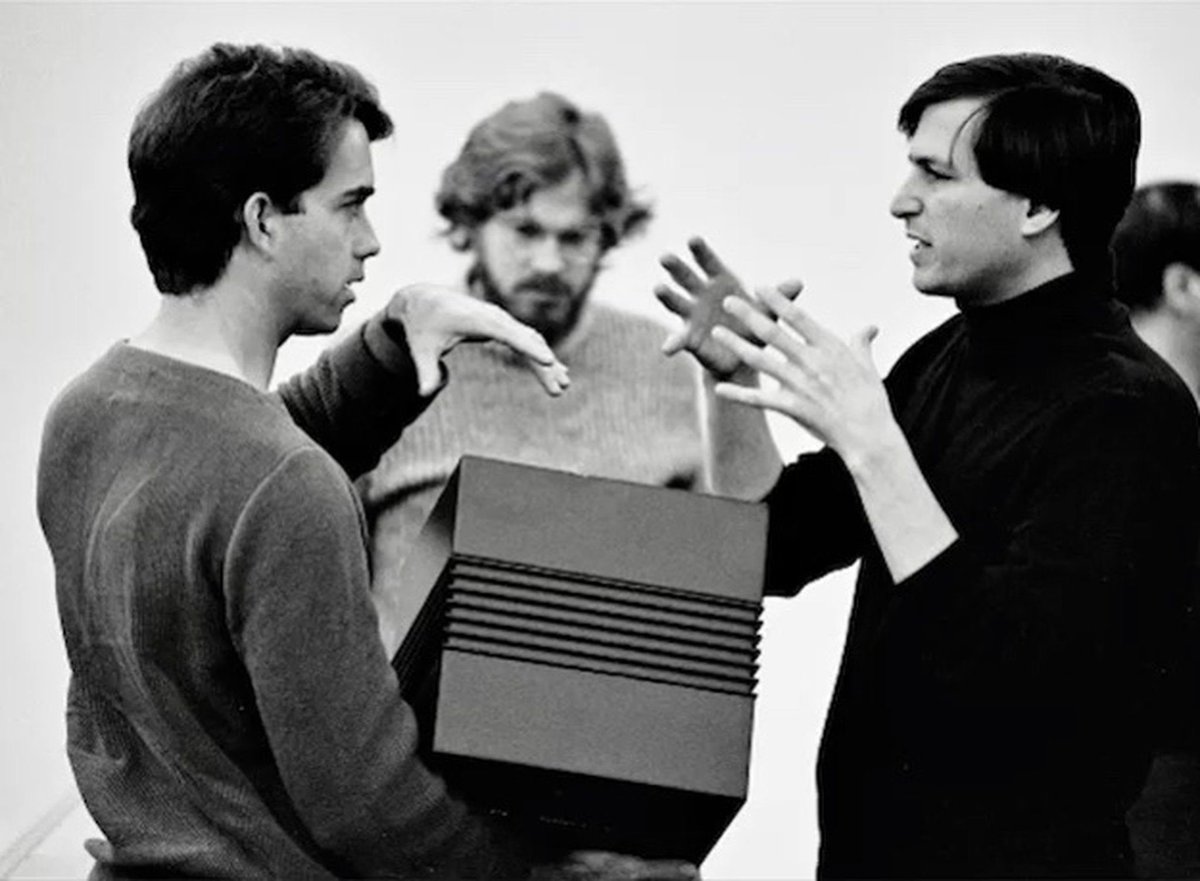
This AI generated reenactment image of Chris Espinosa, Steve Wozniak and Randy Wigginton working on the Woz’s prototype before a Homebrew Computer Club meeting begins is inspired by main facilitator Lee Felsenstein’s recollections: https://t.co/SdKg56WEeK
#stevewozniak #apple1 #apple50 #homebrew #hackers #innovation #prototype #intrinsicmotivation
Moderator Peter Richardson with speakers Editor at Large WIRED @stevenlevy and author/former NYT technology columnist @JohnMarkoff01 last night at Manny’s in San Francisco.
It was all about the counterculture’s impact of the founding of #Apple50 and the blossoming of the personal computer movement.
Trippy, I happened to sit next to Nolan Bushnell’s daughter (not that she offered that until we spoke for quite a while). She said that her dad purposefully allowed Steve Jobs to have the late shift because then Steve Wozniak could visit Atari after his full time job at HP and they’d both work together.
p.s. I love John Markoff’s book “What the Dormouse Said: How the Sixties Counterculture Shaped the Personal Computer Industry.” 📕 💻🌈
#thinkdifferent #apple50 #sixties #counterculture #innovation
SF people! I just got added to a panel at Manny's on "Apple, the Counterculture, and Digital Culture." Expect mentions of LSD, HyperCard and Bill Gates v Homebrew! Monday night! See you there! https://t.co/PGCpNPXaYD
Tonight at Manny’s SF a “look at the founding of Apple through the lens of the counterculture movement that, by the mid-1970s, was shaping Silicon Valley as well as mainstream culture. What role did hippie values play in Apple’s early days? How did these values fare as the company became a tech giant? What does Apple's story tell us about the tech industry's history and profile today?” Speaking will be @StevenLevy, Peter Richardson and @JohnMarkoff01.
Be there, or be square. I’ll be there!
Tickets: Think Different: Apple, the Counterculture, and Digital Culture, 1976-2026
https://t.co/8A6lIj5fz6
#apple50
If you step back, the early personal computer ecosystem formed almost like a sequence of interwoven layers:
- Visionaries arguing computers should empower individuals
- Hobbyist communities experimenting with kits
- Retail pioneers like Paul Terrell building storefronts
- Product builders like the two Steves, Jobs and Wozniak, supplying the shelves
Each group was preparing the ground for the others.
Today I cover the people who recognized that the new one-chip microprocessors originally built for calculators had quietly ushered an entirely new category of retail commerce even before the products were fully functional.
See post 28 of 30 in the #apple50 series:
https://t.co/cvIWHAmO2N
#Apple50 #byteshop #stevejobs #stevewozniak #siliconvalley
“The journey is the reward.
People think that you’ve made it when you’ve gotten to the end of the rainbow and got the pot of gold. But they’re wrong.
The reward is in the crossing the rainbow.
That’s easy for me to say—I got the pot of gold (literally). But if you get to the pot of gold, you already know that that’s not the reward, and you go looking for another rainbow to cross.
Think of your life as a rainbow arcing across the horizon of this world. You appear, have a chance to blaze in the sky, then you disappear.“ — Steve Jobs, from a 1996 talk to graduating class of Palo Alto High School
Today’s post is on the influence of Zen and Zen masters on the founders and founding of Apple Computer Company nearly 50 years ago.
https://t.co/KtnYMNHMBC
#Apple50 #zen #stevejobs #suzuki #meditation
Tourism consumes places.
Pilgrimage transforms the traveler.
The structure of pilgrimage often includes:
leaving the familiar world
entering uncertainty
encountering teachers or symbols
returning with insight and a “boon” to offer the rest of your community
Steve Jobs himself later described the trip as a serious search for enlightenment.
Even though he never found the guru he intended to meet, the structure of the journey itself may have been the initiatory experience.
Many spiritual traditions say the pilgrimage works even if the seeker never meets the teacher.
Part 1 of Steve Jobs’ seven-month long pilgrimage to India, 1974: https://t.co/CqIREWULXR
#apple50 #stevejobs #india #enlightenment #intuition #spiritualjourney #pilgrimage