I started my career as a front-end developer working with React in fintech.
I loved coding solving bugs and building products.
Later, I moved into Web3 and started building something with @web3catalysts
Now I’m working as an early-stage co-founder helping grow our marketing agency in the crypto & AI space.
Still building. Just in a different way.
Most founders destroy their own attribution in week one.
Five formats. Ten platforms. Three accounts.
Someone converts, and you have no idea which one did it.
Viktor (@onlinedopamine) on sequencing content properly 👇
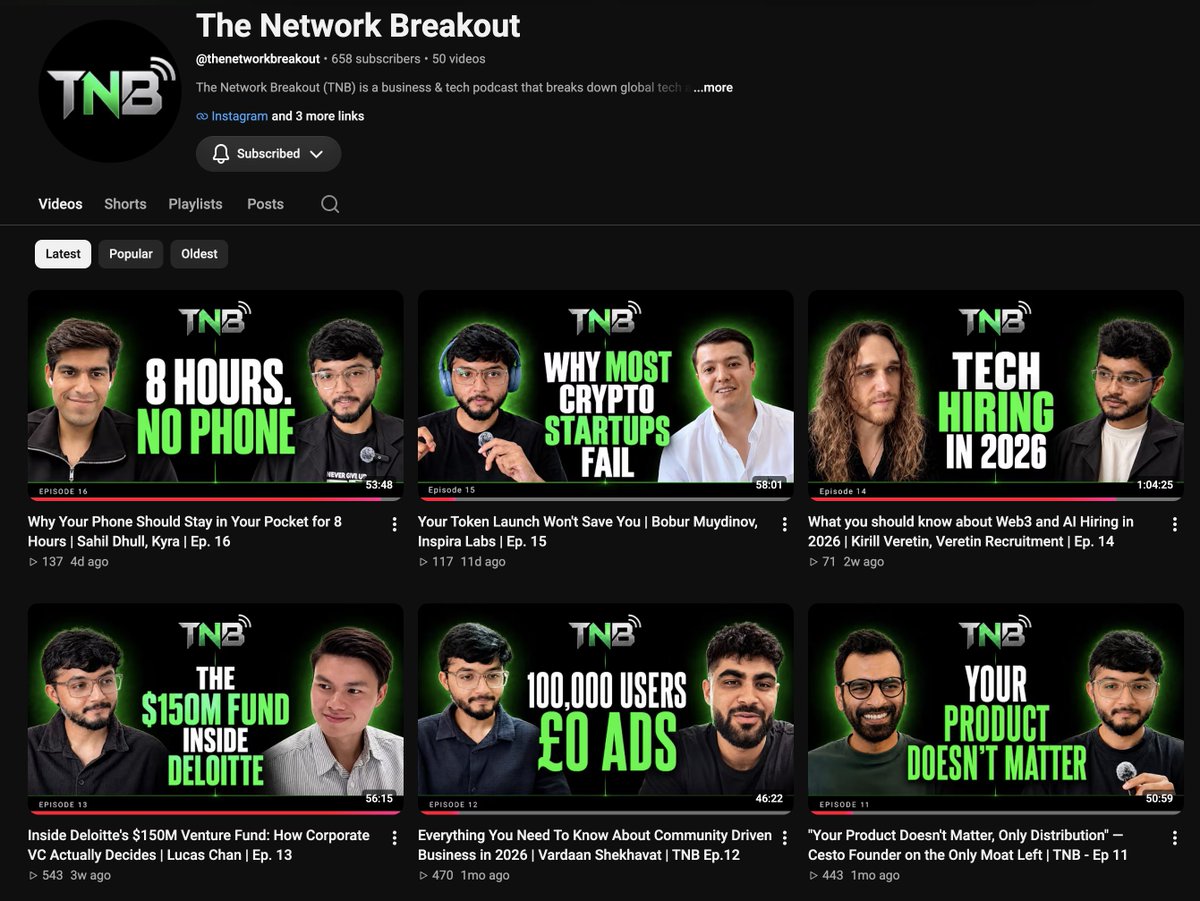
didn’t realise we’re already 15+ episodes deep on @tnb_pod.
founders, operators, investors, builders. some seriously sharp conversations so far, and the next batch of guests is even better.
more soon: https://t.co/D9hUWfrwZE
Sahil Dhull @_sahildhull - is spending more on content than most founders at his stage. Deliberately.
His logic: people back founders they can watch build.
Relatability makes them part of the journey, and distribution becomes the moat.
Full episode on @kyra_interface drops Thursday.
how does a company turn a good product into something people choose and return to?
one gives us operating work.
the other gives us founder conversations.
we want to share stories of the reasoning behind both.
running @web3catalysts and building @tnb_pod gives me two ways to examine the same questions.
- how does a company earn attention?
- what makes someone try the product?
- what gives them a reason to return?
- which decisions look obvious only after they work?
there is plenty of advice about what founders should do.
i am interested in understanding how they decide.
"If you're coming and asking me what your traction should look like, then you're doomed."
Bobur Muydinov (@bobur_muydinov) runs @InspiraLabsHQ.
His bar: you tell him your 3, 6 and 12-month traction, and exactly how you'll hit it.
Full episode drops tomorrow on our YouTube.