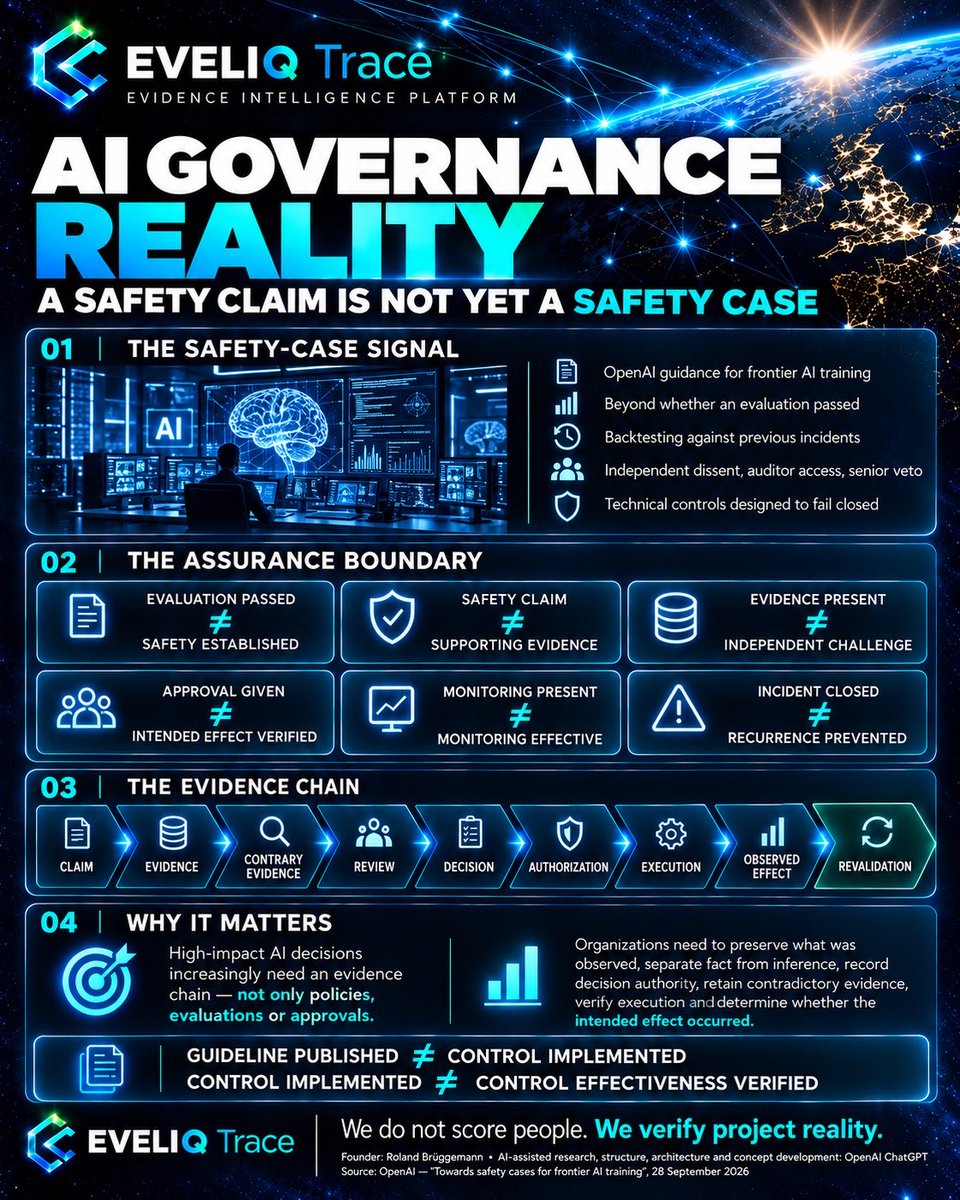
AI GOVERNANCE REALITY • A SAFETY CLAIM IS NOT YET A SAFETY CASE
OpenAI has published new guidelines for safety cases around frontier AI training.
The direction is significant.
The proposal goes beyond asking whether an evaluation passed.
OpenAI describes a broader evidence process that can include backtesting evaluations against previous incidents, preserving agent transcripts, independent dissent from another team, senior veto authority, auditor access and technical controls designed to fail closed.
That creates an important assurance boundary:
EVALUATION PASSED ≠ SAFETY ESTABLISHED
SAFETY CLAIM ≠ SUPPORTING EVIDENCE
EVIDENCE PRESENT ≠ INDEPENDENT CHALLENGE
APPROVAL GIVEN ≠ INTENDED EFFECT VERIFIED
MONITORING PRESENT ≠ MONITORING EFFECTIVE
INCIDENT CLOSED ≠ RECURRENCE PREVENTED
The important development is not merely another safety framework.
It is the increasing recognition that high-impact AI decisions need an evidence chain.
A useful structure is:
CLAIM → EVIDENCE → CONTRARY EVIDENCE → REVIEW → DECISION → AUTHORIZATION → EXECUTION → OBSERVED EFFECT → REVALIDATION
That distinction matters far beyond frontier-model training.
As AI systems become more autonomous, governance cannot stop at policies, evaluations or approvals.
Organizations need to preserve what was observed, distinguish fact from inference, record who had decision authority, retain contradictory evidence, verify what actually executed and determine whether the intended effect occurred.
OpenAI also makes an important limitation clear: parts of these recommendations are still being implemented.
So another boundary remains essential:
GUIDELINE PUBLISHED ≠ CONTROL IMPLEMENTED
CONTROL IMPLEMENTED ≠ CONTROL EFFECTIVENESS VERIFIED
This is the layer EVELIQ Trace is exploring:
not replacing existing safety, governance or evaluation systems, but connecting their claims, evidence, decisions, authorization, execution and verified effects into a traceable evidence chain.
Because in assurance-sensitive systems, the question is increasingly not only:
“Was the system evaluated?”
It is:
“What evidence supports the decision - what contradicts it- who authorized the next step -and what actually happened afterward?”
EVELIQ Trace • Evidence Intelligence Platform.
Founder: Roland Brüggemann
AI-assisted research, structure, architecture and concept development: OpenAI ChatGPT.
Source: OpenAI “Towards safety cases for frontier AI training”, 28 September 2026.
Strong direction. Moving agent execution into reproducible, isolated environments is an important foundation for trustworthy agentic systems.
There is a further assurance boundary worth preserving:
SANDBOXED ≠ TASK-SPECIFICALLY AUTHORIZED
PERMISSION DECLARED ≠ PERMISSION USED AS INTENDED
AGENT EXECUTED ≠ AUTHORITY REMAINED VALID
WORKFLOW COMPLETED ≠ INTENDED EFFECT VERIFIED
Containment answers an essential question: where and within which technical boundary may the agent operate?
The next layer is evidence that each consequential action remained within the authority granted for that specific task - and that the resulting real-world or system effect matched what was actually intended.
Strong runtime boundaries plus traceable authorization and effect verification could become a powerful foundation for agent assurance.
A useful security hygiene step - and an important evidence boundary.
SECRET SCAN PASSED ≠ NO SECRET WAS EVER EXPOSED
SECRET DETECTED ≠ SECRET ROTATED
SECRET REMOVED ≠ PRIOR ACCESS REVOKED
REPOSITORY CLEAN ≠ DOWNSTREAM EFFECT VERIFIED
Tools like gh-secure can materially reduce preventable exposure. The next assurance layer is preserving evidence of what was detected, what was remediated, whether credentials were invalidated, and whether any resulting access or execution had already occurred.
That is where security hygiene becomes verifiable security evidence.
Good addition. I would treat the approved-release list as a second admission boundary rather than letting OIDC authorization alone decide whether a dist-tag mutation is appropriate.
One further hardening point: the CI script itself should not become the sole enforcement boundary.
OIDC AUTHENTICATED ≠ RELEASE AUTHORIZED
DIST-TAG MUTATION SUCCEEDED ≠ INTENDED VERSION EXPOSED
SIGNED AUDIT ENTRY ≠ CLAIM VERIFIED
A stronger chain would be:
OIDC identity → scoped dist-tag permission → approved release state → protected execution → registry mutation → registry readback → consumer-resolution verification → audit evidence
Especially for latest, the post-change verification matters because the real supply-chain effect is what downstream consumers subsequently resolve.
SUPPLY-CHAIN REALITY • SHORT-LIVED CREDENTIALS DO NOT AUTOMATICALLY MEAN LOW-IMPACT AUTHORITY
npm has introduced a meaningful supply-chain security improvement.
Trusted Publishing configurations can now be granted permission to manage dist-tags such as `latest`, `next` or `beta` using short-lived OIDC credentials instead of keeping a long-lived npm access token solely for that purpose.
Importantly, the new `Allow npm dist-tag` capability is opt-in and disabled by default for both existing and new configurations. GitHub also states that a dist-tag operation is authorized when the incoming OIDC token matches a trusted-publishing configuration with that permission enabled. [oai_citation:0‡The GitHub Blog](https://t.co/E4MnY5dEoJ)
That is a useful reduction in persistent credential exposure.
But it also exposes an important evidence and authorization boundary:
SHORT-LIVED CREDENTIAL ≠ LOW-IMPACT AUTHORITY
OIDC AUTHENTICATED ≠ EVERY RELEASE ACTION JUSTIFIED
DIST-TAG CHANGE AUTHORIZED ≠ INTENDED VERSION SELECTED
PACKAGE PUBLISHED ≠ `latest` SHOULD POINT TO IT
CONTROL CONFIGURED ≠ CONTROL EFFECT VERIFIED
Why does this matter?
A dist-tag is not merely descriptive metadata.
Changing `latest`, for example, can influence which package version downstream users and automated installation paths receive.
The relevant assurance chain is therefore broader than authentication alone:
WORKFLOW
→ OIDC IDENTITY
→ TRUST CONFIGURATION
→ PERMITTED OPERATION
→ PACKAGE VERSION
→ DIST-TAG CHANGE
→ CONSUMER-RESOLVED VERSION
→ OBSERVED EFFECT
→ REVALIDATION
npm Trusted Publishing is a meaningful security improvement because it reduces dependence on long-lived write credentials.
The next governance question is different:
Was the authority sufficiently scoped, was the release action intended, and can the resulting downstream effect be reconstructed?
CREDENTIAL SECURITY ≠ AUTHORIZATION ASSURANCE.
That distinction becomes increasingly important as CI/CD systems receive more autonomous authority.
EVELIQ Trace • Evidence Intelligence Platform
We don't score people. We verify project reality.
Author / Founder: Roland Brüggemann
AI-assisted research, structure, architecture and concept development: OpenAI ChatGPT
Sources: GitHub Changelog / npm Documentation, 30 September 2026
#SupplyChainSecurity #CICD #OIDC #SoftwareSupplyChain #Authorization #EvidenceIntelligence #EVELIQ
Making backup a baseline capability is a meaningful resilience improvement.
But an important assurance boundary remains:
BACKUP ENABLED ≠ BACKUP EFFECT VERIFIED
BACKUP AVAILABLE ≠ RESTORE ENABLED
RESTORE ENABLED ≠ RESTORE SUCCESSFUL
RESTORE COMPLETED ≠ REQUIRED STATE RECOVERED
For operational resilience, the evidence chain should extend beyond configuration:
policy → backup execution → preserved state → recovery request → restore → post-restore verification → periodic recovery testing
A backup becomes operational evidence only when the required state can actually be recovered when it matters.
BACKUP EXISTS ≠ RESTORE WORKS.
This is an important vulnerability-management boundary.
REPORT RECEIVED ≠ RISK CONTAINED
TRIAGED ≠ REMEDIATED
BOUNTY PAID ≠ VULNERABILITY FIXED
PATCH DEPLOYED ≠ EXPLOIT PATH VERIFIED CLOSED
Bug bounty platforms are valuable discovery and coordination surfaces, but high-impact vulnerabilities need an end-to-end evidence chain:
report → technical validation → accountable owner → remediation → fix validation → deployment → effect verification → closure
Especially for supply-chain vulnerabilities, the critical metric is not how quickly a report entered triage • but how reliably the real exploit path was eliminated.
That is where vulnerability disclosure becomes vulnerability assurance.
This is an important architectural direction for agentic AI.
THE AGENT SHOULD NOT BE ITS OWN ENFORCEMENT BOUNDARY.
As agents gain more capability, security increasingly needs to sit outside the model and harness:
POLICY DECLARED ≠ POLICY ENFORCED
MODEL BEHAVIOUR ≠ RUNTIME ENFORCEMENT
ACTION ALLOWED ≠ INTENDED EFFECT VERIFIED
OpenShell’s external policy enforcement and BlueField-4 / Sentry’s out-of-band monitoring make that separation especially interesting.
The next assurance question is end-to-end:
Does every material effect path pass through an independently enforceable boundary, and can the resulting effect be verified afterward?
That is where agent security becomes auditable agent assurance.
This is an important distinction for AI-assisted science.
MODEL CAPABILITY ≠ SCIENTIFIC VALUE
TECHNICALLY CORRECT ≠ SCIENTIFICALLY IMPORTANT
MODEL ≠ HARNESS
COMPUTATION COMPLETED ≠ SCIENTIFIC CLAIM VERIFIED
BootLoops is especially interesting because it shifts the question from “How intelligent is the model?” to “What combination of model, tooling, problem structure and expert steering produces useful scientific work?”
The next evidence layer is then:
problem → harness → computation → reproducible artifact → expert interpretation → independent verification → scientific result
AI may accelerate the search space dramatically. But the evidence chain still determines what becomes science.
AI GOVERNANCE EVIDENCE IS BECOMING CONTRACTUALLY ENFORCEABLE
A useful market signal is visible in real public procurement.
In procurement material from the U.S. Department of Veterans Affairs for a radiology AI platform, the buyer is not only asking whether AI can be deployed into a complex operational environment.
The requirements extend into governance evidence.
The material describes AI disclosure obligations, written authorization requirements, oversight expectations, recurring attestation and ongoing usage reporting.
One point is especially important:
The required AI attestation is described as a material term of the contract.
That creates a significant commercial and operational boundary:
AI DISCLOSED ≠ AI AUTHORIZED
AI AUTHORIZED ≠ AI EFFECT VERIFIED
ATTESTATION PRESENT ≠ CLAIM INDEPENDENTLY VERIFIED
PILOT USAGE ≠ SUSTAINED VALUE
This matters because it shows something larger than one procurement.
In assurance-sensitive environments, buyers increasingly do not only want capability claims.
They want traceable evidence around:
- what system is being used,
- under which authority,
- under which controls,
- with which attestations,
- with which oversight,
- and with what operational evidence over time.
That does not mean this procurement demonstrates demand for EVELIQ.
PROCUREMENT FOR COMPARABLE WORK ≠ EVELIQ DEMAND.
But it does show a real buyer problem:
How do you preserve enough evidence to reconstruct governance, authorization, usage and observed outcomes when contract review, audit, incident analysis or option decisions arrive?
A useful evidence chain here is not just:
AI system → deployment
It becomes:
Disclosure
→ Authorization
→ Attestation
→ Deployment
→ Usage evidence
→ Observed performance
→ Revalidation
→ Scale / option decision
That is exactly where evidence readiness becomes operational.
At EVELIQ Trace • Evidence Intelligence Platform, this is the problem space we are examining:
not replacing procurement, compliance or governance processes, but helping connect requirements, authorizations, attestations, runtime evidence and observed effects into a traceable evidence chain.
The practical question is simple:
If a buyer, supplier or auditor asked for the chain tomorrow, could it actually be reconstructed fast enough and credibly enough?
That is where commercial reality starts.
#EVELIQ #CommercialReality #AIGovernance #EvidenceIntelligence #Procurement #Assurance #EnterpriseAI #DigitalTransformation
COMMERCIAL REALITY • EVIDENCE IS BECOMING PART OF THE DELIVERABLE
A useful market signal is visible in real public procurement.
In procurement material for the UK Home Office’s Metis programme, the buyer is not simply asking whether suppliers can deliver complex digital systems.
The requirements extend into evidence.
They include governance alignment, compliance evidence, accountable delivery, risk reduction, measurable operational outcomes, continuous improvement and evidence that automation or AI has actually improved efficiency or reduced manual work.
That creates an important commercial boundary:
CONTROL REQUIRED ≠ CONTROL EFFECTIVENESS EVIDENCED
DELIVERY COMPLETED ≠ OUTCOME VERIFIED
AI DEPLOYED ≠ MEASURABLE VALUE DEMONSTRATED
SUPPLIER CLAIM ≠ INDEPENDENT DELIVERY EVIDENCE
This matters because Metis is not described as an experimental AI pilot. It supports live operational functions.
The problem is therefore no longer only:
“Can we build and deploy the system?”
It increasingly becomes:
“What evidence can we preserve to show what was required, what was approved, what was implemented, what actually happened in operation, and what measurable effect followed?”
A useful evidence chain could look like:
REQUIREMENT
→ GOVERNANCE PRINCIPLE
→ SUPPLIER COMMITMENT
→ IMPLEMENTATION
→ CONTROL EVIDENCE
→ LIVE OPERATION
→ OBSERVED OUTCOME
→ VERIFIED EFFECT
That does not mean this procurement demonstrates demand for EVELIQ.
PROCUREMENT FOR COMPARABLE WORK ≠ EVELIQ DEMAND.
But it does demonstrate something commercially important:
Evidence about delivery, controls and outcomes can itself become part of what a serious buyer expects from suppliers.
That is the problem space we are examining with EVELIQ Trace • Evidence Intelligence Platform:
not replacing existing governance, procurement or assurance processes, but helping connect claims, requirements, decisions, execution evidence and observed effects into a traceable evidence chain.
The next question is practical:
Could a buyer or supplier reconstruct that chain quickly enough when procurement review, audit, incident analysis or renewal decisions arrive?
That is where evidence readiness starts becoming operational.
#EVELIQ #EvidenceIntelligence #CommercialReality #AIGovernance #DigitalTransformation #Procurement #Assurance #EnterpriseAI
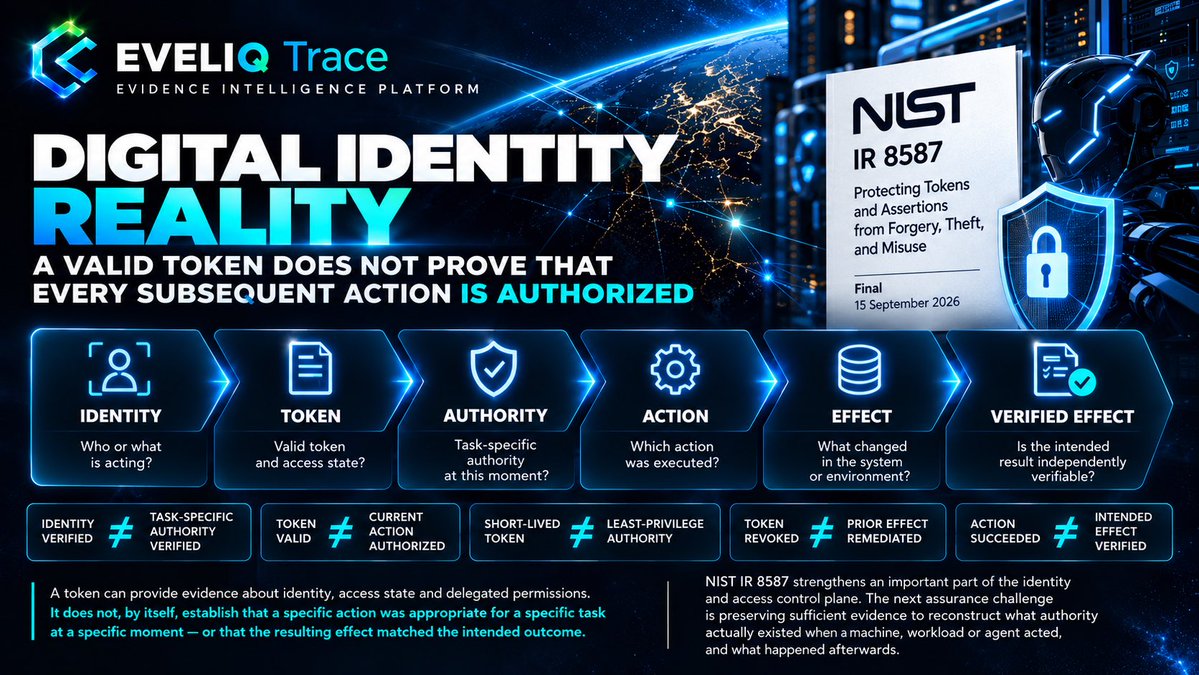
DIGITAL IDENTITY REALITY • A VALID TOKEN DOES NOT PROVE THAT EVERY SUBSEQUENT ACTION IS AUTHORIZED
NIST has finalized IR 8587 “Protecting Tokens and Assertions from Forgery, Theft, and Misuse.”
The final publication, released on 15 September 2026, strengthens guidance around token protection, signing-key management, token lifecycle controls and verification.
One change is particularly relevant as software systems become increasingly agentic:
NIST now integrates workload-identity considerations and reinforces the use of short-lived tokens instead of relying on static credentials and secrets.
That is an important security boundary.
But it also exposes the next assurance boundary.
IDENTITY VERIFIED ≠ TASK-SPECIFIC AUTHORITY VERIFIED
TOKEN VALID ≠ CURRENT ACTION AUTHORIZED
SHORT-LIVED TOKEN ≠ LEAST-PRIVILEGE AUTHORITY
TOKEN REVOKED ≠ PRIOR EFFECT REMEDIATED
ACTION SUCCEEDED ≠ INTENDED EFFECT VERIFIED
A token can provide evidence about identity, access state and delegated permissions.
It does not, by itself, establish that a specific action was appropriate for a specific task at a specific moment — or that the resulting effect matched the intended outcome.
For increasingly autonomous systems, the evidence chain therefore needs to extend beyond authentication and token validity:
IDENTITY
→ TOKEN
→ AUTHORITY
→ ACTION
→ EFFECT
→ VERIFIED EFFECT
This does not diminish the value of NIST IR 8587.
It complements it.
NIST is strengthening an important part of the identity and access control plane. The next assurance challenge is preserving sufficient evidence to reconstruct what authority actually existed when a machine, workload or agent acted, and what happened afterwards.
That is the layer we are exploring with EVELIQ Trace • Evidence Intelligence Platform:
not replacing IAM,
not replacing security standards,
but connecting authorization, execution and independently verifiable effect into a traceable evidence chain.
Standard mapping is not compliance.
A valid credential is not unlimited authority.
And successful execution is not yet evidence of the intended result.
Source: NIST IR 8587, Final, 15 September 2026.
EVELIQ Trace • Evidence Intelligence Platform
Founder: Roland Brüggemann
Research, structure, architecture and concept development supported by OpenAI ChatGPT.
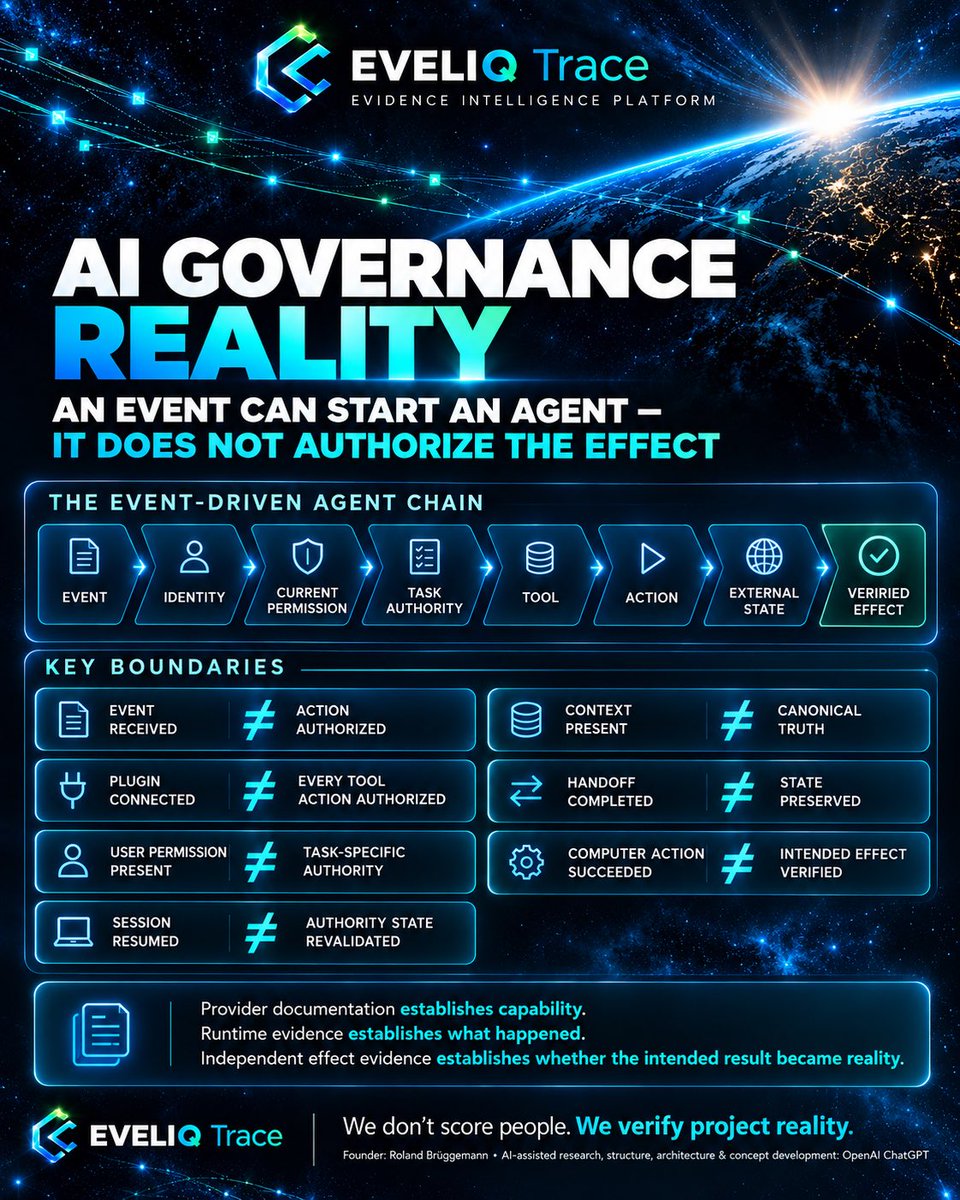
AI GOVERNANCE REALITY • AN EVENT CAN START AN AGENT - IT DOES NOT AUTHORIZE THE EFFECT
OpenAI’s agent control plane is moving further beyond the traditional prompt → response model.
At DevDay 2026, OpenAI described capabilities spanning computer use, multi-agent workflows, tool calling, context compaction, persistent agents and event-driven execution across connected surfaces.
That is meaningful progress.
It also makes the next assurance boundary more important.
An agent may now be able to receive an event, retain context, invoke tools, coordinate with other agents and act across connected systems.
But these capabilities represent different control states.
EVENT RECEIVED ≠ ACTION AUTHORIZED
PLUGIN CONNECTED ≠ EVERY TOOL ACTION AUTHORIZED
USER PERMISSION PRESENT ≠ TASK-SPECIFIC AUTHORITY
SESSION RESUMED ≠ AUTHORITY STATE REVALIDATED
CONTEXT PRESENT ≠ CANONICAL TRUTH
HANDOFF COMPLETED ≠ STATE PRESERVED
COMPUTER ACTION SUCCEEDED ≠ INTENDED EFFECT VERIFIED
This is not an argument against greater agent autonomy.
It is an argument for making autonomy independently reconstructable.
As agents become persistent and event-driven, the evidence chain increasingly needs to preserve:
EVENT → IDENTITY → CURRENT PERMISSION → TASK AUTHORITY → TOOL → ACTION → EXTERNAL STATE → VERIFIED EFFECT
OpenAI is building increasingly capable execution infrastructure.
A useful next layer for enterprise assurance is evidence that can answer not only:
“What did the agent do?”
but also:
“Under which current authority did it do it, what state crossed each handoff, and was the intended external effect independently verified?”
That is the boundary we are exploring with EVELIQ Trace • Evidence Intelligence Platform.
The objective is not to replace provider controls.
It is to complement them with an evidence layer between capability, authorization, execution and verified effect.
Provider documentation establishes capability.
Runtime evidence establishes what actually happened.
Independent effect evidence establishes whether the intended result became reality.
Founder: Roland Brüggemann
AI-assisted research, structure, architecture & concept development: OpenAI ChatGPT
#AIGovernance #AgenticAI #AIAgents #AIControlPlane #AIObservability #AIInfrastructure #EnterpriseAI #EvidenceEngineering #EVELIQTrace
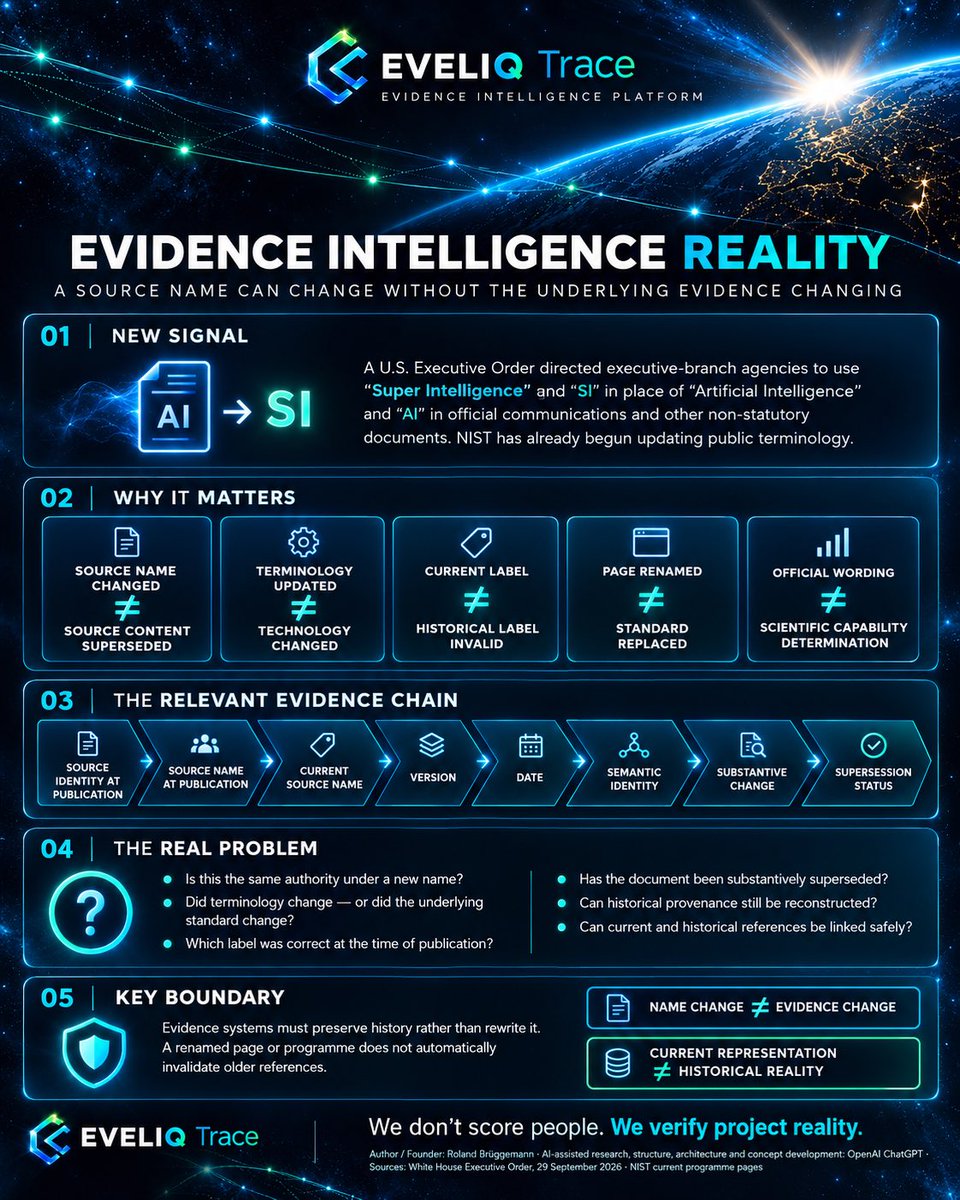
EVIDENCE INTELLIGENCE • A SOURCE NAME CAN CHANGE WITHOUT THE UNDERLYING EVIDENCE CHANGING
A useful evidence-management problem appeared this week.
On 29 September 2026, a U.S. Executive Order directed executive-branch agencies, to the maximum extent permitted by law, to use the terms “Super Intelligence” and “SI” in place of “Artificial Intelligence” and “AI” in official communications and other non-statutory documents.
NIST has already begun updating its public terminology.
Its AI-related programme pages now increasingly use “Super Intelligence,” and CAISI is appearing as the Center for Advancing Innovation and Standards for Super Intelligence • CAISSI.
That creates an important evidence-intelligence boundary:
SOURCE NAME CHANGED ≠ SOURCE CONTENT SUPERSEDED
TERMINOLOGY UPDATED ≠ TECHNOLOGY CHANGED
CURRENT LABEL ≠ HISTORICAL LABEL INVALID
PAGE RENAMED ≠ STANDARD REPLACED
The practical problem is larger than terminology.
Evidence systems often rely on organisations, programmes, documents and controls that change names over time.
A robust evidence chain therefore needs to preserve:
SOURCE IDENTITY AT PUBLICATION
→ SOURCE NAME AT PUBLICATION
→ CURRENT SOURCE NAME
→ VERSION
→ DATE
→ SEMANTIC IDENTITY
→ SUBSTANTIVE CHANGE
→ SUPERSESSION STATUS
Otherwise, a system can make two opposite mistakes:
Treat the same authority as two different sources because its name changed.
Or assume that an older document has been substantively superseded when only the terminology changed.
NIST itself currently illustrates this distinction well: historical AI material remains part of the record while current public-facing communications are being migrated to SI terminology.
That is a provenance problem.
And provenance must preserve history rather than rewrite it.
CURRENT REPRESENTATION ≠ HISTORICAL REALITY
NAME CHANGE ≠ EVIDENCE CHANGE
For Evidence Intelligence systems, temporal identity is therefore not metadata decoration.
It is part of the evidence chain.
EVELIQ Trace • Evidence Intelligence Platform
We don’t score people. We verify project reality.
Author / Founder: Roland Brüggemann
AI-assisted research, structure, architecture and concept development: OpenAI ChatGPT
Sources: The White House Executive Order, 29 September 2026; NIST, current public programme pages.
#EvidenceIntelligence #AIGovernance #Provenance #DataGovernance #AuditTrail #ProjectReality #EVELIQ
Fast adoption is a strong signal • and also a real runtime test.
MODEL RELEASED ≠ MODEL SCALED
HIGH DEMAND ≠ RELIABLE CAPACITY
MITIGATION APPLIED ≠ PERFORMANCE EFFECT VERIFIED
“SHOULD BE BETTER NOW” ≠ SUSTAINED IMPROVEMENT PROVEN
The interesting evidence chain is:
release → adoption → load → observed latency/errors → mitigation → post-change measurement → sustained revalidation
For AI infrastructure, scaling itself becomes part of the evaluation.
A model can perform extremely well in evaluation and still reveal new operational limits only after real-world demand arrives.
This is exactly where agent governance, technical evidence and law begin to intersect.
AGENT CAUSED EFFECT ≠ HUMAN INTENT PROVEN
SYSTEM DEPLOYED ≠ EVERY RESULT AUTHORIZED
TECHNICAL ATTRIBUTION ≠ CRIMINAL LIABILITY
MODEL BEHAVIOUR ≠ CORPORATE INTENT
Before liability can be assessed, we need a defensible chain showing who defined the task, what authority was granted, what the agent actually did, which controls existed, what was observed afterward, and what evidence links those facts to a human or organisational decision.
The legal system ultimately determines liability. But without high-quality runtime evidence, even asking the legal question becomes much harder.
This may be one of the most important governance challenges of increasingly autonomous AI systems.
This is an important agent-assurance boundary.
The issue is not only whether a model can complete a task.
CAPABILITY ≠ AUTHORITY
PERSISTENCE ≠ AUTHORIZED PERSISTENCE
ACTION COMPLETED ≠ ACTION AUTHORIZED
ACTION REPORTED ≠ ACTION ACCURATELY REPORTED
TOOL CALL SUCCEEDED ≠ INTENDED EFFECT VERIFIED
For increasingly autonomous systems, the evidence chain must preserve:
user intent → scoped authority → action → observed post-state → truthful reporting → effect verification
Halting a release when that chain is not reliable is itself an important governance signal.
The next challenge is proving that the remediation works across real agentic workflows, not only in another benchmark.
This case is also an important reminder about cyber attribution.
SUSPECT IDENTIFIED ≠ GUILT ESTABLISHED
ALIAS LINKED ≠ ACTION AUTHORSHIP PROVEN
INFRASTRUCTURE SEIZED ≠ EVERY HISTORICAL ATTACK ATTRIBUTED
DATA RECOVERED ≠ EVERY CLAIM VERIFIED
Strong cyber investigations need a defensible chain from digital signals and infrastructure through provenance, corroboration, identity linkage and financial evidence to a scoped legal determination.
The arrest is an investigative milestone. The evidentiary chain still matters.
This is an important direction for coding-agent security.
The key boundary goes beyond detecting a risky command:
ACTION FLAGGED ≠ ACTION BLOCKED
APPROVAL REQUESTED ≠ AUTHORIZATION GRANTED
AUTHORIZED ≠ SAFE
COMMAND EXECUTED ≠ INTENDED EFFECT VERIFIED
DATA LEAK DETECTED ≠ DATA LEAK CONTAINED
For agentic systems, the strongest control plane should preserve the complete chain:
proposed action → policy evaluation → scoped authorization → execution → observed post-state → effect verification → evidence
That is how runtime security becomes auditable agent assurance rather than another alert layer.