The biggest bottleneck in world model learning is the curation of training-ready data. We work with both operators and labs to curate robotics data for training using our proprietary signals.
See open positions: https://t.co/bu8A3xYbPp
Get in touch: https://t.co/204o3NSjzi
From Nov 9-12, researchers from all over the world will be gathering in beautiful Austin Texas for the 10th anniversary of The Conference on Robot Learning (CoRL).
Eventual is proud to sponsor the event, particularly at a time where the field is evolving so quickly. Advancements in both video and latent world models has disrupted the field of robotics ushering in the era of Physical AI.
Eventual made Paraform's top 50 for talent density this year again, alongside OpenAI and Anthropic. Looks like we’re the smallest team on the list, too.
I don’t know exactly how they score it, but this team is the thing I’m proudest of as CEO.
Smart, ambitious people who care a ton about the work and each other. We work incredibly well together, and I’d do anything for this crew.
One of our core values is fun. Building a company can feel like chewing glass sometimes, but figuring out something really hard with people you love working with is also a lot of fun.
This is my favorite place I’ve ever worked. With everything changing so quickly, I wouldn’t want to figure out what comes next with anyone else.
Photo from a teammate’s birthday today. The little things matter.
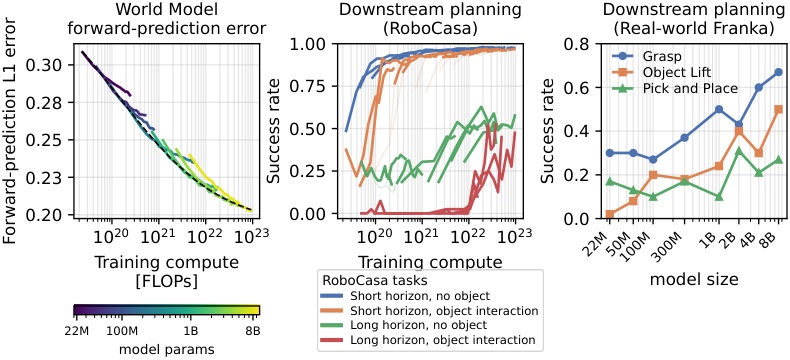
RoboJEPA builds on V-JEPA 2.1 and links better predictions to better robot planning.
My bet: choosing which interactions to train on gets more valuable as we scale.
At Eventual, we're building signals to help labs make that choice.
You don’t have to have a ticket to #DevDay to witness frontier AI.
You can just call a Waymo!
Rey and I got to experience the culmination of over a decade of progress on our ride into work this morning.
Grippers have landed in the office. 🦾
We’re dogfooding our own product to live in the same pain our customers do.
This was our first successful trajectory was captured by yours truly. I’m just glad I didn’t rip my coat
VLAs ground language unevenly, and apparently in a consistent order...
We keep seeing VLMs fumble scene understanding in robotics.
According to the paper the order goes: color first, then object, spatial (left vs right), verb, size
The verbs come last.
https://t.co/FLiZKboHPU
A teleoperated robot episode doesn't start when the recording does - the operator is still setting up while the camera rolls.
The robot's own joint positions tell you which frames matter without decoding a single pixel. With this method, trimming all of DROID - 500 hours of robot data - took 32 seconds on a laptop.
https://t.co/qvQcRoxE9N
The product is physical intelligence.
Systems that move and change things
in the real world.
Web engineering runs on server-grade hardware.
Cloud instances. Comfortable.
Physical AI runs somewhere else.
Hand-pose annotation is the plumbing between raw robot video and a trained model. daft-physical-ai packages it into a single Daft UDF.
This is how it works: track_hands in daft-physical-ai passes a Daft image column and gets a hand-pose column back. MediaPipe (CPU/2D) or WiLoR (GPU/3D MANO), same schema either way. Lazy, batched, distributed — Daft handles execution.
On EgoDex: detect=100%, [email protected]/.2/.3 = 49/84/96.
Try it: pip install daft-physical-ai
Check more use cases here https://t.co/HkEIbQeXBi
@daftengine is a compute engine as much as a dataframe library. You can run models with it, scale heterogenous compute, all with world class IO.
Vectorizing LLM or embedding operations across text and images is effectively trivial once you have the model downloaded.
Here's how that looks with @huggingface Transformers — local inference, no API key with Daft's AI functions: prompt, embed_text, and embed_image.
Excited to announce: daft-physical-ai, a new Python data processing library for physical AI.
We're starting with two use cases: hand tracking and reward scoring - essential steps for making robot data useful for training.
https://t.co/4WiP1oHk5L
After DeepScale, he worked at a number of self-driving companies,
all circling the same question.
How do you sift through all the data
and train the models
so we can make robots real?
Where does he see himself in ten years?
Working on robotics. https://t.co/AITR39Lm1V
He still is that kid.
Then came the decade.
Berkeley, where he was a researcher in computer vision.
Then chief architect at a self-driving startup called DeepScale.
He sold it to Tesla.
Eventual is his second company.
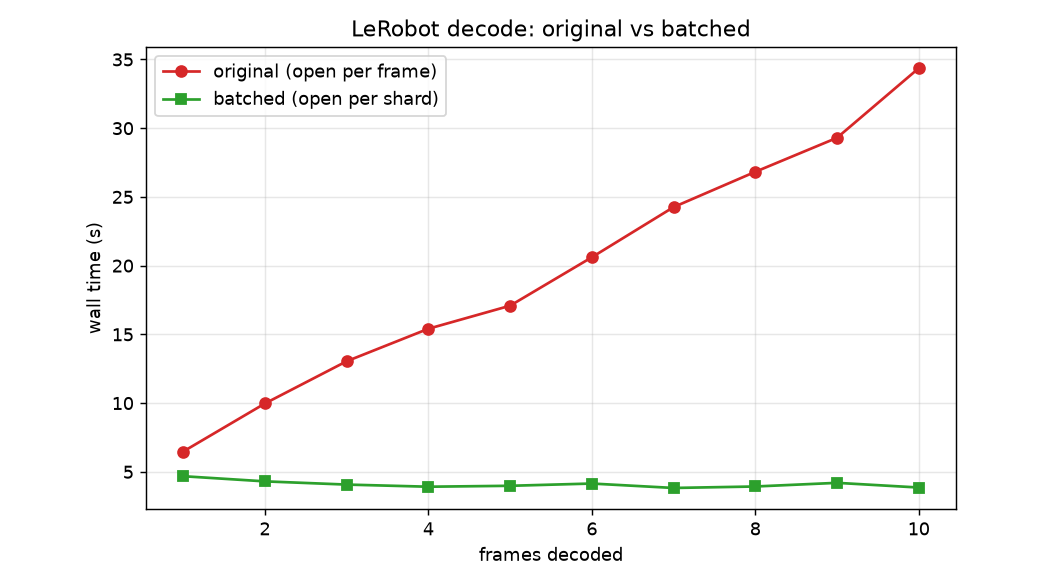
.@LeRobotHF is becoming the dominant open format for robot data.
We recently introduced a native LeRobot reader in Daft, and we've now made it up to 15× faster.
We're excited to share that the Eventual team will be at AUTONOMOUS: The Future of Robotics & Physical AI
We're looking forward to meeting with some of the most talented builders and investors in the industry.
See you on July 16th at The Midway, San Francisco.
#PhysicalAI #Robotics #AUTONOMOUS2026
How well do you know the open source physical ai community?
I asked claude to help me craft an awesome list of 178 repos across 11 categories: VLAs, sim, world models, RL infra, middleware, perception, data, evals, and deployment.
https://t.co/HvQ2LPNiYB