We back founders building what lasts, across AI, robotics and Web3.
Capital when you need it. Builders beside you when it matters.
We don’t just fund companies. We forge them.
This is what real adoption looks like.
Visa just gave AI agents something they've never had: a verifiable identity and a way to get paid. Verify your agent with a Visa card, register its key in Visa's Agent Directory, and it can earn OUSD for real work on Taskmarket.
The insight is easy to miss. Agents can't participate in an economy until someone can prove who stands behind them and settle what they're owed. Visa already owns the largest identity graph in payments — and instead of fighting the agent economy, it's building its on-ramp.
Stablecoins as the settlement rail for machine-to-machine work. A payments incumbent choosing to build rather than block. Experimental today, US-only and invite-only — but this is the kind of infrastructure that compounds.
This is how crypto actually goes mainstream: not through leverage, but through plumbing.
#Stablecoins #AIAgents
At Visa Crypto Labs, we believe ordinary people should be able to earn income from the AI economy.
Today we're launching a new version of Visa CLI, an agent wallet that lets people verify their agent with a Visa card, then work with it to earn OUSD by completing creative tasks.
US users with eligible Visa cards can try it out here https://t.co/O5Xa8Q1MXQ
Hardware is where Bitcoin security stops being a slogan.
Ultraviolet just flagged the first hardware signer supporting Prime, RGB, and Ultraviolet — built by MyCitadel, NFC-only, no USB, no Bluetooth, no display, and no private key export at all.
That last detail is the whole point.
Most wallet hacks don't break cryptography. They break the plumbing around it: a cable, a Bluetooth handshake, a backup file sitting on a laptop. Strip the signer down to NFC and a sealed key, and the attack surface collapses to almost nothing.
What matters more is what it supports in one device. RGB brings programmable assets to Bitcoin. Ultraviolet brings compute. One signer covering the whole stack means the ecosystem is growing out of the demo phase — builders are now shipping the boring, unglamorous pieces real users need before they trust it with real value.
Infra doesn't go mainstream on whitepapers. It goes mainstream on hardware like this.
Proud to back the team building it.
#Bitcoin #RGB
A 3.27-sigma week. Only 11 weeks in 40 years have fallen this hard.
The Nasdaq 100 lost 10.4% in a week — worst since March 2020 — and it's now ~20% below its October peak. Kobeissi's point is the one to sit with: returns have fat tails. The "impossible" week keeps happening.
But the cause matters more than the statistic. This isn't a random shock. It's a repricing: the market stopped paying for the AI narrative and started asking about capex, financing, and the earnings trajectory. Nvidia -14% on an accounting probe, Anthropic fading after day one — trust, not growth, is what's being priced.
The builders who survive a repricing are the ones whose revenue was real before the market asked.
#AI #Markets
Maxim is right — and @dr_orlovsky has earned the right to say it.
He spent years building RGB — the smart contract layer for Bitcoin — line by line. Meanwhile the people now loudest about RGB's future never wrote a single line of its core protocol.
Bitcoin doesn't need more memes about building. It needs the builders who stayed when nobody was watching. RGB exists because one developer kept working through the years the crowd dismissed the work as too hard, too slow, too academic.
The protocol belongs to the people who built it. The narrative should too.
#Bitcoin #RGB
Both sides got wiped out in 24 hours. That's the whole story.
Bitcoin fell to $55K, then ripped back above $60K in hours — $1.86B in longs liquidated on the way down, $230M in shorts on the way back up. Fear & Greed printed 9.7, the lowest since March.
When leverage is the market, price is just the scoreboard for forced flows. The signal underneath: open interest is down 40%+ in two months, and the liquidation cluster that hung under the price is now cleared.
A bottom isn't a feeling. It's the absence of forced sellers. We're closer to that than we were on Friday.
#Bitcoin
@shanshan521 Sometimes it's really frustrating that good people and ethical companies don't always come out on top. Maybe investors should form their own Justice League! 😂 Standing with and supporting open-source builders.
DeepMind's map of AGI → ASI has four paths, but only one is a builder's market today: coordination.
Scaling and paradigm shifts are lab problems. Recursive self-improvement is a research bet. But wiring thousands of agents into a group that does what no single model can — that's an orchestration layer, a verification layer, an evaluation layer. It's infrastructure you can ship now.
The Fable 5.2 Fermat run showed it: 1,000 agents, self-organized, formal proof in 30 hours. The moat isn't the model. It's the coordination.
#Agents #AI
Ethereum delaying Glamsterdam to protect deployed contracts is the base layer doing its job.
200 compatibility findings, three high-severity, 50+ companies contacted — and the core devs are still willing to slip the fork to May rather than break invariants nobody knew existed. That's not slowness. That's the discipline that makes Ethereum the settlement layer everyone else builds on.
The lesson for builders: the most expensive bugs aren't in your code. They're in the assumptions your code inherited from the chain.
#Ethereum
The door to the US just got a map.
CFTC Chair Selig laid out how onchain venues like Hyperliquid reach US retail: register as an exchange, or partner with one that already is. No special rules for being onchain — the same rules as everyone else.
Backpack just proved the first route works, completing the full DCM + DCO + FCM stack this week. Kraken/Bitnomial and ICE are taking the second, building regulated markets on Hyperliquid's rails.
This is the moment onchain derivatives stop being an offshore story. The moat is no longer the matching engine — it's the license stack and the partnerships that carry onchain liquidity into regulated markets.
The winners won't be the venues that dodge regulation. They'll be the ones that treat compliance as distribution.
#DeFi #Crypto
This week had one theme: AI finally turned narrative into cash flow, while crypto paid the price for tightening.
Anthropic closed the largest IPO in history at a ~$1.5T valuation. In the same week, Bitcoin broke below $62,000 — and below its 200-week moving average.
Real revenue on one side, liquidity retreating on the other. That is the dividing line of this week.
**1. AI capital markets: Anthropic's record IPO, Nvidia doubles revenue**
Anthropic priced on November 18 at $83 a share, raising $81.3B — the largest IPO ever — at a ~$1.5T fully diluted valuation, and listed on Nasdaq as ANT on November 19. Strategic investors including Nvidia, Microsoft, Alphabet and Micron committed a further $26B. Revenue reached $33.2B in the first nine months of 2026, ~13x year over year; Q3 revenue was $17B, with the company's first quarter of operating profit, at a 15% adjusted margin. Anthropic plans $70B of compute spend over the next 12 months, with ~$900B in long-term compute commitments.
What it means: an AI lab has, for the first time, taken public-market pricing on operating profit and a verifiable revenue curve — the valuation anchor moves from narrative to cash flow. For builders: revenue growth and unit economics matter more than model rankings, for the first time. For investors: the next round of AI valuations gets recalibrated to Anthropic's multiples.
Nvidia reported on November 17: Q3 revenue of $115.8B, up 103% year over year; data center revenue of $107.6B, up 110%; the new Vera Rubin platform contributed nearly $20B in its first quarter — the fastest product ramp in company history; Q4 guidance of $130B; FY2028 revenue growth outlook raised to 75%; a $150B buyback authorization. The earnings also confirmed: Jensen Huang resigned as CEO on November 12, with long-time CFO Colette Kress as interim CEO — and rumours of an SEC investigation circulated after the close, scope unclear.
What it means: there is no sign of demand cooling — cloud vendors carry $2.5T in backlogs and $390B in purchase commitments. But a leadership handover and regulatory noise arrived together, and the stock fell after earnings: the market is now pricing whether AI capex can last, not this quarter's numbers. Watch: Rubin's delivery cadence, and whether the interim CEO becomes permanent.
**2. Macro: the Fed turns hawkish; a December hike is now the base case**
October CPI rose 0.4% month over month, core 0.3% — both above expectations. October nonfarm payrolls added 165,000, far above the 70,000 expected, and unemployment fell to 4.1%. PPI rose 6.5% year over year, the fastest since November 2022. Q3 GDP grew 3.4% annualized. The October FOMC minutes leaned hawkish; Governor Waller said December brings at least +25bp, with 50bp on the table if core CPI cooperates. The market has fully priced a hike on December 9 and started pricing another in January. The federal funds rate now sits at 3.75–4.00%.
What it means: this is the source of this week's simultaneous slide in crypto and growth stocks — not a crypto problem, a repricing of liquidity. For builders: funding costs keep rising, and the window for burning cash for growth narrows. For investors: 2027's theme switches from the "rate-cut trade" to "real revenue at high rates."
**3. Web3: Bitcoin breaks the 200-week moving average; ETF outflows continue**
Bitcoin fell to ~$61,600 this week, down ~13% in seven days; Ethereum ~$1,745 and Solana ~$72, both sharply lower. Bitcoin broke below its 200-week moving average — a historically rare signal of extreme weakness. US spot Bitcoin ETFs saw another wave of redemptions: $306.5M of net outflows on November 18 alone, and cumulative net outflows in 2026 now exceed $2.5B. Total crypto market cap is back to ~$2.19T.
What it means: the ETF channel has flipped from incremental buying to an outflow channel; price support now depends on spot buyers. Notably, Glassnode data this week showed some Bitcoin miners shifting hashpower and capital toward AI — selling the narrative asset to buy the revenue asset. That matches our call this week: cycle bottoms aren't decided by belief, they're decided by who's still paying for electricity and compute. Watch: whether the $60,000 level holds, and whether ETF flows stop bleeding.
**4. Frontier models: Claude Fable 5.2 and 1,000-agent collaboration**
Anthropic launched Claude Fable 5.2 and Mythos 5.2 on November 9 — the same model, different safety configurations: output up to 30% faster, prices down 20%. The headline is multi-agent orchestration: 1,000 Fable 5.2 agents self-organized without scaffolding and formally proved Fermat's Last Theorem in 30 hours (the previous attempt took 11 days); the RoboDojo robotics score jumped from 27.6% to 64.9%.
What it means: the agent race is shifting from "how smart is one model" to "how many models can work together." For builders: the orchestration layer, the verification layer and the evaluation layer are worth more than another chatbot — the coordination cost of 1,000 agents is becoming the new moat.
**5. Robotics: OpenAI dissolves its robotics team; Nvidia bets on "agentic robotics"**
OpenAI confirmed on November 13 that it is dissolving its standalone robotics team, folding researchers into chief research officer Mark Chen's main research organization and apps and hardware teams into Greg Brockman's Applied division. The reason: general models like GPT-6 Astra can already drive robots directly — no separate "robot brain" needed. In Nvidia's simulation benchmarks, Astra-driven agents reached 74.8% manipulation success, above specialist robot models' 51.0%. OpenAI still plans a first humanoid demo in 2027.
The same week, at CoRL 2026, UC Berkeley and Nvidia proposed "agentic robotics": LLMs writing inspectable robot programs instead of stacking demo data — 99% success on industrial tasks in simulation, versus ~20% for imitation-learning baselines. Nvidia also launched the GR00T 2 open-world action model and Isaac Lab 3.0.
What it means: robotics is having the same "generalization" moment as large models — specialist stacks giving way to general models plus agentic programming. Whoever owns the simulation-verification-deployment loop owns scale. For Everforge: look at simulation infrastructure and task-level benchmarks, not another humanoid body.
**6. Stablecoins and compliance: GENIUS rules land; Binance hack aftershocks**
The US OCC published its final stablecoin rule on October 21, effective January 18, 2027, covering reserves, redemption, audits and supervision; the GENIUS license application form is under OMB review, with comments due November 23. Ripple's national trust bank charter took effect on October 26 and will custody RLUSD reserves. SEC Chair Atkins said on October 31 that "most crypto assets are not themselves securities." The UK's October 28 budget confirmed that, from April 2027, individuals disposing of compliant stablecoins are exempt from capital gains tax.
On security and enforcement: Binance's ~$6.3B hot-wallet theft on October 30 moved into court proceedings this week, with asset freezes and recovery ongoing; Abu Dhabi's FSRA said it is in close contact with Binance; South Korea's FSC told exchanges to move more assets to cold wallets. The US market-structure bill, the CLARITY Act, remains stalled after a 49–50 procedural vote in the Senate in September.
What it means: the rules are moving from "legislative debate" to "regulatory execution" — OCC rules plus trust-bank charters plus tax exemptions are laying a compliant track for stablecoins on three lines at once. ADGM/FSRA's direct engagement on the Binance incident shows the Middle East is becoming the market where compliance arbitrage and compliance standards take shape at the same time. Watch: next steps after the November 23 GENIUS comment deadline, and whether FSRA issues further guidance.
---
This week's takeaway: the market is measuring everyone with the same ruler — revenue.
Anthropic earned a $1.5T valuation on $33.2B of revenue and operating profit. Nvidia defended the AI capex story with doubled revenue. Assets with no revenue anchor can only follow liquidity down when money tightens.
For builders: put the revenue curve ahead of the model ranking. For investors: the next cycle's winners are the companies that can still turn compute into cash flow in a high-rate world.
We don't just fund companies. We forge them.
#AI #Web3
She's right about the format, and it's bigger than TV. Hongguo's twist-every-three-minutes isn't a writing style — it's a retention engine tuned by data. Netflix still optimizes for prestige and completion; short drama optimizes for the next episode. The lesson for builders: the unit of competition isn't the show anymore. It's the cliffhanger.
The peg held — that's the headline, and it matters: $2B+ of outflows in a day, USDS still at $1. But the questions that decide the next one are structural, not about today. What happens when one holder can drain two-thirds of the PSM's available liquidity in a day? A stablecoin's real test isn't the peg on a calm day. It's whether the reserve design survives its largest holder leaving. #DeFi
Apple is running the App Store playbook on agents: build your own, then make the rivals' path 14 steps long. Apple calls it security. Either way, the layer between the user and the work is the prize — and the platform owner always defends it. Every agent startup just learned the same lesson: if your distribution runs through someone else's OS, you need an OS hedge. #Agents
The shift is chat → work. Gemini doing multi-step tasks across your files, apps and the web — in a background window, with your cursor free — is the moment agents stop being a chat box and start being a coworker. The interesting layer isn't the model. It's permissions: who gets to click, type and spend on your behalf, and how you revoke it. That's the infrastructure worth building. #AIAgents
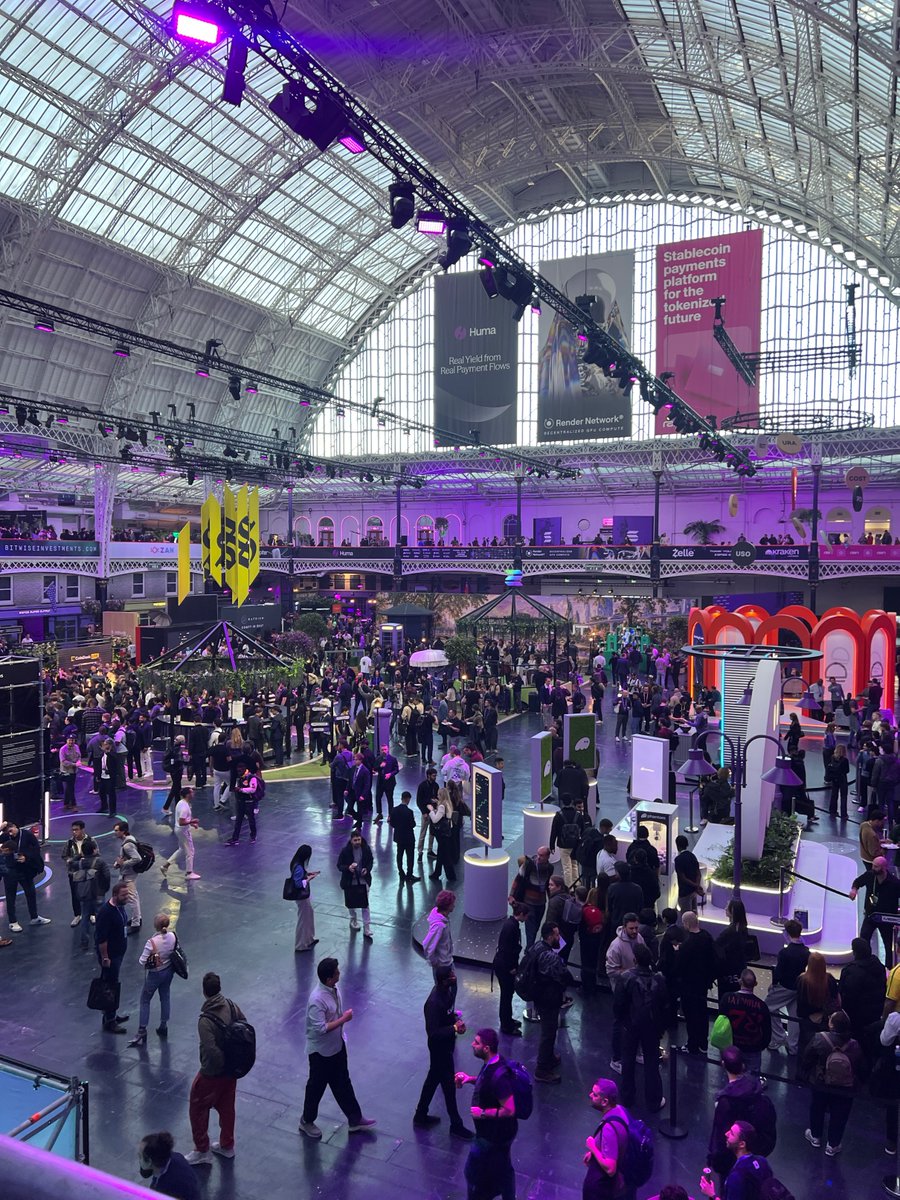
Our portfolio team @constant_fi is on the road — and this is what onchain credit looks like in motion.
Photos from Solana Breakpoint in London, then straight to Bangkok for Binance Blockchain Week, Nov 26–Dec 1. If you're there, grab a coffee with them and talk onchain credit.
Here's why we're backing them: credit is the next thing to move onchain, and fixed rates are the missing piece. Variable-rate lending works for traders. It doesn't work for the businesses, treasuries, and funds that need to plan. Constant is building the predictable yield layer — the boring, essential infrastructure that lets real capital come onchain and stay there.
Go find them in Bangkok.
#OnChainFinance #DeFi
A few photos from our teammate at @solana Breakpoint in London
We’re headed to Bangkok next for #BinanceBlockchainWeek on Nov 28–29. We’ll be in town from Nov 26 to Dec 1, so if you’re around, let’s grab a coffee and talk onchain credit.
The most important sentence in this post isn't about November 25.
It's this: a more powerful model alone can't solve the physical world.
XPENG is saying out loud what every embodied AI builder already knows. Language models got smart in a world of text. The physical world doesn't come with a training set — it comes with friction, gravity, and consequences. You can't prompt your way out of a robot falling over.
That's why Physical AI is a different game. The moat isn't the model. It's the data loop: deploy in the real world, fail, learn, redeploy. Cars gave XPENG that loop at scale — millions of kilometers of physical-world data. A humanoid is the same stack pointed at a harder body.
November 25 is worth watching for one reason: if IRON shows real progress, it means the car-to-robot transfer is working. And that would be a very big deal for everyone building embodied AI.
#PhysicalAI #Robotics
XPENG AI Day is coming on November 25.
The next frontier of AI isn't just about making models smarter. It's about making intelligence work in the physical world.
Why is Physical AI fundamentally different? Why can't a more powerful model alone solve it?
On November 25, we'll share our latest thinking, explore the co-evolution of AI models and physical systems, showcase the latest capabilities of IRON humanoid robot, and unveil how physical AI will reshape the future mobility experience.
See you there!
The trick isn't the roller skates. It's the brake.
Zhejiang Sci-Tech's lab has a robot gliding on skates — smooth, balanced, and it knows how to stop. Going fast on wheels is a demo. Stopping without falling is control.
That's the whole story of embodied AI right now. The demos keep getting flashier — backflips, marathons, now roller skates — but the real question is the same one every robotics founder has to answer: can the system handle the messy, unscripted part? A curb. A sudden stop. A floor it has never seen.
The labs that win won't be the ones with the best highlight reel. They'll be the ones whose robots fail gracefully, recover, and keep going. Locomotion is becoming a solved problem in pieces; general-purpose physical intelligence is still wide open.
Watch the control stack, not the stunt.
#Robotics #EmbodiedAI
Welcome to the Forge, @kyleellicott.
Kyle joins Everforge Labs as Venture Partner.
He's spent his career at the intersection of builders and capital — Executive Director of the Stacks Asia Foundation, previously Partner at Stacks Ventures, and the person who seems to track every new fund on the planet.
For Everforge, this is a big one. Based in the US, Kyle brings real American market access — the customers, capital, and partners our founders need to break in — plus the Bitcoin L2 lens and the operator's eye for what actually gets built. Our founders get a partner who's been on both sides of the table.
If you're building in AI, robotics, or Web3 — come talk to us.
#Bitcoin #VentureCapital