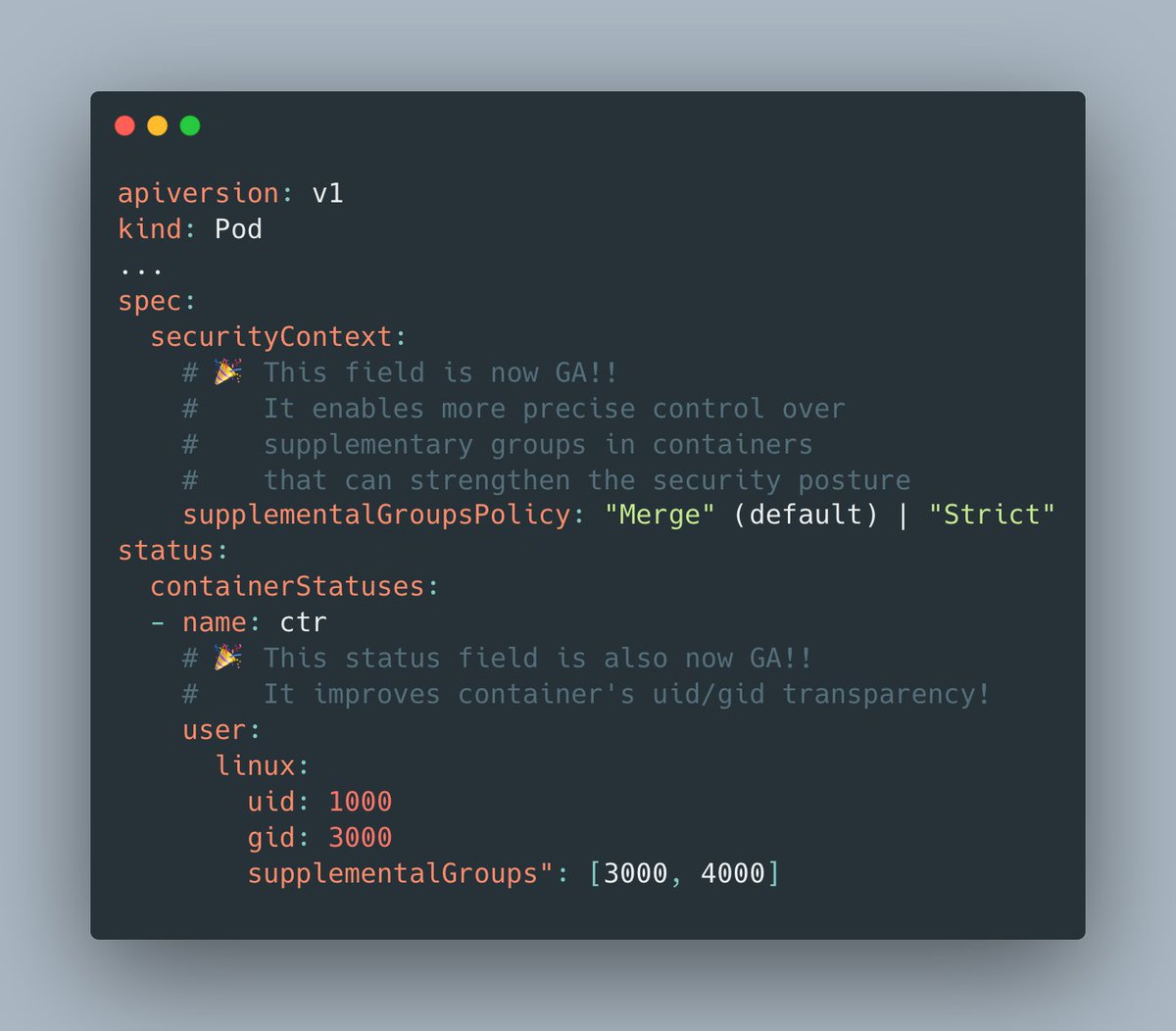
☸️ My first KEP has finally graduated to GA🎉 I think it’d be an important security improvement that can strengthen the security posture and improve uid/gid transparency. I'm proud that the field in PodSpec I proposed is now available worldwide! #kubernetes#k8s#k8sjp (1/2)
Kubernetes turns 12 today!💙
Today, we're celebrating Kubernetes and everyone who has been part of its journey over the years. Thank you for helping shape the past 12 years and for building what's next.
Happy Birthday, Kubernetes!🎉
#Kubernetes#CloudNative#OpenSource#CNCF
How is your team actually running cloud native projects in production? We want to see your setups and real-world lessons.
Submit your entry to the CNCF End User Case Study and Reference Architecture contest for KubeCon + CloudNativeCon Japan. You could land a spot to deliver a keynote live on stage in Tokyo (July 29-30) and get your story published on https://t.co/fVLn4uZGXS.
Submit by June 11: https://t.co/5TfPqesvD2
【懇親会スポンサー募集】
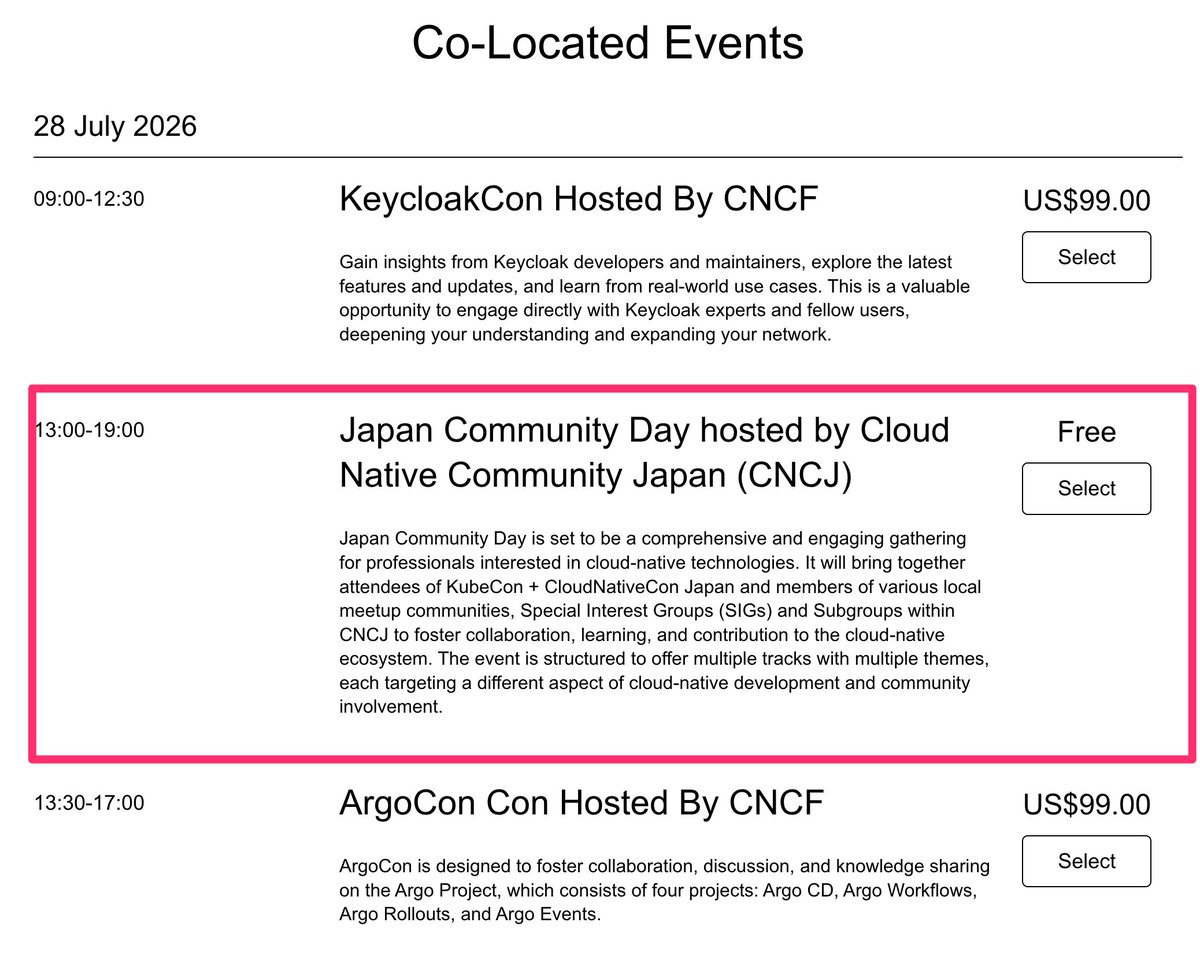
今年も #KubeCon + #CloudNativeCon Japan 2026のCo-located Eventとして、Japan Community Dayを開催します!
今年は本会場と同会場で前日開催!
協賛にご興味のある方、ご質問のある方のご連絡をお待ちしております。(5分間のLT込、20万円 x 2社、60-90minを予定)
#CNCJ
KubeCon Japanに合わせてEnvoy Meetup Tokyo復活させれたら面白いかもなという話をしてるんですが、どれくらい興味ある人いるのか気になってます。登壇ネタあるよとか会場貸せるよという方いましたらDMなり連絡ください🙇♂️
We are plotting to host an Envoy User Meetup in Tokyo during the KubeCon Japan week - let me know if you are interested
🎉 Excited to share that I’ll be speaking at #KubeCon + #CloudNativeCon Japan 2026 — my first KubeCon talk! 🚀
I’ll share how we safely scale in our on-prem KaaS across 1,300+ clusters and 40,000+ nodes ☸️
See you in Yokohama! 👋🇯🇵
https://t.co/vtiO0FG1D0
🥳 I’m excited to be speaking at #KubeCon#Japan 2026 alongside Yiyang Zhan — my very first time speaking at KubeCon🎉 Looking forward to discussing how to balance advanced LLM optimizations with operational simplicity with many of you in Yokohama🎡🇯🇵👋😀
https://t.co/V42zDXIhQ9
KubeCon + CloudNativeCon Japan 2026のCo-located Eventとして、Japan Community Day 2026を今年も開催します!
参加登録も開始!
前回は参加枠が早い段階で埋まったのでお早めに登録お願いします🙇
昨年実施の内容
https://t.co/TvATB0XVqm
#CNCF#CNCJ#Kubernetes#k8sjp#ebpfjp#oteljp
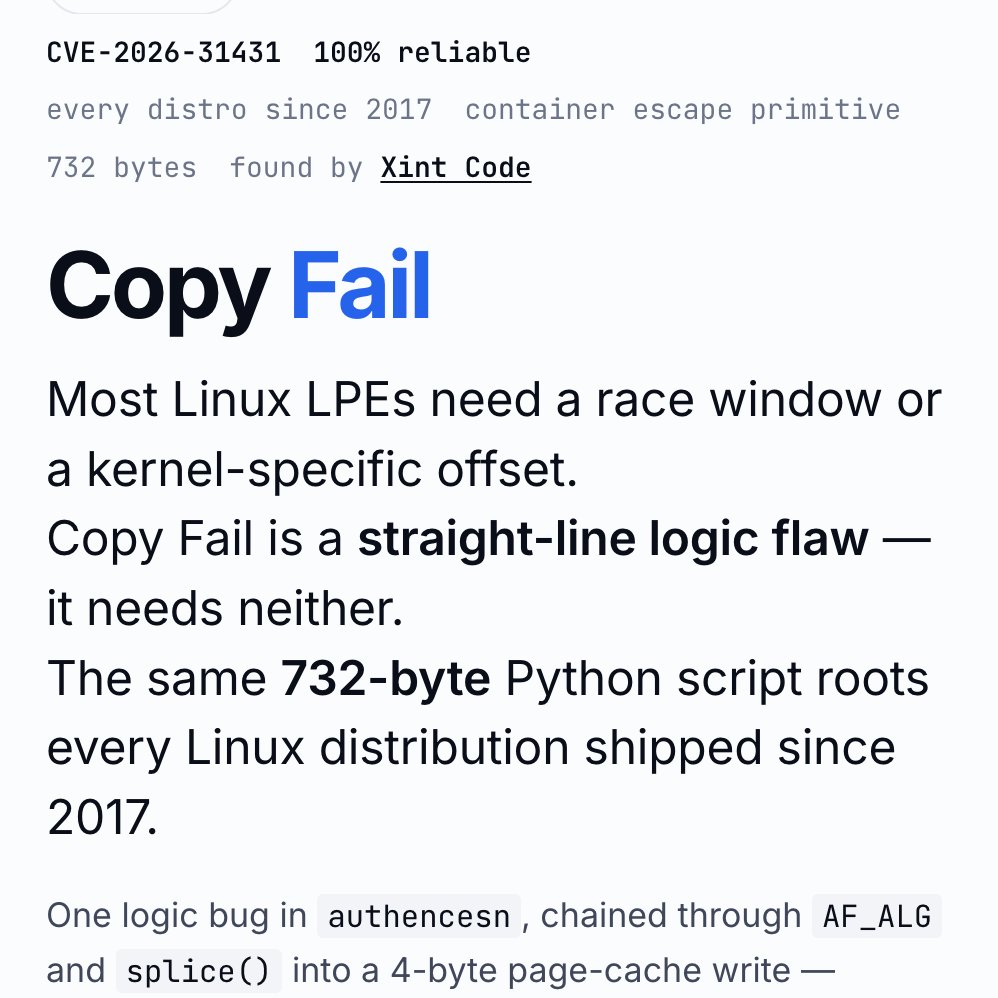
‼️🚨 BREAKING: An AI found a Linux kernel zero-day that roots every distribution since 2017. The exploit fits in 732 bytes of Python. Patch your kernel ASAP.
The vulnerability is CVE-2026-31431, nicknamed "Copy Fail," disclosed today by Theori. It has been sitting quietly in the Linux kernel for nine years.
Most Linux privilege-escalation bugs are picky. They need a precise timing window (a "race"), or specific kernel addresses leaked from somewhere, or careful tuning per distribution. Copy Fail needs none of that. It is a straight-line logic mistake that works on the first try, every time, on every mainstream Linux box.
The attacker just needs a normal user account on the machine. From there, the script asks the kernel to do some encryption work, abuses how that work is wired up, and ends up writing 4 bytes into a memory area called the "page cache" (Linux's high-speed copy of files in RAM). Those 4 bytes can be aimed at any program the system trusts, like /usr/bin/su, the shortcut to becoming root.
Result: the next time anyone runs that program, it lets the attacker in as root.
What should worry most: the corruption never touches the file on disk. It only exists in Linux's in-memory copy of that file. If you imaged the hard drive afterwards, the on-disk file would match the official package hash exactly. Reboot the machine, or just put it under memory pressure (any normal system load that needs the RAM), and the cached copy reloads fresh from disk.
Containers do not help either. The page cache is shared across the whole host, so a process inside a container can use this bug to compromise the underlying server and reach into other tenants.
The original sin was a 2017 "in-place optimization" in a kernel crypto module called algif_aead. It was meant to make encryption slightly faster. The change broke a critical safety assumption, and nobody noticed for nine years. That bug then rode every kernel update from 2017 to today.
This vulnerability affects the following:
🔴 Shared servers (dev boxes, jump hosts, build servers): any user becomes root
🔴 Kubernetes and container clusters: one compromised pod escapes to the host
🔴 CI runners (GitHub Actions, GitLab, Jenkins): a malicious pull request becomes root on the runner
🔴 Cloud platforms running user code (notebooks, agent sandboxes, serverless functions): a tenant becomes host root
Timeline:
🔴 March 23, 2026: reported to the Linux kernel security team
🔴 April 1: patch committed to mainline (commit a664bf3d603d)
🔴 April 22: CVE assigned
🔴 April 29: public disclosure
Mitigation: update your kernel to a build that includes mainline commit a664bf3d603d. If you cannot patch immediately, turn off the vulnerable module:
echo "install algif_aead /bin/false" > /etc/modprobe.d/disable-algif.conf
rmmod algif_aead 2>/dev/null || true
For environments that run untrusted code (containers, sandboxes, CI runners), block access to the kernel's AF_ALG crypto interface entirely, even after patching. Almost nothing legitimate needs it, and blocking it shuts the door on this whole class of bug...