I am delighted to share a Call for Articles for a special issue of the 'Journal of Historical Research in Marketing' that I am editing focusing on clothing and fashion. Please share with your networks - more information here: https://t.co/ihkq4AFhf2
Good morning Twitter
This marvelous creation of a scale model of Erddig is a bug house and was made by a member of the gardens team
She's so clever!!
It will have towers of sweet peas growing up behind and wild flowers underneath
Have a great day 😁
Just out (+open access): 'The Material Body: Embodiment, history and archaeology in industrialising England, 1700-1850' eds @ecraigatkins & me. A unique collaboration of historians & archaeologists who stepped outside their discipline to study embodiment
https://t.co/04RDmqjb1w
News of a new PhD opportunity at ARU - come work with me and @GressenhallFW on a fantastic collection of some c. 1,000 workhouse objects!
https://t.co/jWCL5UHbeY
Very much looking forward to giving an online Thread Talk for the Embroiderers' Guild on Saturday at 2pm, looking at the history of the smock frock and the 19th century women who made them. Please join us if you can - details at https://t.co/sa3elh35SG
I am delighted to share a Call for Articles for a special issue of the 'Journal of Historical Research in Marketing' that I am editing focusing on clothing and fashion. Please share with your networks - more information here: https://t.co/ihkq4AFhf2
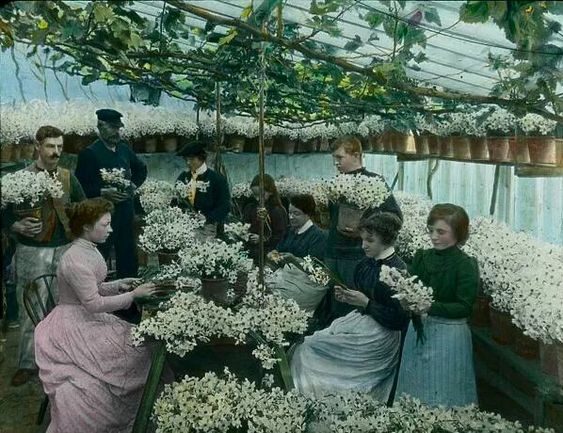
Bunching Scilly Whites, St Mary's, 1900. The narcissi were prepared in large sheds, the men doing the trimming and boxing, the women the bunching. Growing spring flowers was the largest industry on the Scillies until tourism eventually overtook it.
In 1807, the ship Anne Marie was captured by the British Navy while sailing from the Faroe Islands to Denmark. Five packages and two hundred letters were confiscated from the ship and survived, still sealed, in the Prize Papers. What’s inside? Read below to find out. /1
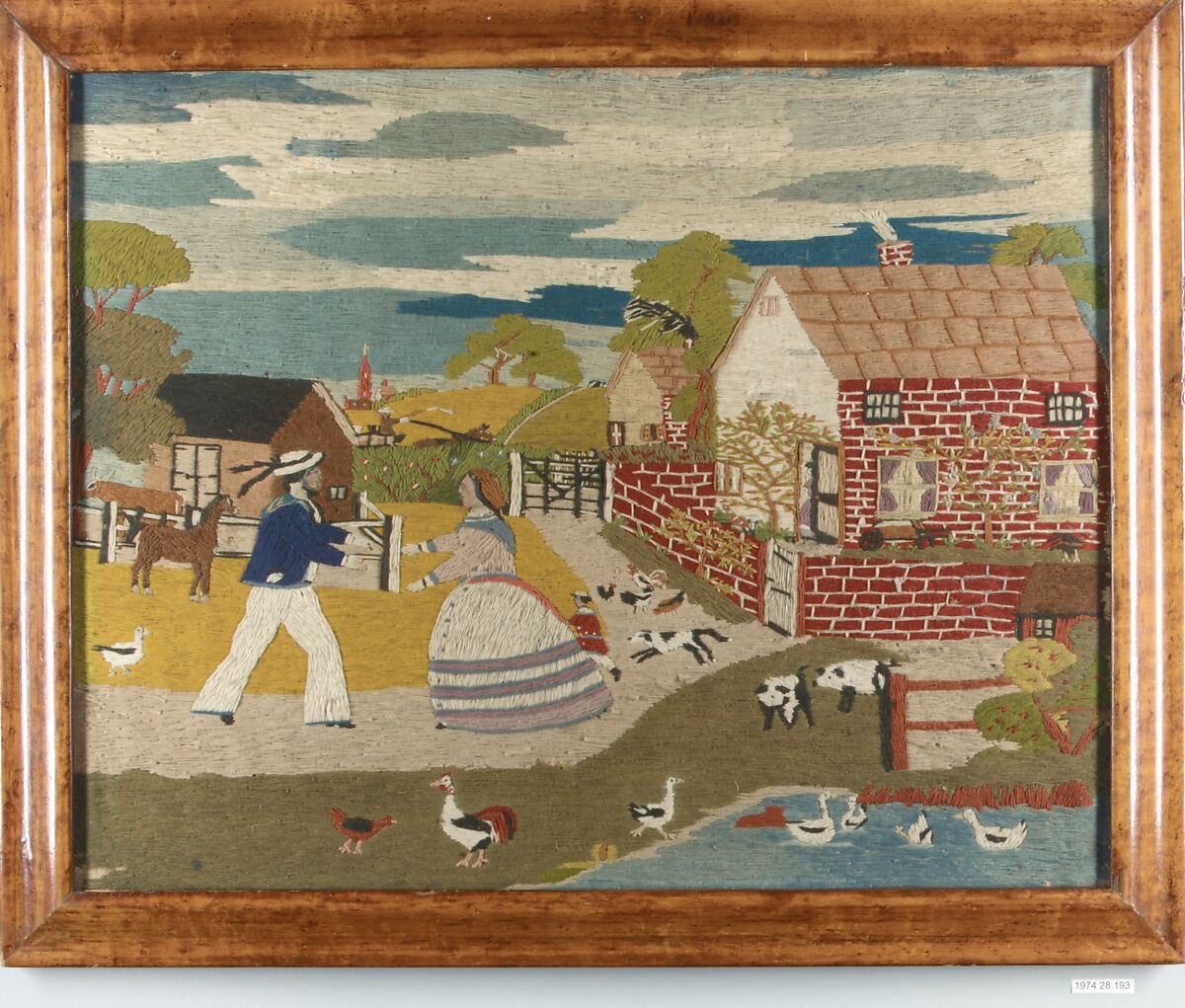
Posted this on Insta but love it so much I gotta post it here, too. This is an embroidery (@metmuseum) of a sailor’s return to his sweetheart from the second half of the 19th century. It’s a sailor’s woolwork or “woolie,” stitched by a sailor during his downtime
Today is Plough Monday, by tradition the start of the farming year, a day of significance in every rural community. This 1849 headstone for 21 year old Samuel Croft at Blyford, Suffolk has a relief of horses unharnessed from the plough, a symbol of his labours being over.
Blyford: https://t.co/lDHQpwmjXV
From an advertisement for D.H.Evans's Oxford Street Department Store, Christmas gifts for servants, a nice few yards of suitable fabric to make a new uniform dress @NTKillerton swatches as a magazine supplement, about 1900-1910
👔CALL FOR PAPERS! 👗All political fashion enthusiasts! Check out this CFP for a one-day symposium at De Montfort University on political dress and fashion. Due date 15th December. Contact @egernerd for details!
Bought this photo recently of house builders. Think this is around 1910 but what fascinates me the most is the old chap 3rd from right whose clothing is more 1870s/1880s rather than 1900s/1910s. When dating pictures it’s always important to remember people kept clothes for years
We’re very excited to announce that https://t.co/Kgd1j4mypx is now live, as is our special issue of https://t.co/lFUrW0HVGC. This debuts our first 25 years of data and will expand as the dataset grows @marselykehoe @canderson771
I am thrilled to announce our 'Stitches that Speak' online seminar series that I am co-organising with @Serena_Dyer to follow on from our Symposium on 20th April! All talks will be online via Teams. Email or DM for links! 🪡🧵 #dresshistory