What is actually holding Uganda back?
In this #WeShapeGov episode, we talk with @NadaAndersen about using your voice to hold power to account.
Nada says it starts with the lack of a shared ideology. Every good company has a vision and a mission, so what is Uganda’s? Without civic education, she says, people don’t know how to take part.
@mkatagaya points out that Uganda has plenty of plans on paper.
Watch the full conversation here: https://t.co/qPPdbPz7tK
Walk into a government hospital in Uganda today and, Nada Andersen says, you are literally jumping over people.
In this #WeShapeGov episode, we talk with @NadaAndersen about using your voice to hold power to account.
@mkatagaya asks her how service delivery has changed. Nada remembers doctors who were more committed, more dedicated, and less money-hungry, and patients who paid less and weren’t pushed into unnecessary procedures.
Today, she says, anyone who goes to a hospital will be found to have something, and it will cost money.
Watch the full conversation: https://t.co/qPPdbPz7tK
Uganda has the laws and the policies, where it falls short is implementation.
In this #WeShapeGov episode, we talk with @NadaAndersen about using your voice to hold power to account.
Nada says we’ve fallen into a habit of too many meetings and too few action points.
@mkatagaya adds that almost everything has become political. In the 90s, neighbours chased each other to pay graduated tax. Now, when people see something wrong, nobody cares, because they believe it will only benefit a few individuals.
Watch the full conversation here: https://t.co/qPPdbPz7tK
We know how to describe Uganda’s problems because we’ve lived them. The harder part is the solution.
In this #WeShapeGov episode, we talk with @NadaAndersen about using your voice to hold power to account.
Nada says working alone isn’t productive work. If you want to achieve something, you have to join hands with others.
She believes being part of the solution starts with being honest about the problem, asking for help, and being accountable to the people around you.
Watch the full conversation: https://t.co/qPPdbPz7tK
Uganda doesn’t lack policies, it lacks follow-through.
In this #WeShapeGov episode, we talk with @NadaAndersen about using your voice to hold power to account.
She says the problem is too many meetings, too many per diems, and too few action points, with good policies left sitting on the shelf.
Watch the full conversation: https://t.co/qPPdbPz7tK
If politics is failing most of the world, why do we keep funding the system that fails it?
Jackie Dugard of Columbia University’s @ishrcolumbia put that to the room at #TheListeningState. Asked whether the next decade of support belongs in the courts or with government, she looked past both. Her answer is local power: funders backing local organisations and local mobilisation, with ecofeminism leading the way.
Watch the full conversation: https://t.co/T6gXJqRgwH
#WeShapeGov #UNGA81
Closed civic space calls for a new way of funding.
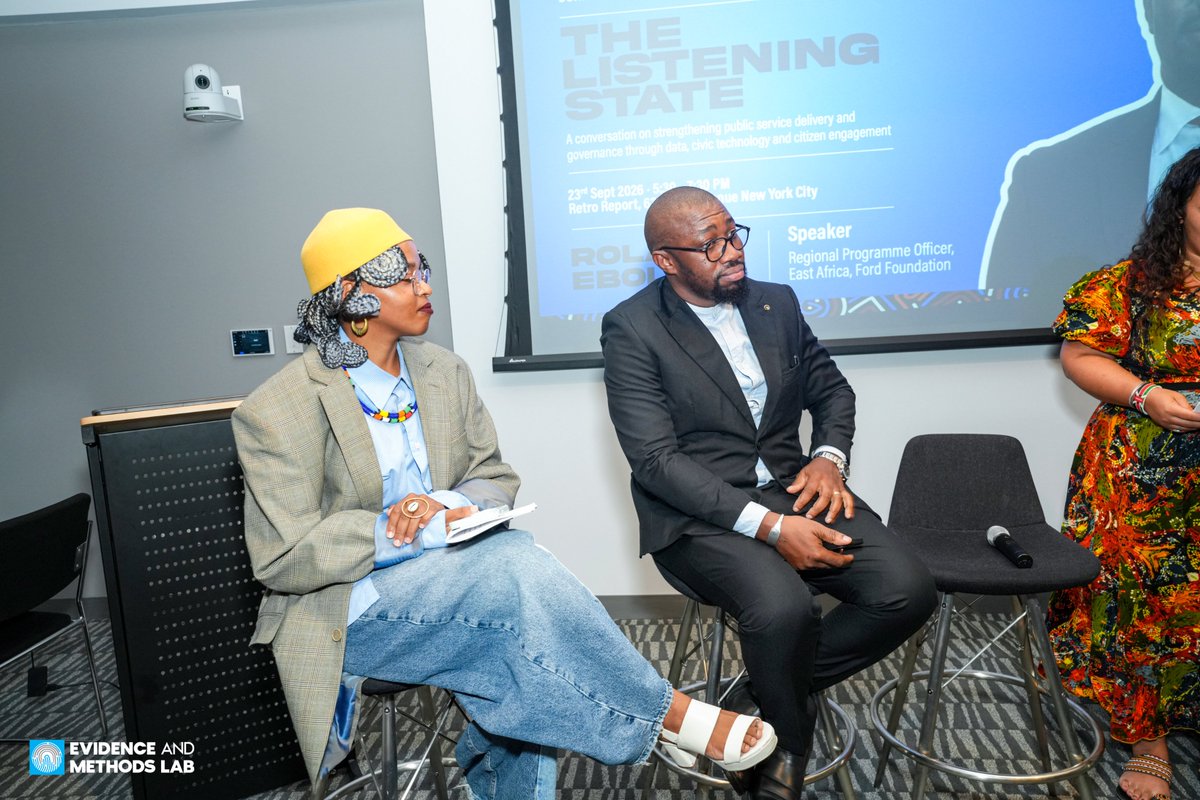
@RolandEbole of the @FordFoundation, speaking as a funder at #TheListeningState event, argued that giving has to change as authoritarian practices change. He called for support that goes beyond legacy organizations, through routes like fiscal sponsorship and basket funds, so it reaches diverse actors and strategies.
Watch the full conversation: https://t.co/T6gXJqRgwH
#TheListeningState #WeShapeGov #UNGA81
We’re building the Civic Engagement Academy (CEA), a free 6-week hybrid program for civic actors across East Africa, and we want you to help shape. Your answers will decide what the academy teaches.
It will run across three modules:
▪ Civic Participation & Governance
▪ AI & Technology for Civic Impact
▪ Design for Social Impact
Tell us what you need to learn to make civic change happen.
Take the survey: https://t.co/MvCi3v5ST3
#CivicEngagementAcademy #WeShapeGov
Thirty years after apartheid, does the South African state listen to poor, rural Black communities?
At #TheListeningState, Zenande Booi, Youth Legal Coordinator at @PeerDefense, pointed to land as the starting point. The Constitution promises to secure land rights weakened by racist laws, yet the state mostly shows up for votes or required laws, and public participation is a box-ticking exercise.
Listening means recognising people’s dignity, agency and right to decide for themselves.
Watch the full conversation: https://t.co/T6gXJqROmf
#WeShapeGov #UNGA81
"In the 90s, you could go out in the evening and find anyone in your favourite kafunda."
@NadaAndersen remembers sitting in a tiny kafunda in Kabalagala with people who are ministers today. There were no chairs, so they sat on empty beer crates and had a drink together. Today, those same people are hugely distanced from ordinary people, a lost chance to be immersed in the population and to listen to the voice of reason.
When did you last see a leader just sitting with ordinary people?
Watch the full episode here: https://t.co/nYdPjZGicI
Every morning for more than two years, @NadaAndersen has posted the same question on X: “Good morning, has she resigned yet?”
She started on the day her friends were arrested while writing protest placards, and she says she will keep going until she gets an answer.
On this episode of #WeShapeGov, @mkatagaya sits down with Nada Andersen, Founder and CEO of Star:Leo Advertising, to talk about using your voice to hold power to account. They talk about why activism that lives only on social media achieves nothing, why you should document everything, and how a citizen’s registered letter puts a legal duty on a public office to respond.
Watch the full conversation: https://t.co/qPPdbPz7tK
If shame no longer works, what replaces it?
For years, civil society has exposed the numbers, shown the data, and published the figures on what isn’t working, including state excesses. But governments don’t seem to get embarrassed anymore.
At #TheListeningState, Tawanda Mutasah, President and CEO of American Jewish World Service, made the case for holding on to the evidence: we shouldn’t throw the baby out with the bathwater. Keep gathering and showing evidence of where delivery falls short and where rights are violated, and aim it at something harder to dismiss: the promises already written into constitutions.
Watch the full conversation: https://t.co/T6gXJqRgwH
#WeShapeGov #UNGA81
What do you want to learn to make civic change happen?
We are shaping the Civic Engagement Academy (CEA), a free 6-week hybrid program for civic actors across East Africa, but before we finalize it, we want you to help design it.
Whether you work in an NGO or CSO, organize in your community, report the news, work in government, or are a young creative or student, your answers will help us shape the academy.
The CEA runs across three modules:
▪ Civic Participation & Governance
▪ AI & Technology for Civic Impact
▪ Design for Social Impact
Take the survey and help us build an academy that works for you: https://t.co/MvCi3v5ST3
#CivicEngagementAcademy #WeShapeGov
Governance works when institutions listen, and when citizens have ways to be heard.
In a conversation with @CIVICUSalliance LENS, our Team Leader, @mkatagaya, shares why Evidence and Methods Lab exists: so that when people follow up on the public services meant to serve them, someone responds.
Read the full interview here: https://t.co/trEO63dHFq
Thank you, CIVICUS, for the conversation.
#CIVICUSLens #WeShapeGov
What does it take for institutions to listen?
During the United Nations General Assembly 2026 (UNGA 81), we held #TheListeningState, bringing together people working across civil society, law, philanthropy, research, media, and civic technology to deliberate on what it takes for institutions to listen after citizens speak.
The conversation covered public services, civic space, community power, litigation, evidence, technology, and accountability.
Enjoy this highlight capturing some of the conversations, ideas, and moments from the event and the ways speakers challenged everyone to rethink trust, power, and the relationship between citizens and institutions.
Giving people a voice isn't enough if institutions aren't ready to listen and respond. Listening should lead to response, accountability, and action.
A huge thank you to all our speakers, including
Tawanda Mutasah, President & CEO, American Jewish World Service, Jackie Dugard, Senior Lecturer in the Discipline of Human Rights @ishrcolumbia, @RolandEbole Regional Programme Officer East Africa @FordFoundation, @zenandebooi, Member @PeerDefense (PDP), our event MC @upendomoja, and @mkatagaya.
#WeShapeGov #UNGA81
Roland also spoke about how donor support needs to change in politically restricted environments. He called for more flexible approaches, including technical support, fiscal sponsorship, basket funds, and stronger community-based support.
His submission made one thing clear: civic action is changing, and the ways we support it must change too.
#WeShapeGov #UNGA81 #TheListeningState
During #TheListeningState, Roland Ebole, Regional Programme Officer for East Africa at the @FordFoundation, spoke about one of the hardest questions facing civil society today: how do you make institutions listen when traditional pressure is no longer enough?
Drawing from his work across East Africa, he said states often become more responsive when pressure reaches either power or resources.
He pointed to examples from Tanzania and Kenya, where civil society found new ways to use financial and institutional pressure to push governments into engagement.
#WeShapeGov #UNGA81