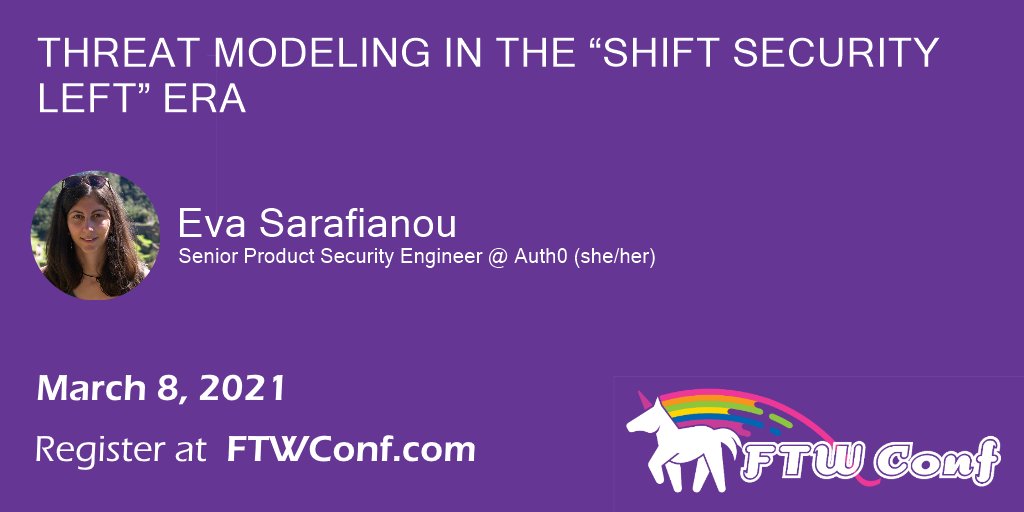
.@evileve6 at @auth0 shares the lessons she learned from scaling a product security program from startup to acquisition.
"Security partnerships may have scaling issues, but investing in Security Champions is the key!" 🔑
#DSC24
🔗: https://t.co/w1WIvcMmOr
DSC24 Speaker spotlight 🔦:
@evileve6 teaches how to run a Product Security program, including where to focus and how to cultivate a security culture! Register now - https://t.co/wSuGR5ZIsZ
Since the Log4J vulnerability news broke, Auth0 has been reviewing our platform for potential exposure. And at this time, we see no direct impact on the Auth0 Identity Platform. We will continue to monitor and investigate the situation.
My speaker's #FTWConf swag box arrived and it's full of goodies. Thank you @auth0 and @Microsoft!
As a reminder, my #threatmodeling talk recording is available at https://t.co/1htZ77keZh.
Join me tomorrow at FTWConf where we'll celebrate the International Women's Day!
I'll be speaking about Threat Modeling and how it can help shift security left.
The talk is introductory level, no prior experience to Threat Modeling is needed.
#ftwconf#threatmodeling
✨Meet @evileve6 a Senior Product Security Engineer @auth0 in this clip Eva talks about how she got to where she is today.
Eva will be speaking about Threat Modeling in the “Shift Security Left” era at https://t.co/fDL9e2rolV
For the whole interview -> https://t.co/dMhQMRqZrh
@disclose_io If it's an open source project with no https://t.co/YwUHfYC3gV file, also look at who are the active maintainers and try to find their email in GitHub, Twitter, LinkedIn etc.
In any case, never open an issue.
@disclose_io 3. Check if company's website <DOMAIN>/security has a place for responsible disclosure
4. If non of the above are successful, check if there is a security email, e.g. security@<domain>. If there is one, also check if they have PGP in case the security issue is critical
(2/2)
@gplusdotgr 3. The vulnerable code causing the XSS attack is not part of the module
4. No globally defined (e.g. JS native) function is used within the module that handles the variable holding the secret
This is indeed similar to what I describe in the closures examples (#3 and #4).
(2/2)
@gplusdotgr This could work in some cases where all of the following hold true:
1. The variable holding the secret is not exported
2. Any function manipulating the secret within the closure is not exported. Otherwise function override attacks can occur
(1/2)