The industry keeps selling the dream of a “multi-chain future.”
But every new bridge exploit proves the same thing:
❌ bridges are still one of the biggest attack surfaces in crypto.
The recent Kelp DAO exploit wasn’t just an operational mistake.
It exposed something deeper:
Even “institutional-grade” cross-chain infrastructure is still fragile.
That’s exactly why @routerprotocol $ROUTE new direction with OGA matters.
Instead of treating interoperability as:
“move assets from A to B through another fragile bridge”
OGA rethinks the execution layer itself.
Bridges, DEXs, solvers, liquidity venues → all become programmable nodes inside one execution graph.
Meaning:
* dynamic route optimization
* isolated failures (one broken route doesn’t nuke the whole execution)
* real-time solver reputation
* programmable liquidity orchestration
* lower dependency on single points of failure
This is a fundamentally different architecture from the old “bridge everything” model.
And now combine that with:
* AI-agent execution via MCP
* SDK integrations
* on-ramp abstraction
* B2B infrastructure expansion
* Route App as the first execution layer showcase
Router isn’t trying to become:
“another bridge.”
It’s trying to become:
the execution fabric underneath cross-chain finance.
That’s the direction the industry eventually needs if:
* institutions move on-chain
* AI agents become users
* multi-chain complexity keeps growing
Because real adoption won’t happen through fragile patchwork infrastructure.
It happens when cross-chain interactions become:
✅ abstracted
✅ reliable
✅ programmable
✅ invisible to the user
And that’s the thesis behind OGA + Router.
At ~600k marketcap, the market still barely notices what’s being built here.
BOB Gateway is now integrated into @RouterProtocol.
Native BTC routes are live and Router's users and partner apps have access to the best native BTC ↔ wBTC and stablecoin routes across 11+ chains.
To celebrate, frontend fees are waived on all BOB-supported BTC routes on Router for the next 3 months.
Try it now: https://t.co/yKYOd4xWVW
In under 60 days, we’ve moved from vision to production on the pieces that matter most: intelligent onramps, developer-first SDKs, and native AI agent integration via MCP.
The rails for seamless onchain execution are now ready. To all builders, protocols, and AI agent teams, this is your infrastructure moment. Let’s move the space forward.
Why does Router’s Open Graph Architecture (OGA) make so much sense?
- Permissionless node registry → Any solver, DEX, or bridge can join in <1 day with onchain reputation scoring.
- Split-and-optimize engine → Large orders are broken into parallel sub-tranches for deeper liquidity and minimal slippage.
- Unified messaging hub + isolated revert logic → Adapts between different bridges with <0.5% revert risk.
The Result is an efficient onchain swap network which is open, permissionless and built for scale.
Try it yourself → https://t.co/BnhwRYCl31
Dear dApps, add best-in-class crosschain and same chain swaps with Router Widget + API!
• Fully customizable branding
• Real-time best routes
• 20+ EVM and non EVM chains
• Zero listings drama
Integrate today → https://t.co/SNQQkt1rNo
Tag your dev/team, we’ll help you go live fast.
Tempo (@tempo) is now live on Router’s Open Graph Architecture!
Seamless access to high-throughput stablecoin payment routes, now available through Router’s app and API.
Try it: https://t.co/3tRSWfctgm
Doma (@domaprotocol) is now live on Router's Open Graph Architecture!
Move assets between Doma and the broader ecosystem via Router's app and API, bringing tokenized domain markets within reach.
Explore it: https://t.co/3tRSWfctgm
There's a shift happening.
Agents don't just analyze anymore. They execute.
Introducing Router MCP: AI agents can now trade across chains and find the best routes in real time.
For years, everything onchain relied on users handling the complexity. Now agents take over.
Looks like $ROUTE #OGA just hit a major milestone at the protocol level. After months of scaling and advancing the tech, it’s now permissionless and fully open.
This might not sound huge at first, but it is.
Take a step back and think about what #Web3 actually represents: a decentralized, permissionless system for moving value from A to B.
$ROUTE #OGA is now bringing that model directly into #DeFi.
No real competitors. Just very early.
And something tells me they’ve secured a serious partner to push this into the next phase: adoption and scaling.
Cross-chain bridges were supposed to make #Web3 feel unified. Instead, most made users nervous, long confirmations, risky hops, and too many "bridge and pray" moments.
That’s why @routerprotocol’s move to build on @arbitrum isn’t just another launch, it’s a shift toward true chain abstraction. One where moving across #Blockchains finally feels like staying on one.
⚙️ Chain Abstraction Done Right
Unlike traditional bridges that simply move tokens between chains, Router Protocol introduces a new layer of interoperability that unlocks real cross-chain functionality.
Here’s what sets it apart:
🔹 Cross-Chain Applications, Not Just Transfers:
Developers can now build #dApps that execute logic across multiple chains simultaneously. Think swapping on @ethereum while staking rewards on @arbitrum, all in one transaction.
🔹 Cosmos SDK-Level Security Meets Arbitrum’s Speed:
Router brings robust consensus from the Cosmos SDK world, but anchors it in Arbitrum’s low-cost, high-throughput Layer 2 environment, making cross-chain interaction secure and seamless.
🔹 Plug-and-Play Integration:
Its widget design means any project, from DeFi to gaming, can go multi-chain in minutes. No complex setup. No risky dependencies. Just simple #interoperability powered by Arbitrum.
Why Arbitrum Makes the Perfect Home
Router’s vision only works if it’s built on infrastructure that’s fast, affordable, and reliable, and that’s where Arbitrum’s ecosystem advantage shines.
✅ Low fees make complex cross-chain actions actually usable for real users.
✅ Quick confirmations mean transfers feel native, not delayed.
✅ Deep liquidity ensures seamless flow between chains and assets.
Arbitrum gives Router the environment to scale safely, making interoperability a native experience, not a risky experiment.
🔍 The Bigger Picture: From Bridges to Unified Chains
For years, “cross-chain” meant friction, manual bridging, confusing networks, and gas fees on both sides. Router Protocol’s approach on Arbitrum changes that narrative.
It’s no longer just about moving tokens, it’s about building #dApps that exist across chains, where transactions flow smoothly between ecosystems like Ethereum, Cosmos, Base, and beyond.
In other words, it’s Web3 without walls.
🚀 Still Early: The Perfect Time to Explore
Router Chain is still in its early stages, and that’s an opportunity.
Users can test the system with small amounts, learn how it works, and experience firsthand what next-gen interoperability feels like.
🔗 Try it here → https://t.co/ojBAKbdoiT
🧭 The Takeaway: Interoperability, Upgraded
Cross-chain shouldn’t mean compromise.
By building on Arbitrum, Router Protocol proves that speed, security, and simplicity can coexist, unlocking a new era where Web3 feels unified, intuitive, and user-first.
The age of chain abstraction is coming…And it’s happening on Arbitrum.
https://t.co/8JfpLC76ou
In case you have not already, pls check out the upgraded docs section for everything you need to know about OGA - whether you are a developer or user or an institution, but especially if you are a developer
It’s up to the $ROUTE team now to decide what $ROUTE becomes.
➡️ You survived the worst bear market.
➡️ You made a necessary pivot, away from being just a chain to OGA, where real adoption can grow without burning runway or losing focus.
➡️ Partners are starting to come in.
➡️ The core community is still here, and when things are done right, they’re fully behind it.
What happens next depends on:
🟢 Clear, consistent communication
🟢 A strong next plan built on top of OGA
🟢 Real partner adoption and volume through OGA
This can become a billion-dollar ecosystem, and I mean that seriously.
Forget what was.
Forget how things were done before.
Use the vision, the experience, and bring in the right resources, funding, talent, and leadership, to execute properly.
There’s a lot of garbage in this space. With this vision and these connections, this has to be doable.
@CryptoMan_Ram
It won’t be easy, but you can do it.
Fibrous is now integrated on @routerprotocol via Router's new OGA model!
We are fully dedicated to pushing the best rates for same chain steps across Monad, HyperEVM and Base.
More routes, better trades
Fibrous Integrates with Router via Open Graph Architecture
There’s a lot of talk in Web3 about being open and permissionless. Very few systems actually prove it in production. Today, we’re doing exactly that on https://t.co/XHTTwQ71BZ
@FibrousFinance, has integrated with Router via Open Graph Architecture (OGA). Fibrous is an advanced DEX aggregator designed to deliver best-price execution at scale.
Instead of routing trades through a single venue, Fibrous:
- scans AMMs, order books, and private liquidity sources,
- intelligently splits trades across multiple venues,
- minimises slippage and price impact,
- and executes everything in a single transaction.
By integrating via Open Graph Architecture, Fibrous didn’t need to wait for approval or coordination. They simply plugged into an open routing graph and instantly:
- Fibrous’ optimised swap logic became available as part of Router’s routing system.
- Their execution paths are now evaluated alongside every other bridge, DEX, and solver.
- Users get access to Fibrous’ liquidity and pricing automatically, whenever it’s optimal.
How Fibrous Plugged In
The plugging is as seamless as it sounds; the OGA follows a hub-and-spoke model. At the centre is Xplore Core, which standardises requests from UI/whoever is looking for a path and broadcasts them across the nodes.
When the request reaches these Xplore Nodes, they compute their best execution using their own logic and send the result back. Fibrous became one such node.
Xplore Core then evaluates all returned paths and surfaces the best one to the UI.
The node structure is open. It’s proof that permissionless aggregation actually scales when integrations are free, open, and self-service.
The ecosystem grows faster than any single team ever could manage manually. Every new participant improves the system with more routes, better prices, deeper liquidity, and stronger execution for users.
The long-term potential is enormous once:
- All major exchange chains are integrated
- All key liquidity providers are connected
- Neobanks and wallet apps and more adopt this technology for their end users
DApps are built on top of it for complex on-chain swaps and advanced execution logic
This is how $ROUTE can evolve into a billion-dollar infrastructure provider.
The hardest phase is behind us.
The technology is now aligned and ready.
As the market shifts and adoption accelerates, the upside becomes significant.
Don’t give up, 80% of the hardest work is already done.
What comes next is adoption, usage, and revenue.
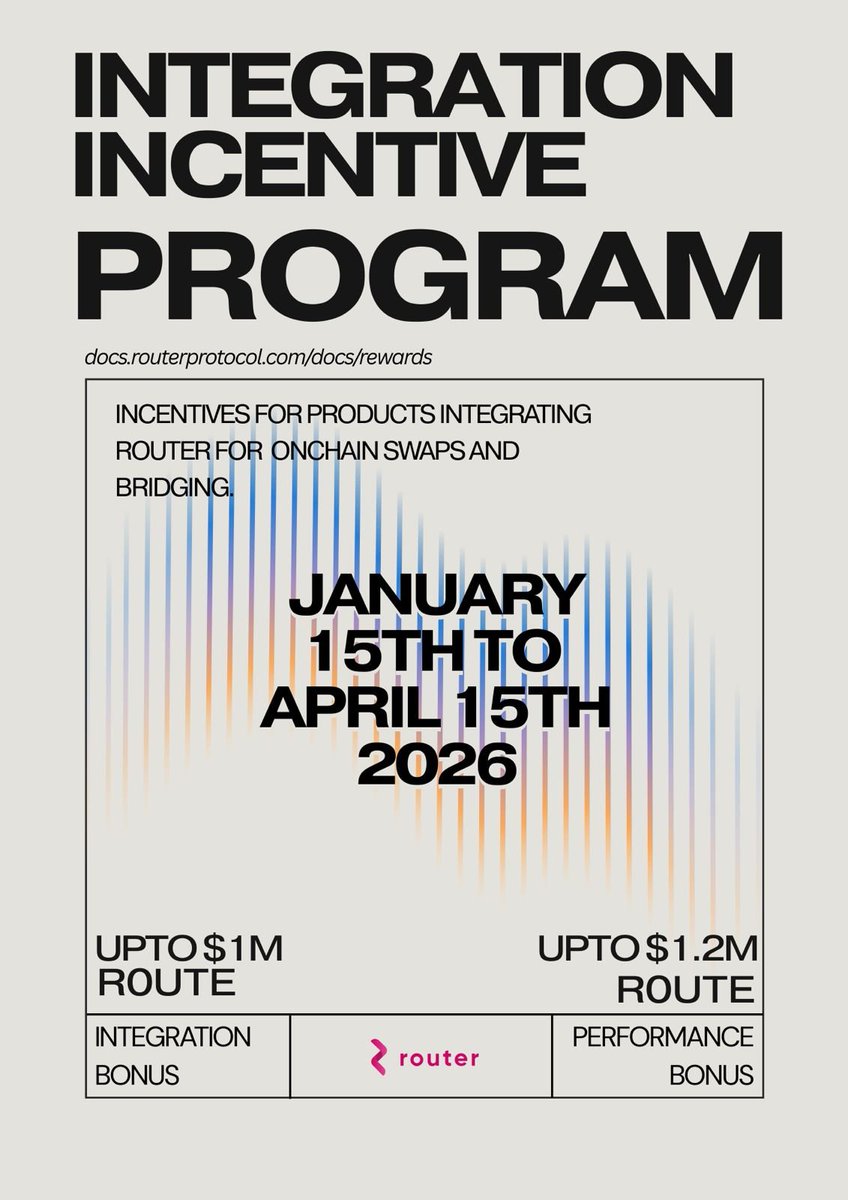
Introducing the Router Integration Incentive Program 🚀
Rewards for teams integrating Router and driving real, sustained onchain swaps and bridging.
Live: Jan 15 – Apr 15 (initial period).
Full details: https://t.co/iyU4IMjSLl