@jbbrisco If I were to guess it’s because Landorus being ground/flying and guardian of the fields they associated him with grasslands and prairies.
Spring Hill Ranch is part of Tallgrass Prairie Nature Preserve.
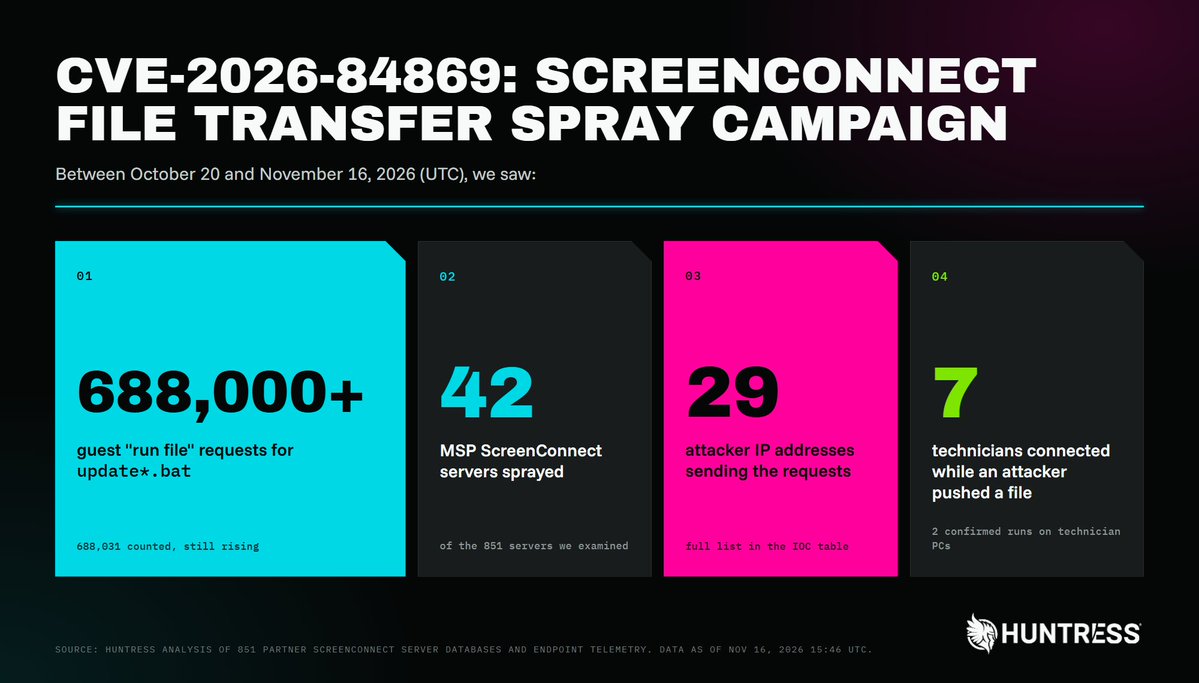
New from @_JohnHammond: Huntress has confirmed in-the-wild exploitation of CVE-2026-84869, a ScreenConnect client flaw that allows a guest to run a malicious file on a connecting technician's host. https://t.co/HQTdn5M36F
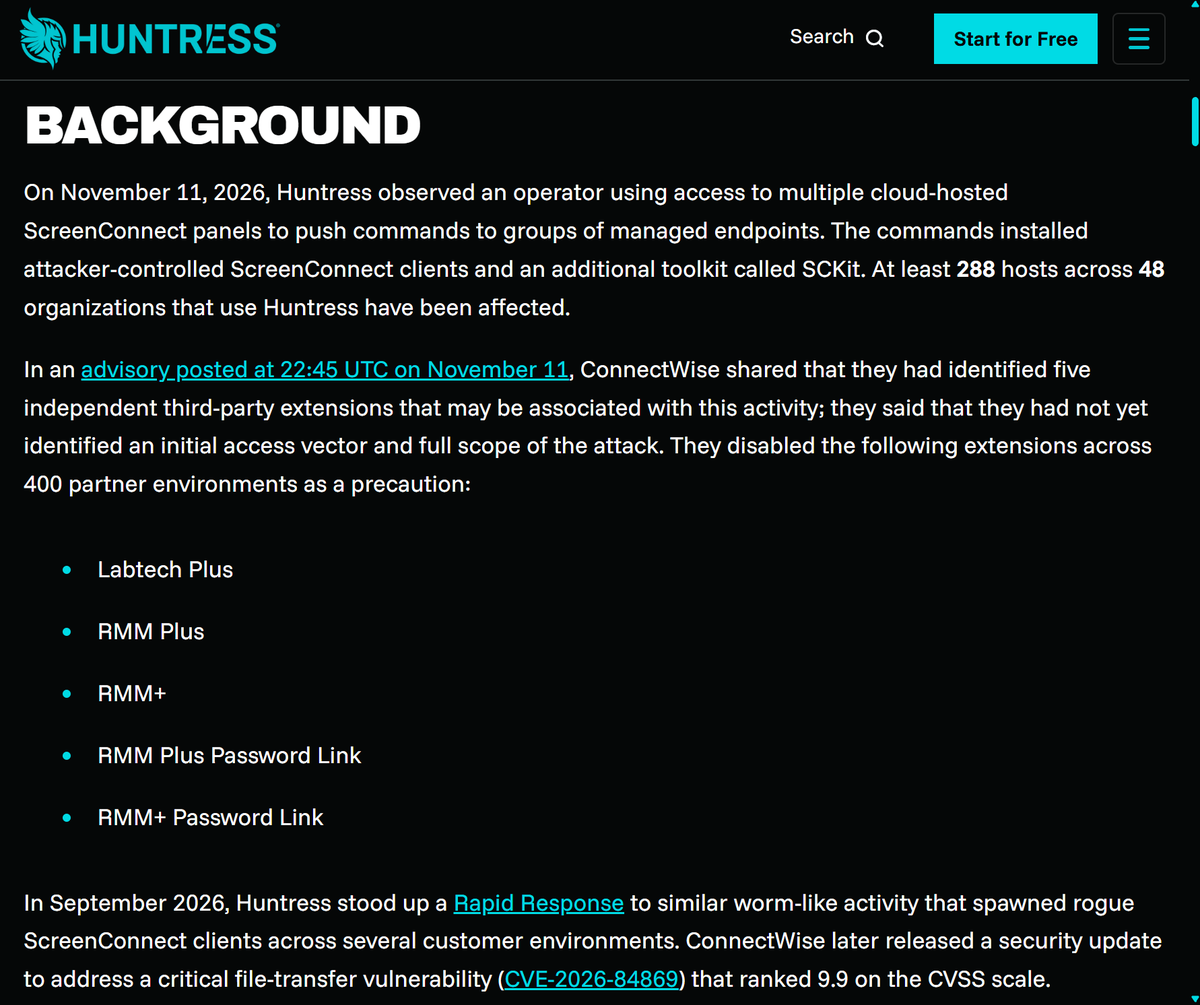
Today (1) we saw another wave of SCKit compromises against ScreenConnect servers and downstream connected clients, including on-premise instances via the weak RMM+ plugin.
Also, (2) I chased "cryptobait" fake guest connections that appeared in multiple ScreenConnect servers. 🔗👇
1. https://t.co/zQOu3Rl0av
2. https://t.co/a6qFikeueK
BREAKING: Our SOC is seeing a spike in detections in ScreenConnect environments that appear to be related to SCKit worm activity we reported on earlier this week. We’ll be updating our blog shortly with more details as our investigation continues. https://t.co/KIWdk7KBEH
So this has been an absolutely hectic week, and it's not even close to over 🥴
Check out some rapid response investigative work that the team over at @HuntressLabs did - we'll continue to update as things progress.
https://t.co/8FzlU9fjCV
https://t.co/wbgH9HvtZP
hey PSA, @HuntressLabs has been chasing a pretty gnarly new incident of a ScreenConnect worm, hitting hundreds of hosts downstream during the holiday today -- genuinely please do read up on this one if you've got ye' ol RMM running ↙️
https://t.co/jGmm8FbmkW
Attackers are using cloud-hosted ScreenConnect panels to install rogue clients on managed endpoints.
Don’t triage infected hosts with ScreenConnect. Connecting can spread the malware to your workstation and other panels you can access.
Details and IOCs: https://t.co/DE0aXUVket
Golang binary “update.exe” (f1235751c9e48e5732b7b183dc2bb175a19e4c6401dfd0e96b4cfdd0d8c54b4c) gets dropped, which also deploys xmrig as “ApplyUpdate.exe”.
Golang binary “update.exe” (f1235751c9e48e5732b7b183dc2bb175a19e4c6401dfd0e96b4cfdd0d8c54b4c) gets dropped, which also deploys xmrig as “ApplyUpdate.exe”.
Looks like we are seeing mass exploitation of Geovision cameras for malware delivery…
Traffic involving 45.32.117[.]34 and 156.246.94[.]183 are a bad sign
How bad is this Gitlab issue? About as bad as it gets.
Anyone on the internet can take over an exposed, self-hosted GitLab server without logging in, on any version from the last 12 years.
Shodan is showing ~60K exposed servers online, which is a lot, but there are are far more internally for anyone with a foothold already.
Effective Immediately, all organizations using PHP for their systems are advised to be prepared for an update addressing two critical vulnerabilities. PHP is widely used for web applications. These vulnerabilities often provide a direct path to the server's file system or database. If an immediate update is not feasible, it is recommend that organizations take the system offline until it can be fully mitigated. NSA will follow up shortly with more specific guidance.
Huntress is aware of reports circulating regarding two critical remote code execution vulnerabilities (CVE-2026-109618 and CVE-2026-109619) in several versions of PHP (versions 5, 6, 7, and 8). 🧵
Full details of a remotely exploitable vulnerability in the core engine of *all* PHP versions will be released tomorrow, October 21st. If your organization has internet facing PHP applications then you need to be ready to patch the minute the update is released or *strongly* consider taking the application offline until you can:
https://t.co/hpdTOdvSsQ
UPDATE: ConnectWise has communicated that it has disabled the relevant applications. We’ve added this and several other developments to the blog: https://t.co/II9sf0gKu9
UPDATE: We have high-confidence the threat actor has also abused these ConnectWise Cloud Management apps:
-Exchange Online (b78f6a77-d4e5-46fb-87e5-d1648bd02519)
-MS Teams (24205314-2b89-4e07-a2a4-579e898a5640)
-SharePoint Online (b2b55f5b-7758-4719-8d8f-88ae172e6bdb)