Excited to kick off a new year at @Camacho_Elem working alongside the amazing Ms. Perkins to help positively impact the mathematical learning experiences of our Cosmos!
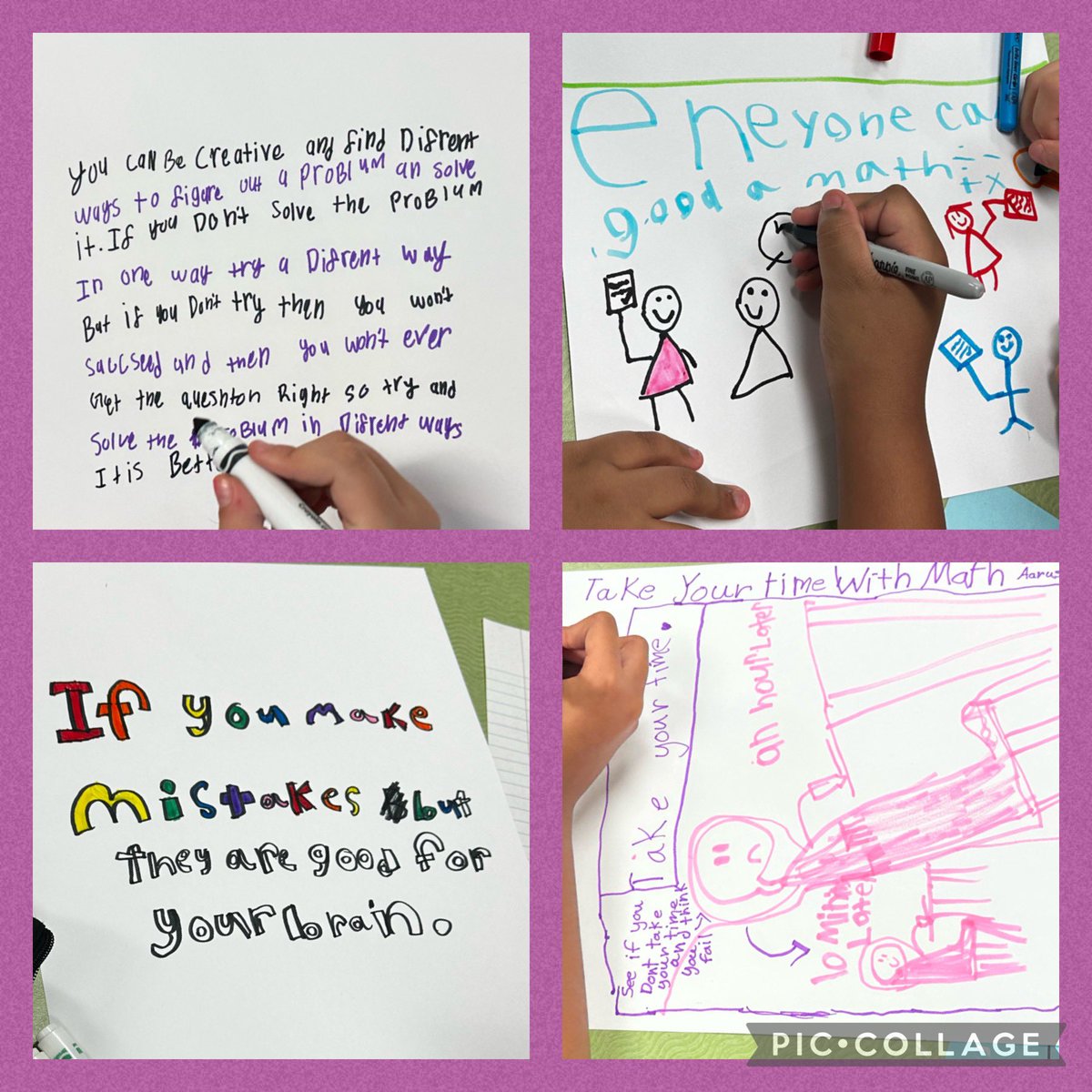
@Camacho_Elem 2nd graders experiencing mathematical challenge for all in the amazing Ms. Morris’s class with Concept Quests! This activity involved collaboration, persisting through struggle, and discussing multiple ways to solve a problem @lisdelemmath
A5: Ss are grouped by ability for small group instruction, & in upper elem grades schools often separate certain Ss for advanced instruction. Even when these groupings aren't made explicit, they have a strong negative impact on Ss' perception of their own abilities. #ElemMathChat
A6: Art is a good context for practicing these because it's a very open ended discipline. But they actually all lend themselves well to math too when we acknowledge that problem solving is much more open ended than it is often assumed to be. #elemmathchat
A2: My favorite thing I've done to combine math and art was teaching 4th/5th graders about symmetry. We created art with paint and then folded the paper to create a reflection with the wet paint. The fold becomes the line of symmetry #elemmathchat
A7: The document camera is great because everyone can see students' manipulatives and notebooks up close. I also love using the Nearpod app to share strategies students drew on tablets. #ElemMathChat
@DingleTeach I think they absolutely have an important place, but we generally need to be more flexible in how we group students and make sure that we are not putting students in "low" groups in which they are only exposed to rote test-prep type work. #elemmathchat
A4: Stop grouping students by perceived ability and instead use rich, open-ended tasks that are accessible to a wide variety of learners and offer multiple entry points and ways of solving #elemmathchat
A3: I feel that the push for implementing Professional Learning Communities (PLCs) in my district really helped to put a spotlight on issues of equity with regards to student achievement. #elemmathchat
A1: Students who are "difficult" to teach (for a variety of reasons) are presumed to have a learning deficit and placed in remedial instructional groups or tracks that provide them with low expectations and rote learning experiences lacking in rigor. #elemmathchat
My name is Elizabeth (she/her) and I am a current M.Ed. grad student at Texas State, former 4th/5th grade math teacher, and (hopefully) a future elementary math specialist. #elemmathchat
A3: Students' (not the teacher's) problem solving strategies are the center of discussion and the focal point of classroom displays. And, students pose their own problems when possible rather than always solving the teacher's problems. #octmchat
A2: I can only imagine the tremendous courage it would take for her to speak up knowing how much more she'd be scrutinized if she made a mistake. #octmchat
A8 I've typically seen problems like this solved concretely with base 10 pieces, but I prefer this way b/c the pieces are already grouped in a logical way. Doing a problem like this with a divisor of 9 with base 10 pieces involves manipulating too many tiny pieces. #elemmathchat
A10: As an 4th/5th grade teacher, I've always seen Cuisenaire rods primarily as a tool for teaching about fractions. This discussion opened my eyes to a lot of ways they can represent whole numbers in lower grades. #elemmathchat
A6: Love how this visually shows the Commutative and Distributive properties of multiplication. Students can physically manipulate the rods to explore different groupings #elemmathchat
A4: This visual representation helps reinforce that the difference between 16 and 8 is half of 16. It also helps students recognize that 16 can be decomposed as 10+6. #elemmathchat
A0: Hi, I'm Elizabeth! I am a former elementary math teacher, working on my M.Ed, and aspiring elementary math specialist. My favorite fall activity is finally getting to play outside with my kids as the Texas heat subsides! #Elemmathchat