Why "communication" and "persuasion" are insufficient approaches to change across an organisation or system.
Communication campaigns can build awareness, but they rarely change behaviour at scale. Persuasion works well when our audience is already open to change. But when we lead any significant change effort, we work across the full spectrum: people who proactively advocate for change, those who passively accept it, and those who actively resist it. For a large portion of that population, even the most sophisticated argument will not shift their position.
We change through our relationships.
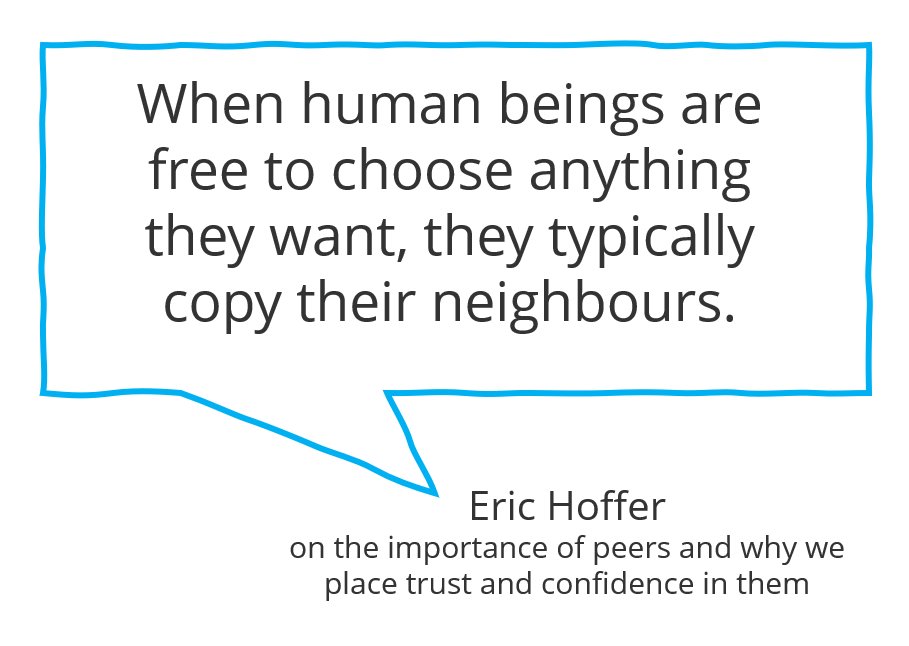
I've learnt greatly from @Digitaltonto (link at the bottom of this piece). Decades of social science research shows we're profoundly shaped by the people around us: our colleagues, peers and professional community. This influence extends not just to our immediate connections but three degrees out: to their networks and the networks beyond. When researchers have studied people who made major shifts in their thinking (e.g., leaving long-held beliefs, changing deeply ingrained ways of working), they consistently find that change followed a shift in their social environment, not exposure to a better argument. People did not think their way into new behaviour. They were drawn into it by those around them.
This has profound implications for how we lead change. The real levers are not in our communications strategy. They're in our social architecture.
Five things we can do as leaders of change to build our social architecture:
1) Find the people who are already moving: People who already believe in what we are trying to do and are quietly making it happen. Find them and connect them to each other. We are not creating energy for change — we are locating it.
2) Create the conditions for peer-to-peer spread: People adopt new ways of working when they see colleagues they respect doing things differently. Prioritise proximity over broadcast. Small group conversations, site visits, and shared learning across teams carry more influence than organisation-wide communications.
3) Make progress visible at the local level: Transformation does not announce itself top-down and cascade neatly through an organisation. It spreads when people can see it working nearby, in their context, for people like them. Celebrate local progress loudly and often.
4) Connect people to the difference their work makes. Creating regular opportunities for people to hear from, or spend time with, those they ultimately serve is one of the most underused and most powerful tools we have as leaders of change.
5) Put our energy where it will travel furthest. Build on the readiness that exists, make it visible, and let success do the persuading that arguments could not.
None of this makes effective change communication redundant. People need clarity, honesty and a coherent narrative about where we are heading. But that is the scaffolding, not the structure. Change travels through people, through trust, through the invisible threads that connect one person's conviction to anothers.
See: https://t.co/k6JJkHhO7X.
I do not like the term “empowerment”.
“Empowerment” is everywhere in the world of change leadership. It’s in the top three of the most commonly used leadership terms globally according to @DigitalDefynd. Personally, I never use “empowerment” unless I’m working with someone who is doing so already.
When organisations or leaders seek to "empower" people, it's often them choosing what's best or how much control others can have. This puts the person or group doing the empowering above everyone else & doesn't really give true freedom to those on the receiving end. Empowerment suggests that power is something that “we” give to “them,” reinforcing the status of the “giver” & (often unintentionally) making others feel weak or dependent, which is the opposite of what empowerment is supposed to do.
“Agency” is a better principle than “empowerment”. It means recognising people's innate ability to contribute & lead rather than relying on managers to bestow permission. People with agency decide what to do, take action & shape what happens. It’s their own drive & ability, not because someone else says they can. Agency makes people active collaborators in change & leads to better, more sustainable change outcomes.
As leaders, we can give people empowerment, by granting permission or sharing authority. We cannot give people agency: people have to build it for themselves through practice, experience & reflection. But leaders can create a climate for agency to thrive through encouragement, resources & space.
Being “agentic” means acting with or displaying agency. This term has become popular recently because of the development of “agentic AI” – AI systems that can act autonomously & make decisions, rather than just react to commands, prompts or rules. We don’t just need agentic AI; we need agentic people too.
“Agentic” is beyond “empowered”; it means shifting from a top-down model of control to one that trusts & supports people to make their own choices, solve problems & shape their own work. This shift requires us to let go of rigid structures, foster open dialogue & design systems that enable autonomy & collective discovery. When teams operate with agency, they become active collaborators, driving innovation & resilience in the face of uncertainty. The future belongs to leaders who encourage agency - rather than empowerment - where people don’t wait for permission, but act with purpose & ownership.
“Designing for agency: how leaders move past empowerment”: https://t.co/S5ehHIHqqA. By Daniel Gagnon & Pete Behrens.
Graphic adapted from “Agency is the highest level of personal competence”: https://t.co/EwXlsbdvC4. By @ThomasSBateman.
Thank you Jaume! And for those interested in this topic of #time x #facilitation, the first 2 posts are up also:
- https://t.co/gWZW6pkJdt
- https://t.co/Uy8GONv5dy
A very complex topic!
The way that we, as leaders, convey emotions really matters. New research busts the myth that leaders who express harsh feedback at the start of a project help to drive performance by showing the required standard. The research showed the opposite: the extent to which leaders expressed positivity (at the start of a project or year) was the biggest predictor of team success. It was as simple as stating how much they cared about team members, enjoyed working with them & valued their specific contributions. The research doesn't suggest that leaders have to always be positive, but that challenging feedback works better at the midpoint of a project or a year. Timing is important. Leaders who express constant negativity hurt team members’ performance:
https://t.co/kIuycINP6K. Via @jacobsglevitt@HarvardBiz.
We don't need to engage everyone in our network/community of practice/improvement campaign. Trying to activate the passive parts of our community or stakeholder group can be exhausting & demoralising . Unequal participation is natural.
In most communities/groups we can see three clear groups:
(1) The most active members at the core: they are the "stewards" who take initiative & make things happen.
(2) The committed members: they want to be part of this group, they contribute & participate to their abilities
(3) The outer circle of people who are mostly passive: some of them were once active in the past; some of them you have never seen.
Group (3) make up the majority of your community.
It is a mistake to try to turn the disengaged people in group (3) into group (2) activists. You can't push anyone into anything. Much better to focus on supporting groups (1) & (2). Keep group (3) informed & make light-touch invitations. People’s energy often changes over time so don't close doors:
https://t.co/T3qhchC8Du. By @pforti. Graphic/additional material from Adrian Röbke & Michel Bachmann.
New on the #AgileFacil blog: What 'dumb' means in groups, what it should mean, and how to smarten up about our dumbness, using the benevolent shade of the #facilitator
https://t.co/bSxW9OVkQQ