Lots of discussions around Aave so I want to clarify a few things:
• First off, there is NO WAY we’d sell AAVE at a 70% discount lol.
• 100% of Aave Protocol and GHO revenue goes to the $AAVE token. This was established in the Aave Will Win proposal.
• AWW also applies to all product revenue, including the Aave App, Aave Pro, and Swaps.
• No protocol or product revenue goes to Aave Labs, which is a service provider to the DAO responsible for building and growing Aave.
• Aave Labs owns an allocation of AAVE that multiple market participants have discussed purchasing, directly or indirectly, through deeper long-term partnerships. The article’s framing is inaccurate.
• Aave is currently generating $134M in annualized revenue, which goes to the Aave DAO.
• As defined in AWW, all intellectual property, including the Aave brand and any software built for Aave, belongs to $AAVE.
• We haven’t shared much on this yet, but the Aave team is designing Aavenomics 3.0, which includes a new automated and non-discretionary buyback mechanism. More on this later.
• Aave is building not only for the crypto TAM, but for the entire finance asset TAM, including RWAs.
• Everyone at Aave Labs and Aave DAO works for $AAVE.
We’ll be hosting our quarterly call in the next couple of weeks. Join us if you want to catch up on what we’ve been working on and get some cool updates on the Aave roadmap.
Bro I'm so sick of pretending this isn't weird.
The internet spent 20 years creating tutorials, open-source projects, blog posts & answers for free.
AI companies turned all of it into products worth billions.
And now the same people who created that knowledge are being told they're replaceable.
We built the library.
Someone else started charging admission.
This is the most important account on X. Well worth a follow.
Everyone should be part of a book club. This is a wonderful group of people to study with.
Agentic marketing is a context problem, not a creativity problem
Personalized marketing has always been a slog. You either blast one message at everyone, or hand-build segments that go stale the week you ship them. The promise was marketing that knows the customer. The reality was a spreadsheet of guesses.
LLMs look like the way out. But point an agent at a pile of customer data and let it run, and you get a false sense of precision: confident, well-written campaigns aimed at people it doesn't understand. The output looks finished. Whether it's right is a separate question, and in marketing you can't prove it before the spend is gone.
After three years building Minerva, we've landed on something blunt: the hard part of agentic marketing was never generating the campaign. It was knowing who it's for.
Marketing is not content generation
Marketing looks like a generation problem, the part LLMs are obviously good at: write the email, cut the variant, draft the report. But the same creativity that makes a model great at copy is what lets it market, fluently, to a customer it has wrong.
The deeper issue is how little most brands know about their customers. First-party data tells you what someone did in your funnel: opened, clicked, bought, lapsed. That's a behavior log. It says nothing about their age, household, taste, or what they care about off your site. Lifecycle stage is what someone did with you, not who they are.
The actual problem is resolving a vague goal, like "reach high-intent buyers," to specific, real people. Do it well and execution is trivial. Do it badly and no creative polish saves the campaign.
Three failure modes cause most of the misses:
Concept-to-customer ambiguity. "High-intent buyer" can mean ten things. Which behaviors count? Over what window? Do past refunders make the cut? The agent picks one reading and runs.
Context staleness. People move, change jobs, change what they want. A profile that was right last quarter quietly targets the wrong person today.
Retrieval failure. The one signal that would have nailed the customer sits in the data, and the agent never finds it.
Each layer of Minerva attacks one of those failures.
The consumer context graph is the foundation: a proprietary, governed model of 270M Americans with demographic, psychographic, and interest attributes. Who a person is, not just what they did in one funnel. Before an agent runs anything, it has narrowed "who is this customer" from thousands of readings to one grounded answer.
The Agentic Data Engineer is the bridge. It merges that context with a brand's first-party lifecycle data in minutes, so behavior and identity finally live in one source of truth. Most tools skip this layer because they only ever had the behavior half. It's also what decides whether everything downstream is right.
The agents are the last mile: they build, launch, optimize, and report across channels, on a foundation that knows who they're talking to instead of guessing at a blank one.
The lesson that reorganized how we build: an agent that doesn't understand the customer markets what you asked for, not what you meant. A smarter model doesn't fix that, and neither does more data access. We've watched agents with everything in front of them still market to the wrong person. The bottleneck was never access. It was structure.
Models will keep getting better and reasoning cheaper. That sounds like it makes the foundation matter less. It's the opposite. A smarter agent on weak context is just a faster way to be confidently wrong. Intelligence is converging for everyone on the same day. Context is the part you have to earn.
That's where the three years went: the unglamorous half, the foundation instead of the demo. But it's the half that decides whether agentic marketing knows your customer or just sounds like it does.
So excited to see this blog post out!! It was an absolute privilege working with @NeuroLuebbert on this. She is genuinely such an extraordinary scientist, mentor, and writer.
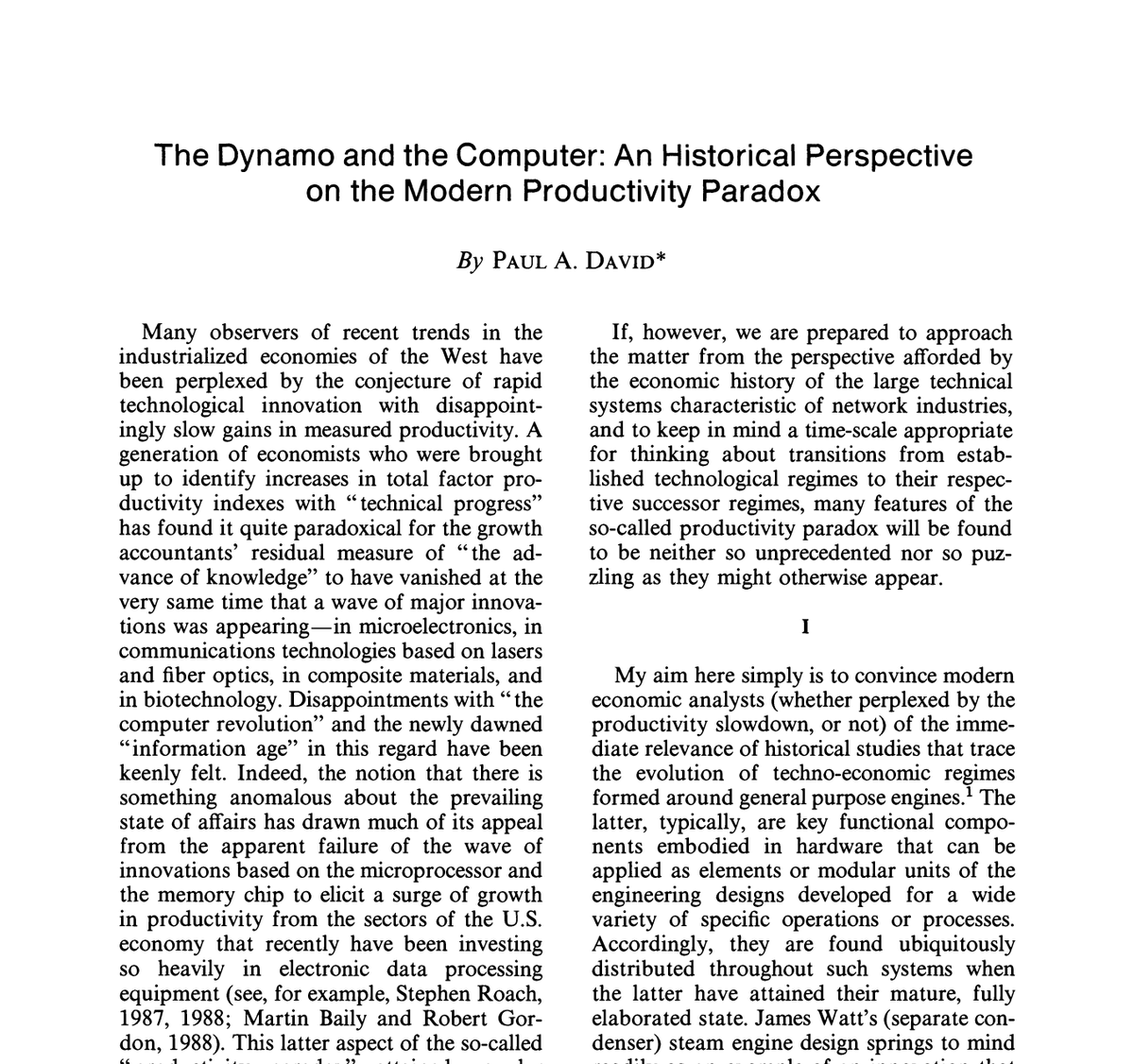
If you've adopted AI at your company but haven't seen any tangible results, read this 1990 article: "The Dynamo and the Computer" by Paul David.
When electricity first arrived, factories that "adopted" it barely got faster. They just swapped the steam engine for an electric one and ran everything else exactly as before: same machine layout, same workflow, same management. Electricity in, no real gains out.
The most common mistake with any new technology is to drop it into the old organization and then declare the transformation done.
The real leap came decades later, when each machine got its own small motor. Suddenly machines no longer had to be lined up around one central drive shaft. They could be rearranged around the actual flow of work.
The productivity gains didn't come from electricity. They came from REDESIGNING THE ENTIRE FACTORY around it.
AI is the same. Bolting it onto your existing process gets you a faster steam engine. The payoff comes when you redesign the work itself.
(link to paper in comments)
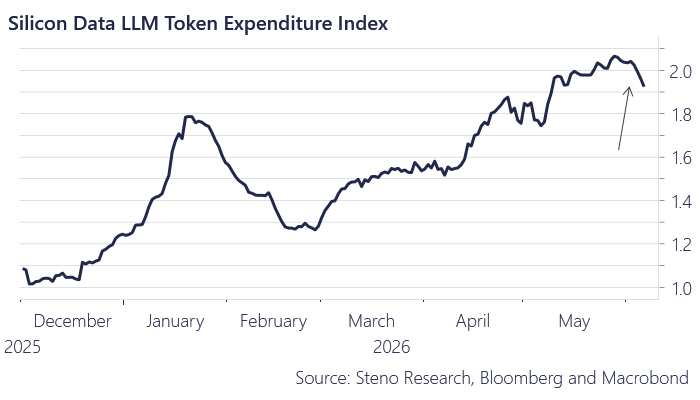
This is the chart that everyone should be watching.
If the Token Pricing rolls over, everything from the memory trade to the broader hard-ware and data-centre trade is over for this cycle imho.
The whole setup depends on this..
🚨 ANOTHER MASTERCLASS FROM @3BLUE1BROWN
The compressibility of language isn’t just a math curiosity, it’s the hidden engine behind every LLM you use.
Grant’s new video reframes Shannon’s entropy through one elegant lens:
Prediction IS compression.
→ The better you predict the next word, the fewer bits you need to store it
→ Shannon measured English at ~1 bit per character: astonishingly compressible
→ This is exactly what GPT-style models optimize
→ Intelligence, in this framing, is compression
FUN FACT: Von Neumann told Shannon to name it “entropy” because nobody truly understands it anyway 😄
Decades later, that same concept became the bedrock of modern AI.
Deep-dive resources in the 🧵 ↓
Was playing around with the AI agents on @tread_fi today.
Tested three things:
1. Had an open $hype position on @HyperliquidX — asked the agent to close it at breakeven. It did exactly that.
2. Asked the agent to find the most profitable MM settings on @OndoPerps . It pulled data from the win rate tool and executed the MM order automatically.
3. Asked it to open a BTC long with a 2% trailing SL — there's no native trailing SL on HL right now. The agent figured it out and made it work anyway.
This is genuinely cool.
A lot of what it did can be done natively in the @tread_fi terminal — but being able to just talk to it and have it execute is a different experience entirely.
It's clearly early days and will get a lot more capable over time. But the direction is right.
Agents in trading are going to be massive.
Check the image below on the sneak peak of the above task
LATEST: 📈 Bitwise CIO Matt Hougan says Hyperliquid today is like ChatGPT when only the AI community was excited about it, and that ChatGPT 100x'd from there.
Robotics likely won’t have a “chatGPT moment” until we’re well into the industrial ramp for the next gen of automation, meaning you’re getting a nice opportunity to be long improving fundamentals right now and the catalyst of widespread attention is still waiting in the wings.
and the hyperliquid community is honestly something quite special
everybody that ive recently started following and interacting with are builders or traders or builders/traders
like mindset ppl and another way that everybody in this community aligns with each other
it has been very refreshing and enjoyable moving to this new blockchain neighborhood from the toxic cesspool that i came from ( $SOL )
hyperliquid
Kinetiq just became a top 3 LST by TVL and flipped Lido in FDV.
(Congrats @0xOmnia 👏)
This is the first step toward massive attention for everything being built around Hyperliquid, and that attention will only grow after every new $HYPE ATH.
Every extra $1B added to $HYPE’s market cap makes CT even more HL-maximalist, and thinking that maximalism won’t spill over into the ecosystem is a mistake in my opinion.
-> The main lending/borrowing dApp, @HyperlendX, has $560M in TVL for a $16.5M FDV: a 34x ratio, while 27% of the tokens are staked.
Aave has $13.9B in TVL for a $1.32B FDV: a 10x ratio, with only 13.9% of tokens staked.
Sounds like a mispricing to me. Imagine thinking Solana’s massive run last cycle wouldn’t spill over into its ecosystem.
What other major Ethereum project that contributed to its success can we look at? Uniswap.
I’m still building @HyperSwapX, and I still want it to become one of the biggest keystones of the Hyperliquid ecosystem.
People often say that having a DEX inside the ecosystem of a DEX may not make much sense, and I couldn’t disagree more.
-> Hyperliquid does not offer the same kind of strong yield source during ranging markets as a well-calibrated AMM pool.
-> Spot listing costs are extremely high for any project that wants to launch a token in the ecosystem without a large dedicated budget.
-> Some spot pairs will not have as much depth on the order book as they can have in our liquidity pools.
Oh, and we’re not just a classic AMM DEX.
-> You can tap trade on Hyperswap.
-> You can trade on Hyperliquid through Hyperswap.
-> You can predict on Hyperliquid through Hyperswap.
-> You can pair trade on Hyperswap.
And there is so much more to come.
We’ve also burned the entire core contributors’ allocation + 75% of Hyperswap revenues, resulting in more than 21% of the total supply being burned forever.
That’s Hyperliquid-aligned.
Why am I even comparing Hyperswap to Uniswap?
It’s far better.
Hyperliquid. Higherliquid. Hyperecosystem.
Reminder, this is the Hyperliquid Ecosystem ⤵️
Being early is a gift and a curse - I sold part of the stack because my mother had cancer and needed treatment. Today, that was my $1 million. But I'm still grateful to God. $Hype 12:21
"Do not be overcome by evil, but overcome evil with good"
#Hyperliquid = game changer UX dex?
The point program has ended, but the growth of OI and volume continues to demonstrate good results in its vertical.
Expectations for TGE with new updates are 2-3 months.
https://t.co/8BAEKq2yhr