@jaimenie @j_r_barrett @SRILeeds open access paper on the EV transition. led by @jaimenie , it shows the main stimulus to economic growth (and energy use, via rebound) is from step change in EV (70%) vs ICE (35%) efficiency, much more than the impact of capital investment or energy prices https://t.co/UWfgBFb9Ue
New publication in Applied Energy on the macroeconomic implications of the Electric Vehicle transition, along with co-authors @exergy_paul, Marco Sakai & @j_r_barrett .
We use the MARCO-UK energy-economy model to explore thermodynamic efficiency and energy rebound. #EVTransition
new open access paper: 📢 @Em_Aramendia from @SRILeeds breaking new ground, extending EROI of global fossil fuel vs renewables to the useful stage. The switch to EVs / heat pumps etc steps efficiency up, meaning renewables EROI is often higher than FF, now. Read his thread: 👀
Last paper of my PhD now out in @NatureEnergyJnl!! What is the #EROI of fossil fuels at the useful energy stage? How does it compare to renewable energy? We find that fossil fuel #EROIs are pretty low, and that renewables compare pretty well! Open access👇
https://t.co/end299Sjzl
new 'degrowth in IAMs' co-author paper out now. led by @JKikstra - link to his tread here: https://t.co/3DmGaJRX5V and the open access paper link here: https://t.co/hDQP6Ttz70
📚📚NEW PUBLICATION!📚📚
Can degrowth save the world?
Co-author @jasonhickel made the case in a book.
How do these ideas stack up in a systems model?
How are such scenarios different from scenarios used in the IPCC?
Let’s find out! 🧵
Open-access: https://t.co/659L5WpDj5
New Economics for Rebels podcast just out: me talking about energy's role in economic growth, and what if we can't shake off those pesky rebound effects https://t.co/rqKuKb033S
PhD opportunity: 👀Collecting and Quantifying the Co-Benefits of Energy Demand Reduction in a Low Energy World
–Deadline for applications is 6th March
–3.5 year PhD. Main supervisor Dr Paul Brockway
–https://t.co/j5lw4ATCrb
–https://t.co/7zjfi7bZtZ
Insights: but changes to future final-to-useful electricity efficiency [a key part of GDP growth [e.g. https://t.co/ASSpB0RYYI] will depend on the shares of high efficiency (e.g. electrified transport) and low efficiency (e.g. cooling and low temperature heating) end uses. ../5
New OPEN ACCESS paper: The rise and stall of world electricity efficiency:1900–2017, results and insights for the renewables transition https://t.co/ETS82hZgTK ...1/3
New open access paper: Co-benefits are much broader than health: In fact we found 86 unique co-benefits across five categories: Health, Energy Security, Economy, Social, and Environment. https://t.co/NatZjspYVu And we propose a 4-step plan to integrate into energy/climate policy
What are the actual energy savings when you upgrade a device to a more efficient one, & why?
In a @IA4EE working paper, Matt Heun, @exergy_paul & I push the boundaries of energy rebound modeling & precisely translate between economic and energy categories. https://t.co/8zBoz1DPKc
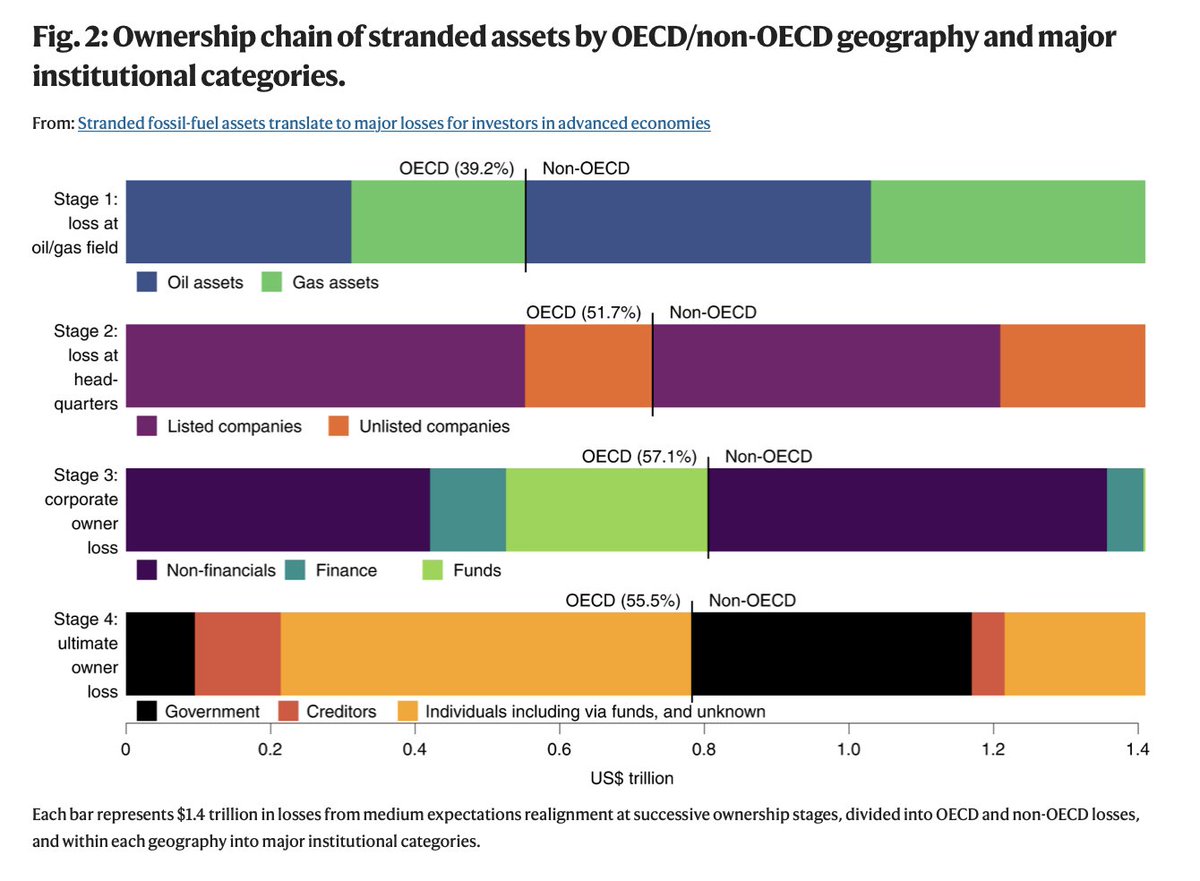
Tackling climate change requires closing many oil and gas fields. Who owns these stranded assets? In @NatureClimate we trace $1.4 trillion in losses at the field to their ultimate owners and show that mainly private persons in rich countries stand to lose. https://t.co/bodGeU0fnU
@sterndavidi Important paper by @AnneBaseler, @sterndavidi + co-authors. Evidence for large rebound is growing, and is a plausible reason why reducing energy via efficiency (to meet climate targets) remains SO hard to do. As a start: large rebound effects need better inclusion in modelling
Key findings: 1: 1800-1950, land productivity(kcal food supply/hectare of cropland) was static. 2: 1950-2012, land productivity 3x higher due to FF-based machine work. But,diminishing returns and plateauing efficiencies mean higher energy usage for future higher land productivity
New paper out: "The Contributions of Muscle and Machine Work to Land and Labor Productivity in World Agriculture Since 1800" Biophysical Economics and Sustainability, vol. 7 (2). Free online at https://t.co/1WXr9WRSoY
@nephologue And not sure we'd have had a enough nonFF resources to sustain 1% natural pop and co2 growth from biomass. Black death occurred just b4 Europe reached biomass limit and we got back to that point again just as we found coal in industrial quantities