@CalltoActivism It’s not a joke.
Dictator Trump is going to kill people who don’t obey him.
Civil war already began.
Trump regards himself as a divine authorized king, not a democratic president.
🚨WHAT THE F*CK:
The President of the United States just said the quiet part out loud, Donald Trump suggests he has DECLARED WAR on American cities: “It's sort of like war. I hate to tell you."
Trump is the worst thing to ever happen to America.
Pope takes Milei to task as he visits divided Argentina.
Pope Leo XIV delivered a stinging critique of President Javier Milei's harsh austerity measures, insisting growth must benefit all in a speech met with rapturous applause
https://t.co/emV11FvuGV
On December 12, 1952, a nuclear reactor in Canada went out of control. Someone had to go inside and take it apart. One of the young men who did it would later become President of the United States.
The reactor was called NRX, at the Chalk River Laboratories in Ontario. It was one of the most important research reactors in the world at the time.
That day, a series of mistakes caused its power to surge. Part of the core overheated and melted, and about a million gallons of radioactive water flooded the basement. It was one of the first serious nuclear accidents in history.
The reactor had to be dismantled before it could be repaired. But the radiation inside was so strong that no one could stay near it for long.
At the time, the United States Navy was working on the first nuclear-powered submarines, and its engineers had a strong interest in learning from the accident. A young Navy lieutenant who was working on the program was sent to Chalk River with a team of American sailors to help.
He was 28 years old. His name was Jimmy Carter.
The plan was carefully worked out. Each man could only be exposed to the radiation for about 90 seconds. So the team built a full-size copy of the damaged part of the reactor on a nearby tennis court.
Over and over, they practiced every movement until they could do their part perfectly and fast.
Then, one at a time, they went in.
Carter later described being lowered into the damaged reactor in a protective suit, working as fast as he could on his task, and then being pulled out. In those 90 seconds, he said, he absorbed the maximum amount of radiation considered safe for a whole year. For months afterward, his urine was tested for radioactivity.
Years later, he would joke that he and his men were "hot" for a while afterward. But at the time, nobody knew exactly what the long-term effects of that much radiation would be. The young sailors volunteered anyway. They knew the reactor had to be fixed, and they knew someone had to do it.
The work took weeks. Team after team went in, each man doing one small job in his 90 seconds before the next man took his place. Slowly, piece by piece, the damaged parts were removed. The reactor at Chalk River was eventually rebuilt and ran for decades afterward.
He later said the experience changed the way he thought about nuclear power and nuclear weapons for the rest of his life. He had seen with his own eyes what happens when something that powerful goes wrong.
Carter rarely made a big deal of it. In his memoir, he described it in a few plain sentences, the way a man describes a job that simply had to get done. Many Americans who voted for him never knew it had happened.
The following year, his father died, and Carter left the Navy to go home to Plains, Georgia, and run the family peanut farm. He went into local politics, then became governor of Georgia, and in 1977 he became the 39th President of the United States.
After the White House, he spent decades building homes with Habitat for Humanity, monitoring elections, and fighting diseases in some of the poorest countries on earth. In 2002 he was awarded the Nobel Peace Prize.
Jimmy Carter died on December 29, 2024. He was 100 years old, the longest-lived president in American history.
Few people knew that before any of it, as a young officer, he had once been lowered into a broken nuclear reactor with 90 seconds to get the job done.
Did you know this part of Jimmy Carter's life?
From 1979 to 2012, Marion Stokes recorded 24/7 TV news on 70,000+ VHS tapes.
She ran 8 VCRs simultaneously in her home, sleeping in 3-hour shifts so she’d never miss a tape change.
Why?
She knew TV networks were constantly erasing history. 🧵👇/1
BREAKING: In a stunning moment, Rep. Jamie Raskin just went on live TV and made clear that it is REPUBLICANS who have turned the government into an apparatus of retribution. Every time Republicans scream about RETRIBUTION, it's an admission. Make sure every American sees this.
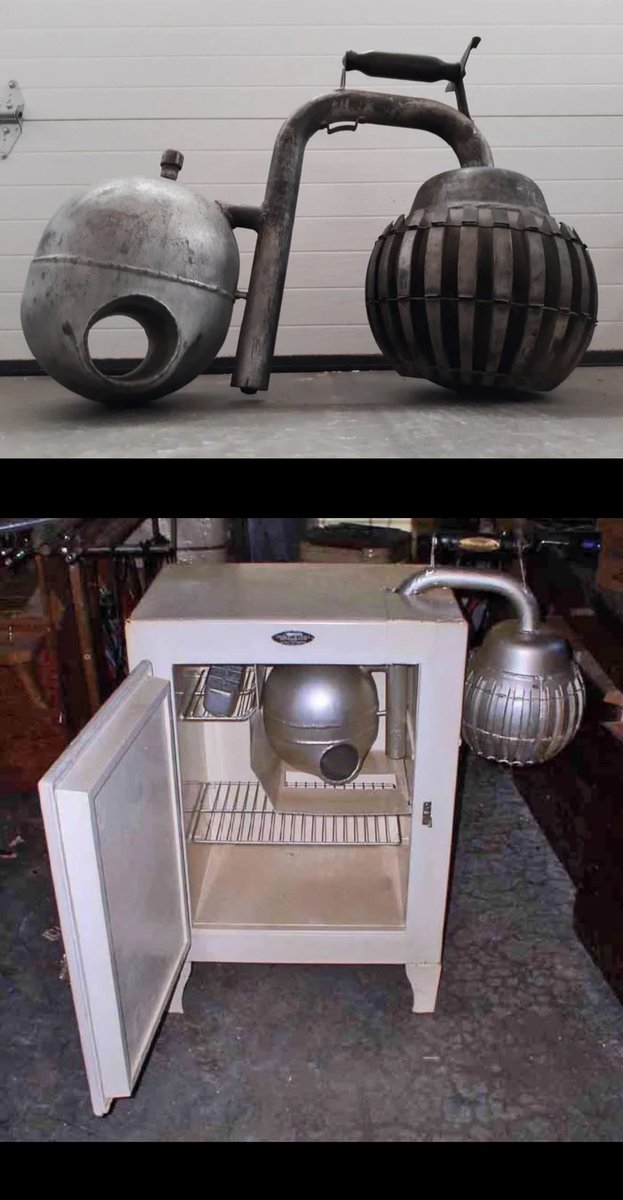
1929 Crosley IcyBall absorption refrigerator, a unique, non-electric appliance with no moving parts. It uses a sealed, batch-operated system containing an ammonia and water mixture....
The hot ball (on the right with the fins/ribs) is placed over a stove or heat source for about 90 minutes. This drives the ammonia gas out of the water solution and condenses it as a liquid into the cold ball (on the left with the hollow/cradle). After charging, the cold ball is placed inside the insulated refrigerator box. As the liquid ammonia slowly evaporates back toward the water-containing hot ball, it absorbs heat from the interior of the fridge, providing 24 or more hours of cooling per charge.
. . . .
In the late 1920s, millions of American farm families still had no electricity. For them, keeping food cold meant buying ice blocks or living without.
The IcyBall offered another way. It was invented by David Forbes Keith of Toronto and sold by the Crosley Radio Corporation starting in 1929.
It worked using ammonia and water sealed inside two metal balls connected by a pipe. Each morning, you heated the “hot ball” over a kerosene stove for about an hour and a half. The heat drove the ammonia over into the other ball. A whistle sounded when it was fully charged.
Then you placed the cold ball inside an insulated cabinet. As the ammonia slowly evaporated and flowed back, it pulled heat out of the box, keeping food cold for roughly a day.
It used no electricity, no motor and only about a cup of kerosene.
As power lines reached rural America in the 1930s, electric refrigerators took over, and the IcyBall faded away.
The idea never fully died. In 2016, a British design student won the James Dyson Award for a small vaccine cooler based on the IcyBall, designed for places without reliable electricity.
#archaeohistories
This is a 3200 year old attendance sheet from Ancient Egypt, and some of the reasons it gives for missing work are absolutely wild:
1. Drinking with Khonsu
2. The scorpion bit him
3. Brewing beer
4. Embalming his brother
5. His feast
6. Building his house
7. His wife is bleeding
8. With Khons making remedies
9. Strengthening the door
10. Making remedies for the scribe’s wife
The craftsmen who built and decorated the royal tombs in the Valley of the Kings lived in a village of their own, Deir el-Medina, and in the fortieth year of Ramesses II’s reign, around 1250 BC, someone drew up a register of their absences on a large flake of limestone. There are forty names, the dates each man was missing are written beside them in black ink, and above most of those dates, in red, is the reason.
The man who went drinking with Khonsu, probably a coworker, could hardly have imagined that his day off would go down in history, let alone that we’d still be reading about it more than 3000 years later. Somewhere along the way, brewing beer stopped getting anyone out of work, and nobody consulted the rest of us, although I doubt any boss would ask a follow up question if you called in and said, "Sorry, I’m embalming my brother."
All joking aside, what strikes me most is how little of this needs translating. Many of the entries I left off the list are about sickness and family, a mother who was ill, a man caring for a relative, and they could have been written yesterday.
Three thousand years have changed almost everything about the way we live, and almost nothing about what it means to be human...