In 4.5 years of war, Ukraine has not created any meaningful protection for its civilians. Today, Ukrainian Telegram channels are sounding the alarm about a massive planned Russian strike on Kyiv and the country as a whole. For the first time, Kyiv could be hit by the “Oreshnik” missile, which we currently cannot intercept, the channels report.
Russia plans to use:
Up to 700 drones of various types, including strike drones such as Geran-2 and Harpia-A1;
Imitation-reconnaissance drones like Gerbera and other lesser-known models;
Jet-powered drones such as Geran-3 and Geran-5.
Zelenskyy has once again urged people to take shelter in the coming days. As usual, the blame is immediately shifted to the United States for not supplying enough Patriot missiles. But what about us? Why, after 4.5 years of war, has nothing been done to make civilians feel safe? Why haven’t we produced our own air defense missiles, shields or protective systems? And why do Patriot systems primarily protect Kyiv and the presidential administration, while some regions receive just one air defense missile per month?
It is becoming painfully obvious that this war has turned into a bloody slaughter inside a closed cage, where the leadership does nothing but play the role of a television host delivering bad news.
As Ukraine's military faces a manpower shortage, even people with serious mental health conditions are being drafted. With tragic consequences.
Bohdan Koshel, 27, who had a disability linked to mental illness, was declared fit for service and mobilized despite his mother's warnings not to give him a weapon.
Weeks later, he shot and killed two instructors and wounded a third one at a military training ground.
On June 9, a court in Chernihiv sentenced him to life imprisonment.
While Ukraine’s defenders risk everything on the front lines, their families back home are quietly breaking under unbearable financial strain: soldiers’ base pay has remained frozen at around €500 per month since 2022, even as inflation has devoured 70% of its real value and civilian wages in big cities now average €700–1,000.
Wives sleep just 3–4 hours a day juggling two or three jobs, remote work with toddlers on their laps, sewing at night, or washing dishes, all while paying skyrocketing rents, heating homes with scarce firewood, and choosing between medicine and food.
Children grow up in debt-ridden homes; wounded veterans with lost limbs drive taxis or cut wood on ruined legs because state support arrives months late or not at all. Families of the missing or fallen with “non-combat” status receive almost nothing.
It is a slow-motion economic tragedy that erodes morale, deepens distrust in institutions, and threatens national security as exhausted defenders question why the state can raise police salaries to €800+ but not index military pay to today’s reality of ~€1,500 per month.
When some Western "patriots" talk we fight for dignity -- they must see how "dignity" in war looks today.
The world that supports Ukraine should think about the poeple of Ukraine more, not just red carpets for Zelenskyy. Ukrainian military families are broken.
As a person who worked closely with Zelenskyy and held TOP-level position in the government I beg you to understand this won't be changed unless the war is over and a democratic and technocratic government is fairly elected.
A blog about this was published by Alina Sarnatska in Ukrainska Pravda: https://t.co/9Qf9BopHFW
While Ukraine’s defenders risk everything on the front lines, their families back home are quietly breaking under unbearable financial strain: soldiers’ base pay has remained frozen at around €500 per month since 2022, even as inflation has devoured 70% of its real value and civilian wages in big cities now average €700–1,000.
Wives sleep just 3–4 hours a day juggling two or three jobs, remote work with toddlers on their laps, sewing at night, or washing dishes, all while paying skyrocketing rents, heating homes with scarce firewood, and choosing between medicine and food.
Children grow up in debt-ridden homes; wounded veterans with lost limbs drive taxis or cut wood on ruined legs because state support arrives months late or not at all. Families of the missing or fallen with “non-combat” status receive almost nothing.
It is a slow-motion economic tragedy that erodes morale, deepens distrust in institutions, and threatens national security as exhausted defenders question why the state can raise police salaries to €800+ but not index military pay to today’s reality of ~€1,500 per month.
When some Western "patriots" talk we fight for dignity -- they must see how "dignity" in war looks today.
The world that supports Ukraine should think about the poeple of Ukraine more, not just red carpets for Zelenskyy. Ukrainian military families are broken.
As a person who worked closely with Zelenskyy and held TOP-level position in the government I beg you to understand this won't be changed unless the war is over and a democratic and technocratic government is fairly elected.
A blog about this was published by Alina Sarnatska in Ukrainska Pravda: https://t.co/9Qf9BopHFW
Rhodium’s conclusion that Chinese carmakers lag global carmakers in productivity/efficiency is based on highly flawed analysis that belies serious lack of depth on variations in operating models of traditional vs. Chinese/EV carmakers that distort the revenue/employee metric and render it meaningless in trying to determine productivity:
▪️ Chinese OEMs like BYD, Li Auto, Leapmotor, Geely and Nio use a mixture of hybrid/DTC/indirect vs. the traditional franchised dealer model that dominates anyone selling in the U.S. market like Toyota and Nissan. This inflates direct employee headcount, but provides zero indicator on productivity, only higher degrees of vertical integration in the business model. For example ~2/3rds of Nio’s employee headcount are involved in sales and service.
Said another way, GM ($2.1M) and Ford ($1.1M) feature significantly higher “revenue per employee” than Toyota, driven by an even higher concentration of sales in U.S. franchise-centric market; does anyone seriously believe that GM designs and manufactures cars at >double the efficiency of Toyota and Tesla?
▪️ BYD’s employee number includes its contract manufacturing division, which has de minimis relation to its auto division and like many contract manufacturing businesses features low revenue per employee compared to the car business. Including it makes no sense unless your goal is to show a lower number to support a conclusion you are merely trying to confirm.
▪️ BYD’s auto division itself is extremely vertically integrated. It designs and mfgs most key internal component from the critical batteries to SiC chips to even in-car refrigerators. This compares with traditional incumbent manufacturers like Toyota and Nissan which outsource most key auto components to third parties (and thus do not include the employee headcount attached to the production of those components in the denominator). Again this reflects level of vertical integration in the business model, not productivity.
▪️ A large component of revenue (and even higher % of profitability) for traditional automakers like Toyota and Nissan derive from captive finance operations in the U.S. This is high leverage for a revenue/employee perspective but says nothing about manufacturing productivity and efficiency.
▪️ Chinese carmakers are growing significantly faster than non-Chinese ones. Collectively, this group grew volume and revenue by 14% and 13%, respectively, in 2025. Toyota grew revenue by 2% while Nissan and Tesla shrunk. This means higher growth-related investment (and direct employee headcount) in capex-related and R&D activities.
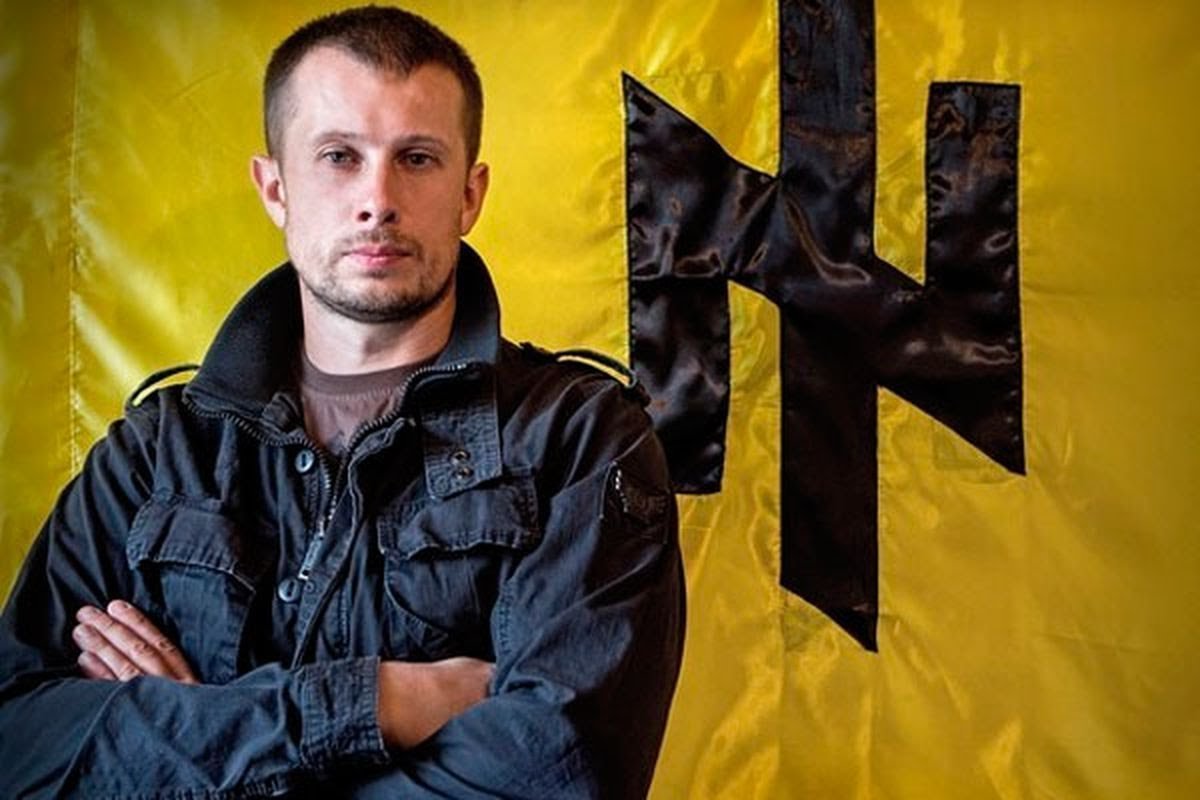
A post for Western analysts who keep chanting that the far-right in Ukraine is “2%” and has no political influence.
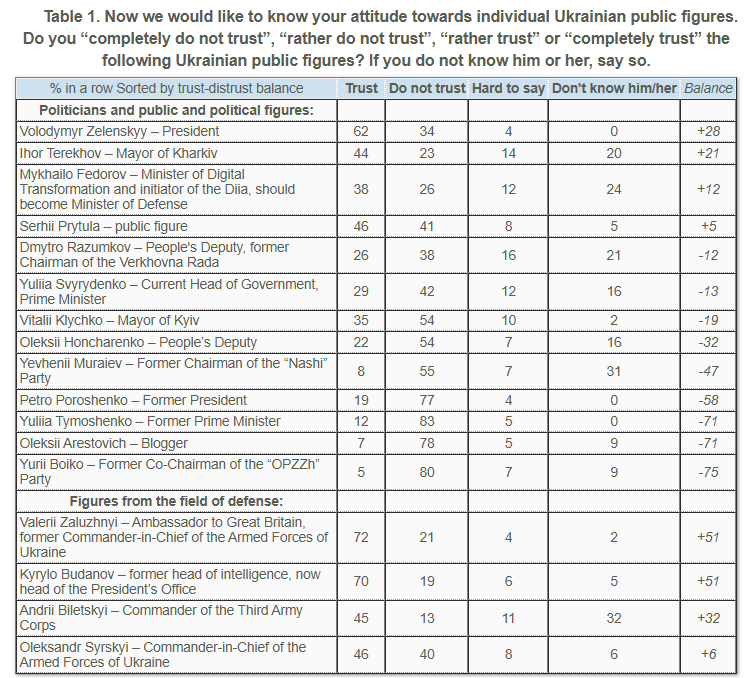
As of Jan. 2026, according to KIIS, the “White Chief” Andriy Biletsky is trusted by 45% of Ukrainians, and only 13% distrust him. Meanwhile, Commander-in-Chief Syrskyi is trusted by 46%, but distrusted by 40%.
Thanks to Zelensky, Biletsky went from a street thug and neo-Nazi leader to a brigadier general and the commander of a corps numbering tens of thousands of highly motivated, well-trained men, armed with the best NATO weapons.
The ideology of his boys is based on the OUN tradition: ethnic nationalism, authoritarianism, homophobia, racism, a cult of the leader, a cult of force.
Biletsky Corps also trains neo-Nazis from around the world and members of Colombian and Mexican narcocartels. Because why not?
Congratulations, Europe, on the flourishing 'democracy' in Ukraine you’re sponsoring 👏
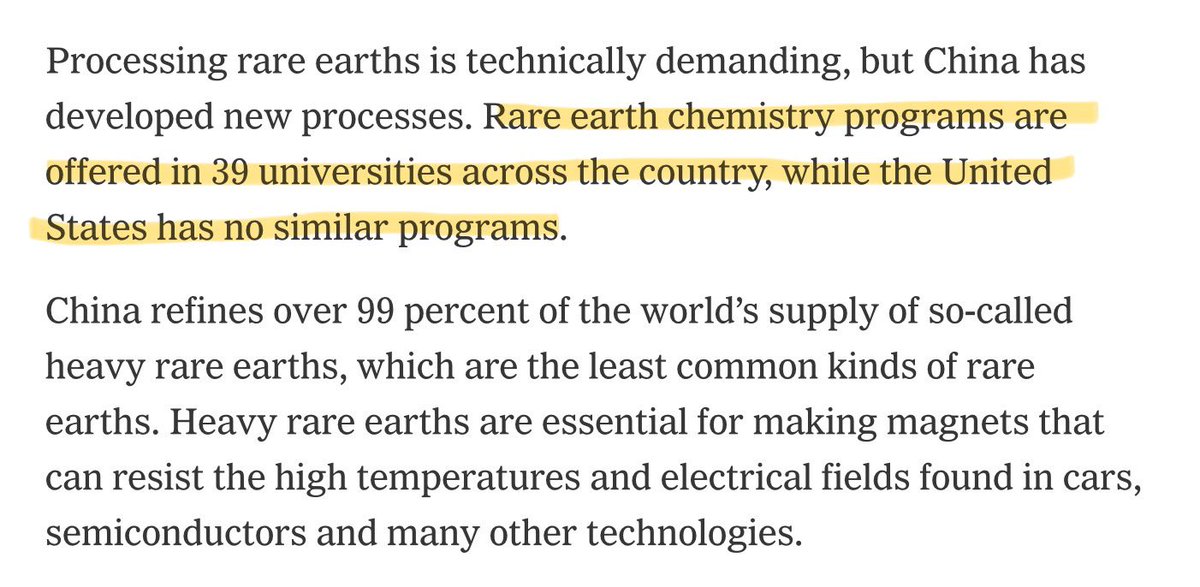
It's fascinating how much folks will go out of their way to avoid attributing China's REE dominance to sustained multi-decade strategic investments in specialized workforce / human capital, process improvements and engineering expertise, preferring instead flawed (but perhaps comforting?) narratives like this one.
1) The GM/Magnequench acquisition focused on one particular type of magnet (NdFeB permanent magnet) and rare earth category (Neodymium). China's rare earths / permanent magnet dominance is broad-based, spanning all categories of REEs (and non-REEs as well) and derivative components like magnets.
2) The NeFeB production process has evolved from the "melt-spun process" used by Magnequench (useful for smaller motors e.g. HDDs) and favored in the 90s to a more advanced "sintered powder metallurgy" process that has enabled larger EV motors and high-end industrial machinery. This sintered powder metallurgy process was developed in Japan at Sumitomo Special Metals, with the key patents for the NeFeB process expiring in ~2014.
Edison stole the lightbulb from British physicist Joseph Swan (and paid a big settlement). Andrew Carnegie took the Bessemer Process from UK's Joseph Bessemer. The US "stole" technology and deployed it in unprecedented scale. To some extent China is doing that to us -- except that China has developed a lot of its own technology (5G, industrial automation, quantum communications, and now maybe fusion power).
Biden says "China is determined to dominate these industries. I'm determined to ensure America leads the world in them."
Let's see where we are today:
- Steel: China 54% global market share, vs US 4.3% (https://t.co/nejIr9UL4b)
- Aluminum: China 55% share, vs US 1.5% (https://t.co/ZkXoon0QKv)
- EVs: China 60% share, vs US 8% (https://t.co/CtdNdMTusd)
- Solar panels: China 78% share, vs US 2% (https://t.co/nM6FQqjm7W)
- Semiconductors: China 7% share, vs US 48%
(https://t.co/zv8vhRTxXn)
In other words, except in semiconductors, the US has about zero chance in hell to "lead the world" in any of those industries given China already completely dominates them.
And it's certainly not with tariffs that they'll catch up. Solar panels is a good case study because the US has had tariffs on them since 2012 (https://t.co/ZM3LT1hiQt). The tariffs did considerably reduce the number of Chinese solar panels coming to the US (86% drop over the 2012-2020 period: https://t.co/KS6cMEBUmY) BUT it did nothing to revitalize the US solar industry. Despite the country pouring billions of dollars in subsidies to do just that since introducing the tariffs, the US ends up with a negligible 2% global market share... And it did nothing to prevent China from dominating the global market since that's the one industry where they have the biggest global market share at an incredible 78%.
Will even higher tariffs somehow change this? It's like doubling down on a "solution" that's proven obviously counterproductive..