AC/DC abre el Monsters of Rock de Donington en 1991 con “Thunderstruck” y el concierto se convierte en una de las imágenes más claras de su legado.
Angus Young entra con el riff de siempre, caminando en el sitio mientras toca. Chris Slade golpea la batería con esa energía que define a la banda.
El público responde al instante…. Brian Johnson sale corriendo y grita “Thunder”.
Es el estilo que AC/DC lleva décadas sosteniendo: riffs simples, ritmo que no se detiene y una presencia en el escenario que no necesita adornos. En Donington, ante una multitud enorme, suena igual de directo que en un disco.
El legado de la banda está en esa consistencia. Décadas de la misma fórmula, la misma intensidad y la misma capacidad de convertir un concierto en una fiesta. “Thunderstruck” no es solo un tema de apertura. Es la prueba de que el hard rock de AC/DC sigue funcionando cuando se toca en vivo, sin filtros y con la misma fuerza que en los 80.
En Donington 1991 se ve por qué AC/DC sigue siendo referencia: No cambian el sonido para el escenario, pese a que el escenario esté con más de 75mil personas… El legado de la banda y el concierto quedan en el mismo lugar.
¿Eres un fan de AC/DC o al menos alguien que lo mantiene en sus listas de música?
¡Thunder! ⚡️🎶⚡️🎶⚡️🎶
Pierre Christin, figure incontournable de la bande dessinée, est mort. Auteur de la légendaire série "Valérian et Laureline", il a marqué des générations de lecteurs avec son imagination visionnaire. À (re)découvrir : un entretien datant d'avril 2018
➡️ https://t.co/4QMIcpa8DF
Le couteau Opinel, une fabrication française, une valeur sûre. Ce couteau tranchant, ergonomique et équipé d'une virole de sécurité, est désormais interdit hors du domicile.
Il n'y aura jamais de loi contre l'agressivité criminelle, qui est une pulsion de causes plurielles.
With a heavy heart, I tell you that my father, Donald Sutherland, has passed away. I personally think one of the most important actors in the history of film. Never daunted by a role, good, bad or ugly. He loved what he did and did what he loved, and one can never ask for more than that. A life well lived.
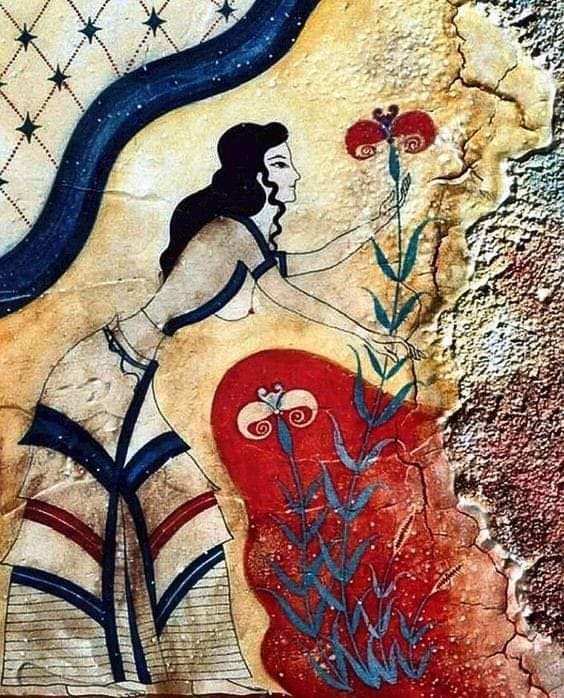
Minoan Lady Fresco (17th Century BC), from Room 1 of the House of the Ladies in Akrotiri/Thera, today's island of Santorini, Greece. The several women depicted on the walls of the room wear typical Minoan dress. Above the women is a representation of a starry sky.
Remains loyalty 'to the original symbols, shapes and coloring. This enchanting fresco is of incredible beauty, a perfect balance of shapes, colors and proportions. The young woman appears well cared for, both in appearance and in her garments, which may look elegant even current clothing.
A soft skirt flow with ease, combined with a short bolero that leaves the breasts uncovered. The skirt decoration, reveals the longitudinal reasons, that specularly, pointing downwards, to symbolize the "V" of the female pubis. Decoration "V" which is also found in the arrangement of the leaves of the two branches of the two flowers, which appear to represent, being lilies (lilium, which also means "bow," she who joins from one life) in the form of the corolla, a female uterus, with lateral volutes curled downward and inward.
The two colors of flowers, white and red, symbolic of the purity and fertility in the menstrual blood. Young woman is taking its red flower, and below of this, there is just a large patch of red, which indicates that she probably she entered adulthood with her first menstrual blood loss. Behind her, in the longitudinal direction, it is easily recognized the Milky Way, the blue stripe studded with golden dots.
And, behind him, beyond the Milky Way, a decoration on golden background and solar, a grid form of lozenges, diamond shapes that recall symbolically, the female vagina, the beginning of creation in general, since it is a grid formed by longitudinal and transverse lines, then opposite, male and female, that at each "intersection", at each meeting point, are marked with an additional decorative element in the shape of rhombus. The sublimation of the Feminine Principle in a work of extraordinary beauty and refinement.
Art historian Christopher L. C. E. Witcombe points out there is plenty of archaeological evidence to indicate that women occupied an important if not dominant position within the practice of Minoan religion and possibly the entire society as well. In scenes of ritual worship, women appear to dominate the proceedings and far outnumber male priests and attendants.
"Moreover men are rarely seen in commanding positions, despite attempts to identify them in such positions," Witcombe says. "Even the lifesize male figure in the reconstructed frescoed stucco relief at Knossos which Evans identified as the "Priest-King" is now believed to be made up of fragments of several different figures. The only thing that seems relatively certain is that one or more of the figures was male."
He also observes that typical evidence of a male-dominated society in the second millennium including walled citadels, fortifications, temples to gods, large public sculpture and boastful inscriptions are essentially absent.
When Sir Arthur Evans found fragments of faïence figurines, one which he dubbed the "snake goddess," in 1903, he asserted it was clear from the evidence that the Minoan religion was based on a dominant goddess of fertility just as described by James Frazer in his text "The Golden Bough" that had been published in 1890.
"Part of the attraction of the figurines is that they can be interpreted as embodying many of the perceived, and admired, characteristics of the Minoans: their elegant, fashionable costumes, their physical gracefulness, their sensitive yet forthright personalities, their sophisticated tastes and love of luxury, their refined manners and worldly ways, their seemingly high intelligence combined with an endearing forthright innocence, and their apparent love of beauty, nature, and peace," says Witcombe.
📷 : Reconstruction based on the Original fresco, preserved at Museum of Prehistoric Thera, Santorini.
#archaeohistories